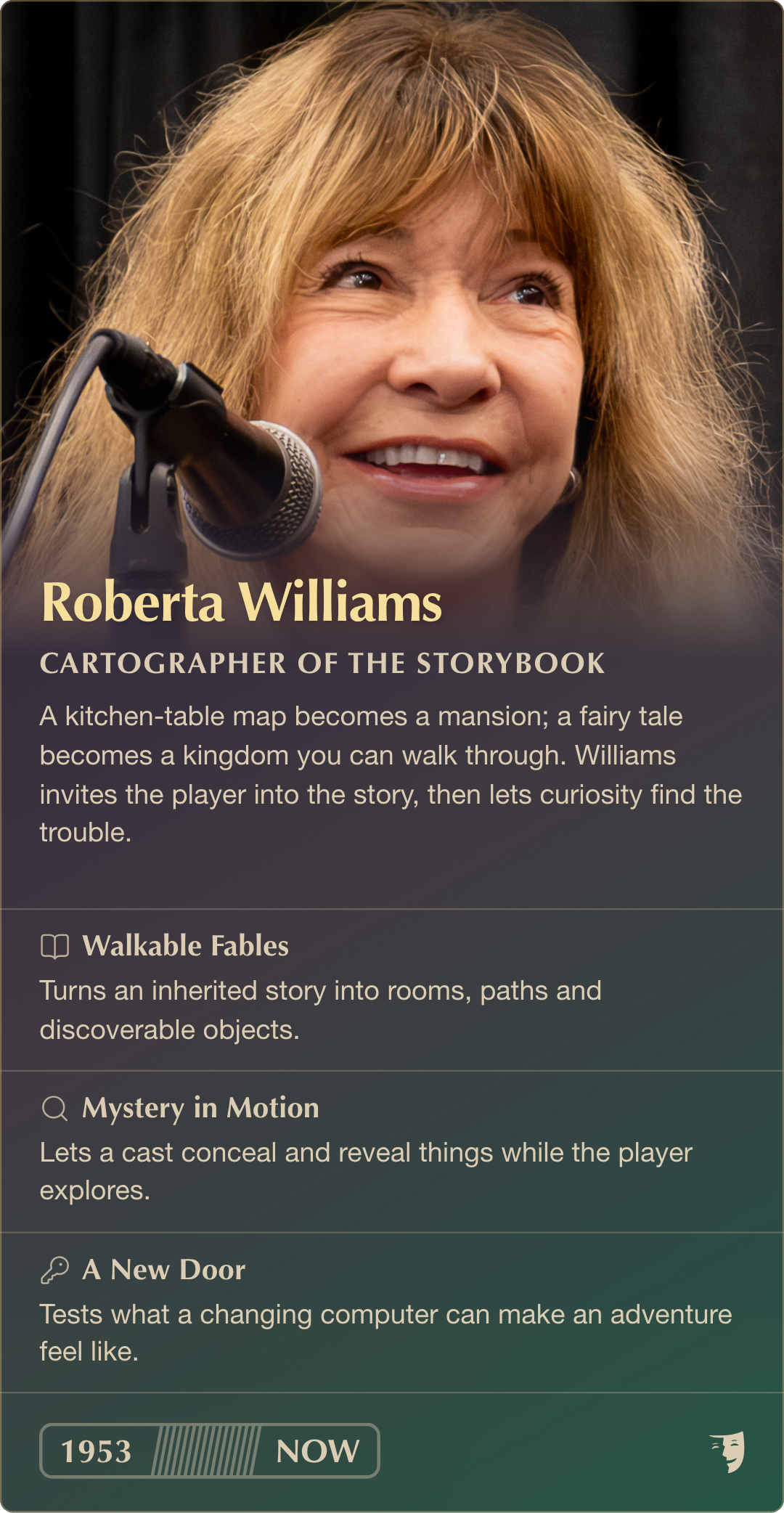
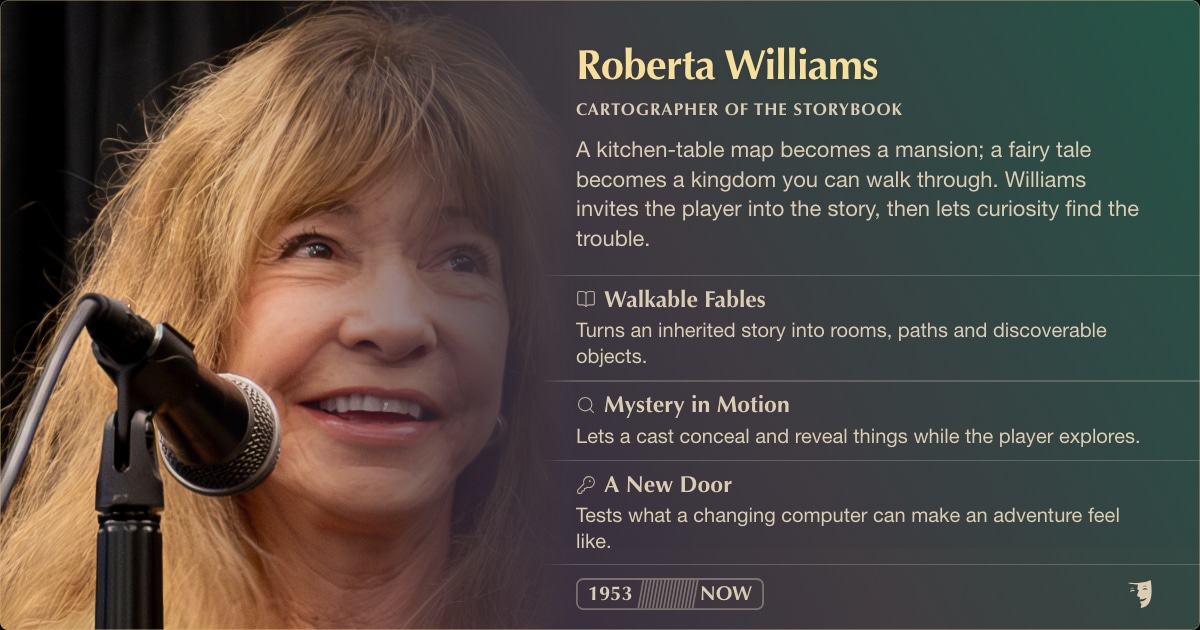
A kitchen-table map becomes a mansion; a fairy tale becomes a kingdom you can walk through. Williams invites the player into the story, then lets curiosity find the trouble.
Walkable Fables
Turns an inherited story into rooms, paths and discoverable objects.
Mystery in Motion
Lets a cast conceal and reveal things while the player explores.
A New Door
Tests what a changing computer can make an adventure feel like.
Roberta Williams helped make a computer adventure into somewhere you could see, walk through and become lost. Her maps borrow the intimate terror of a murder mystery and the remembered promises of fairy tales. The invitation is warm; the worlds can be unforgiving. Her best work comes into focus through the original manuals, design documents and collaborators who helped each imagined place become a working game.
1979–1980
Put the imagined house on the screen
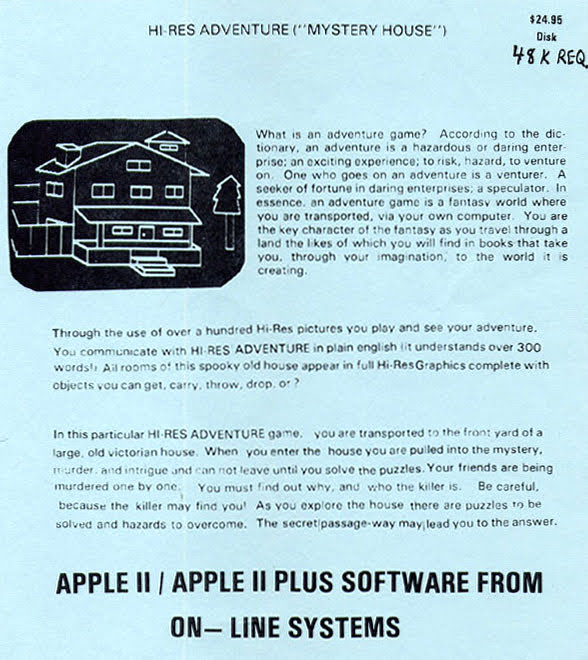
An encounter with the text adventure Colossal Cave helped persuade Williams that the computer could carry a story. She began sketching Mystery House at the kitchen table: a Victorian mansion, a cast of suspects and a sequence of deaths. Ken Williams set aside other software plans to program it, while Roberta’s drawings were digitised into line art.
On-Line Systems sold the Apple II game in 1980 with simple packaging and instructions. Pictures did not remove the need to imagine; they gave that imagining a shared outline. A room could now be seen as well as described. The founders’ retrospective manual preserves the small, practical scale of those beginnings, before Sierra became a much larger publisher with many other designers’ games.
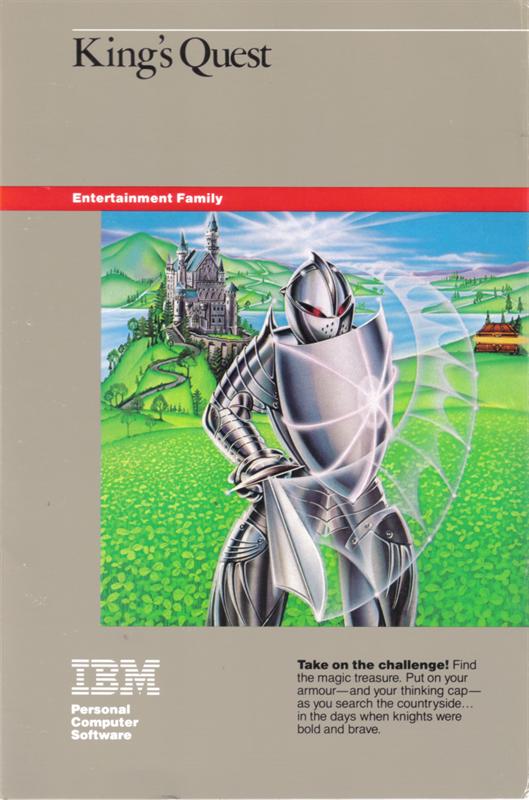
King’s Quest emerged from Sierra’s work for IBM’s PCjr. Its innovation can be felt in the small act of walking Graham behind a tree. A picture became a stage with depth, animated movement and places the player could investigate. Williams’s fairy-tale kingdom offered familiar creatures and objects, but made their meaning a puzzle to be worked out through action.
The game was a team effort built on changing graphics and adventure technology. The first IBM release, later AGI editions and the 1990 SCI remake should be encountered as different versions rather than one timeless object. The original package and instructions help recover what its audience was asked to learn: moving through a landscape, typing a command and discovering that the world had its own rules.
King’s Quest IV gave Rosella the journey, sending her to Tamir in the hope of saving her father. Day and night changed the same terrain and brought different encounters into reach. The familiar storybook world acquired a more personal urgency. Its original manual remains useful because the adventure’s commands and hazards expect patient, observant play.
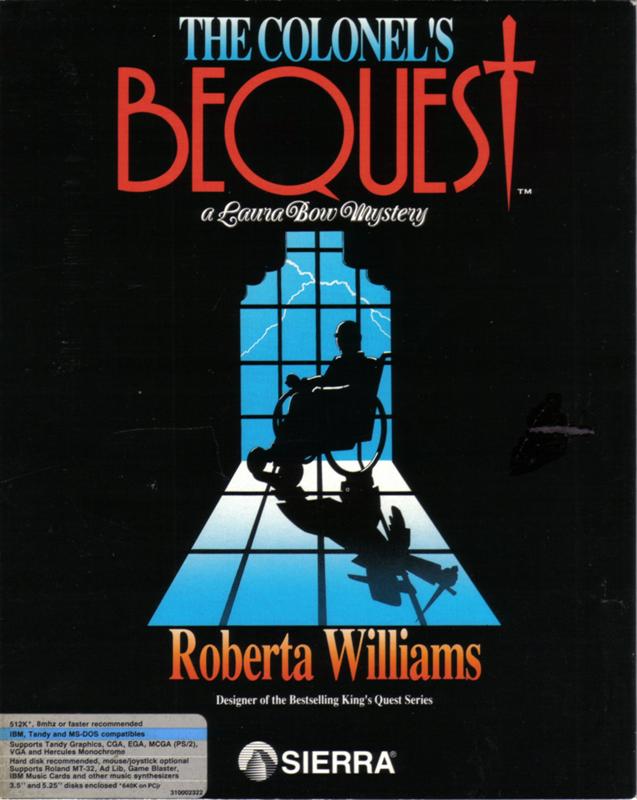
The Colonel’s Bequest turned that interest in time toward a murder mystery. Laura Bow arrives at a plantation where the evening advances through acts and the guests pursue their secrets beyond her attention. Missing a conversation can mean finishing with an incomplete understanding. Williams’s preserved design document makes that choreography inspectable: suspense belongs partly to the things the player was not present to see.
King’s Quest VI was co-designed by Williams and Jane Jensen. Alexander’s search for Cassima passes through islands whose fables and riddles eventually connect to the wider plot. Jensen’s writing and design are central to its richer narrative structure; the credit matters because a continuing series can conceal the arrival of a new creative voice.
The original manual and Guidebook to the Land of the Green Isles extend the fiction outside the screen. They also contain practical knowledge expected by the puzzles. The game rewards attentive reading and a willingness to consider how apparently separate encounters belong together. Its elaborate routes are a fitting place to meet Williams’s worlds, with enough patience for their older habits of saving, searching and trying again.
1995–1998
A haunted house requires a film crew
Phantasmagoria brought live actors into rendered environments and a much darker story. Its 1995 seven-CD release demanded the labour of both a film production and a game team. Williams supplied the design and story; the resulting adult horror includes graphic and sexual violence. Its technological ambition is part of its historical interest, together with the uneasy relation between filmed performance and player control.
Sierra was sold in 1996, and Williams’s last Sierra game, King’s Quest: Mask of Eternity, followed in 1998. A 1996 anthology offered a retrospective of the earlier adventures. Its discs and manual preserve a period when the medium changed repeatedly under the same series, from line art and a parser to speech, animation and filmed actors. The collection also preserves work shared with other designers, whose contributions remain their own.
2020–2026
Return to the cave that opened the door
After years away from game production, Williams published the historical novel Farewell to Tara, tracing an Irish family through famine and emigration. Ken and Roberta formed Cygnus Entertainment in 2021. The return to games grew out of renewed experiments with modern development tools and Roberta’s suggestion that Ken make a game again.
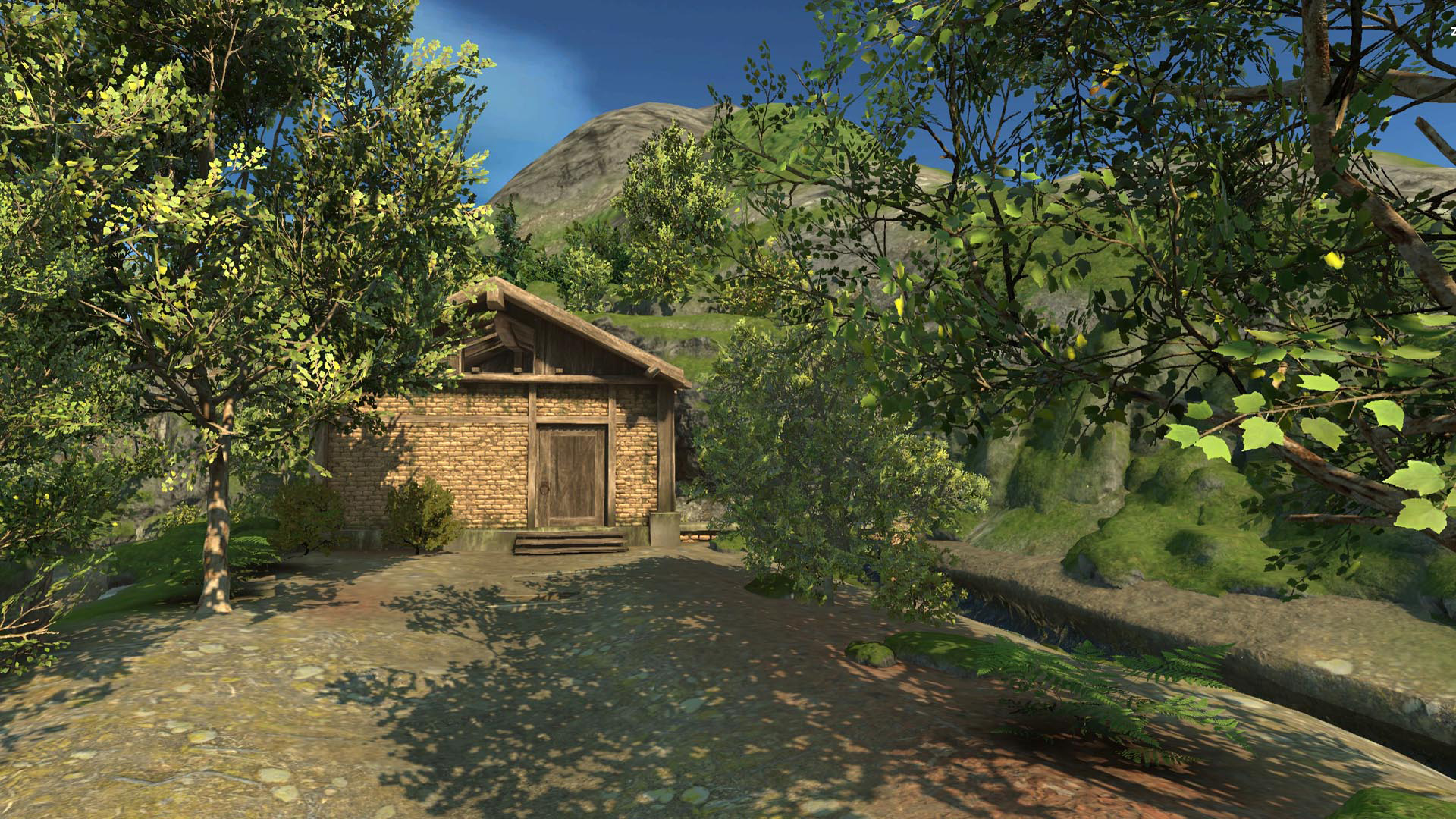
Their Colossal Cave, released in 2023, reimagines the older adventure by Will Crowther and Don Woods in three dimensions, with desktop and VR approaches to exploring it. Williams’s contribution is the new interpretation, not authorship of the original cave. The current Cygnus and author sites continue to document the game and her writing. The circle is unusually tangible: the imagined rooms that first drew her to a computer become rooms a new player can enter.