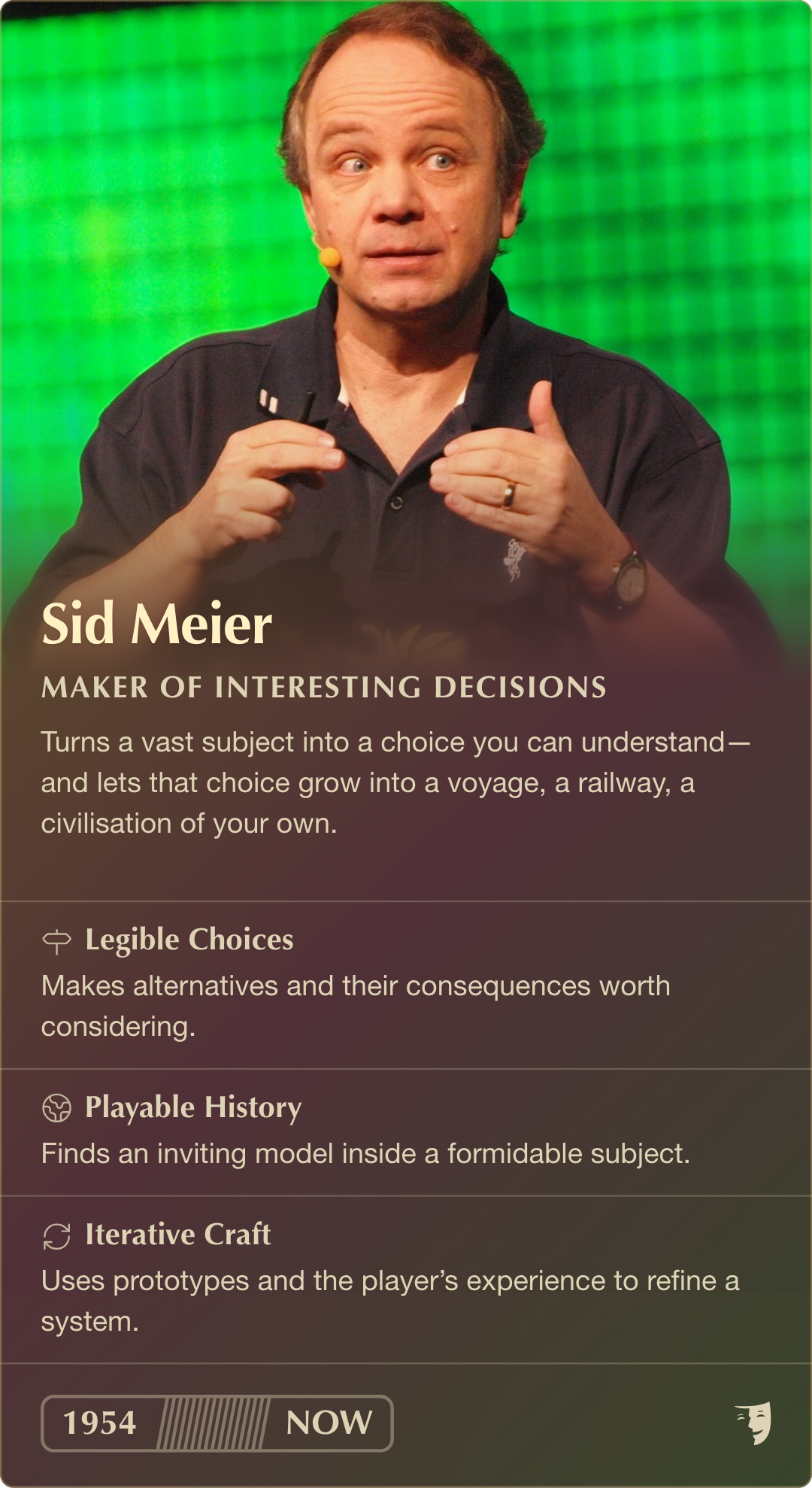
Sid Meier’s worlds are large enough to get lost in and clear enough to begin. A voyage, an economic network or a civilisation becomes a chain of choices, each with a readable consequence and a little room for surprise. His career moves between broad simulations and smaller experiments. Follow the original designs alongside the collaborators and later designers who carry the name forward; that distinction makes the legacy richer, and the craft easier to see.
1982–1987
From the machine to the voyage
MicroProse began in 1982 with Meier and Bill Stealey. In his history interview, Meier remembers beating the former military pilot at the arcade game Red Baron by observing its behaviour. The partnership joined his programming and design to Stealey’s business drive. Hellcat Ace came first; F-15 Strike Eagle and the civilian Solo Flight helped establish a simulation identity. Making a convincing activity answerable at a keyboard was becoming a livelihood.
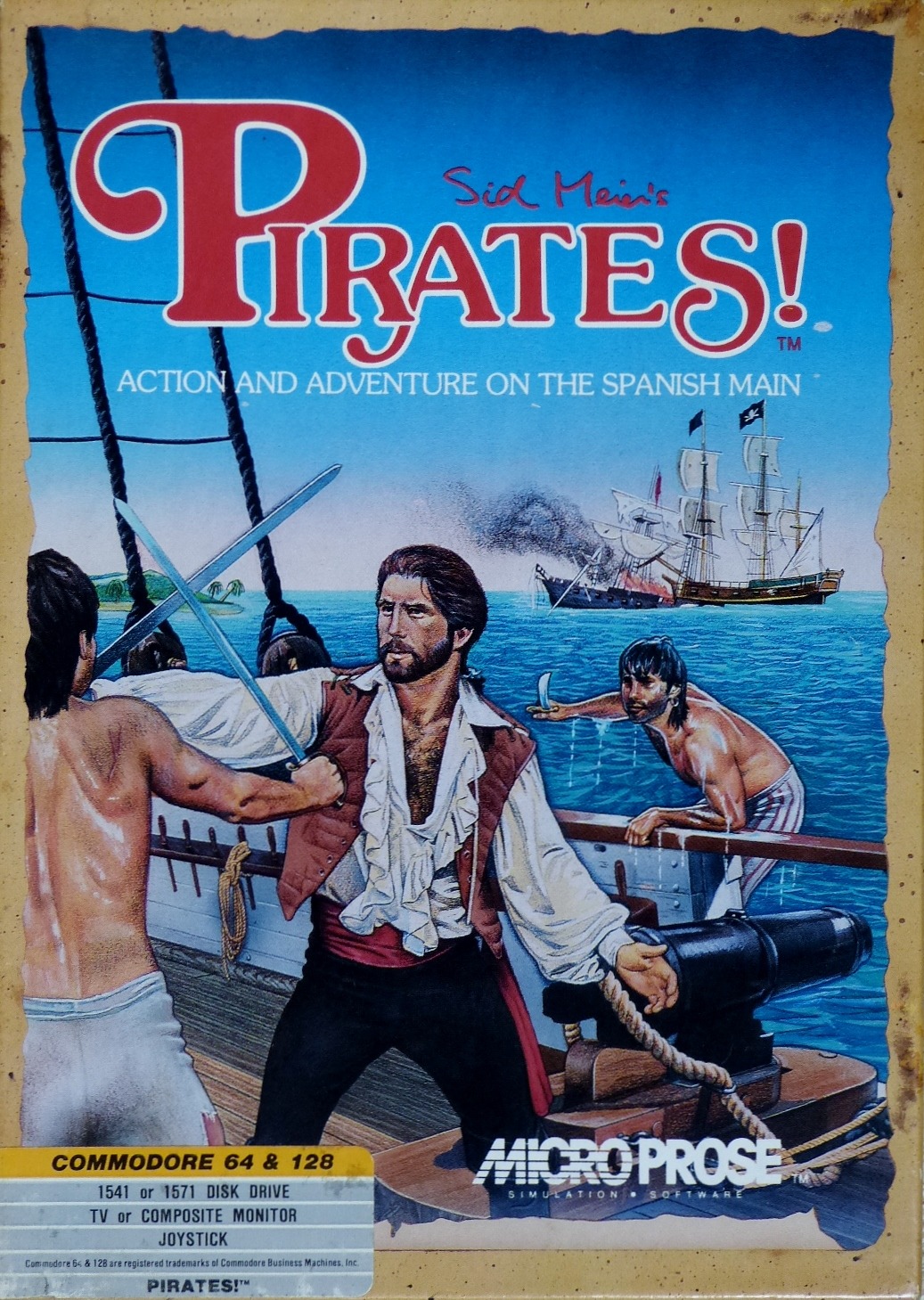
Pirates! in 1987 was a departure from that identity. Meier credits producer Arnold Hendrick with suggesting the subject, then describes his own wish for an adventure that moved through exciting scenes without making a player guess a text parser’s vocabulary. A ship, a duel and a changing allegiance become episodes in a life the player assembles. The original is now available within GOG’s Gold Plus package; the 2004 Firaxis remake is a separate interpretation on this shelf. Try both for the recurring attraction: the next destination is partly an objective and partly a chance to discover what sort of life you want to play.
Railroad Tycoon made economic connections visible as tracks and moving trains. Its original manual describes the first working prototype Meier built on holiday in August 1989, then credits his programming and the design with Bruce Shelley. Max Remington’s graphics gave the growing network its visible form. Their later joint postmortem puts the Meier–Shelley collaboration on the road toward Civilization. A network asks a satisfying family of questions: what connects, what pays, what remains a bottleneck, and what becomes possible after a small investment?
Covert Action, from the same year, offers a different network to understand. The player follows people and evidence while changing between investigation and field activities. Play one case with a notebook and notice how the context has to survive each change of mode. It is a valuable companion to the more celebrated designs because it lets you ask when variety sustains attention and when it competes with the larger decision you were trying to make.
Civilization was designed by Meier and Shelley at MicroProse. Exploration, settlement, research and diplomacy unfold as interlocking choices, with the turn giving the player time to consider them. In the joint postmortem, Shelley’s board-game background meets Meier’s history of simulation development. Their partnership is part of the original game’s identity, not a footnote to its title.
One reason to return to the original is to feel the scale change under your hands. A local decision about a settlement can later become an economic or strategic fact. The next turn offers evidence about your previous choice and the possibility of a new one. Read the historical framing critically: this is a selective model built to be played, not a neutral account of humanity. Its power lies in the questions and feedback it arranges.
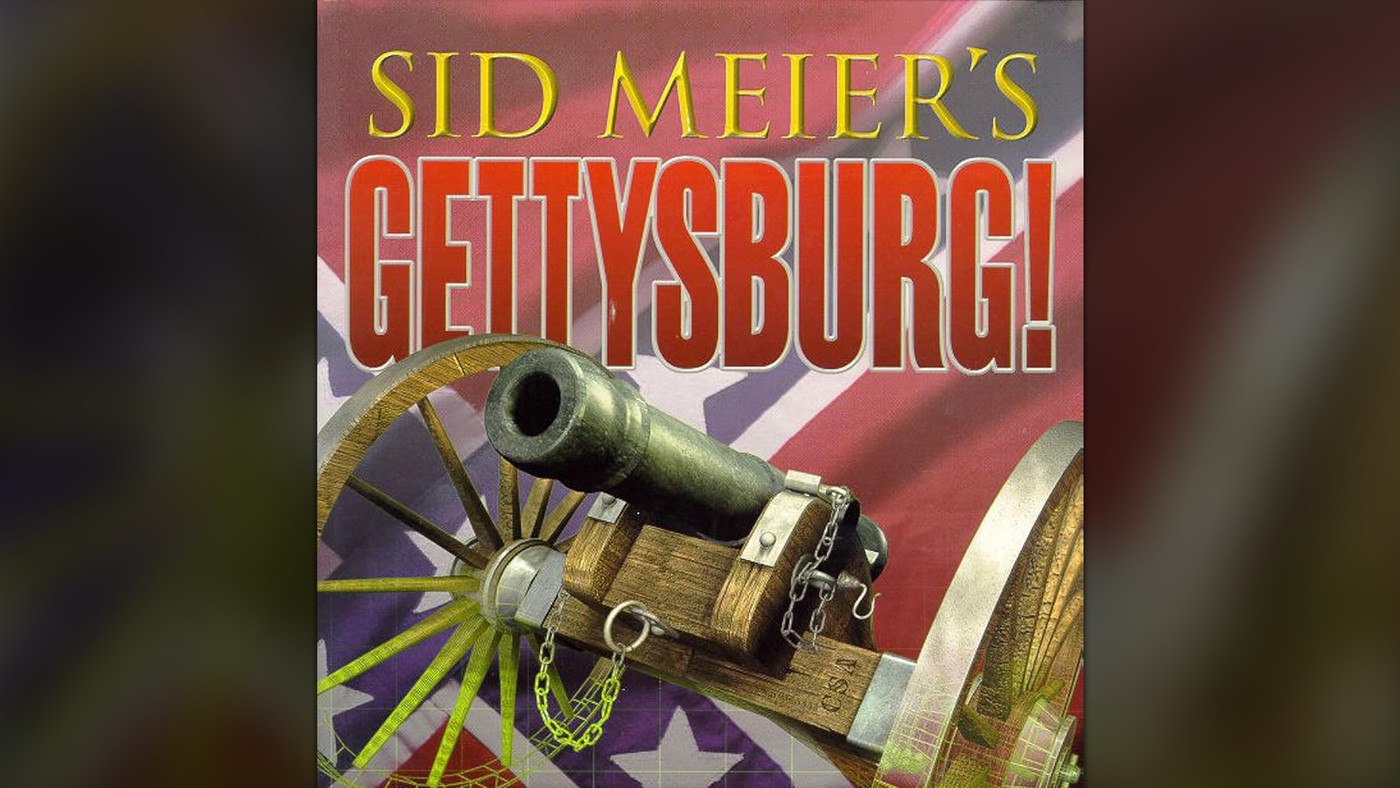
Meier, Jeff Briggs and Brian Reynolds founded Firaxis in 1996. The studio’s first release, Gettysburg!, brings the field of attention down from a civilisation to a battle. Position, timing and morale become the readable relationships. A designer’s identity can survive a change of subject when the work continues to give the player a meaningful grip on what is happening.
Firaxis also makes credit distinctions increasingly important. Meier’s name becomes a continuity across games created by different design leaders and teams. It is a promise of a tradition, not proof that he personally designed every system in every title. Follow the studio archive and the credited talks together: they show a founder’s influence growing through colleagues rather than through an indefinitely expanding claim of sole authorship.
The return to Pirates! and then Railroads! revisits earlier subjects with new teams and new presentation. A cargo travelling along a route remains a particularly elegant piece of feedback: you can watch an economic connection become useful. Railroads! is the 2006 Firaxis game, distinct from the 1990 original and the intervening Railroad Tycoon sequels.
Meier’s GDC talks make the craft explicit. The Psychology of Game Design asks what the player perceives, while Interesting Decisions examines the alternatives, information and pacing that make a choice compelling. These arguments belong together. An option may be mathematically available yet feel meaningless; a technically correct result may seem unfair. Good feedback allows a person to understand enough to make the next decision with curiosity.
Ace Patrol returns Meier to a smaller team and a compact design. In his first-person interviews he identifies his role as lead designer and programmer, and describes the appeal of making a turn-based flying game. Aircraft movement becomes something you can inspect before acting. A subject usually associated with reflexes can be opened to a different kind of attention.
Starships continues that interest in a smaller strategy experience. Its ships and tactical encounters offer a focused alternative to a full Civilization campaign. The publisher explicitly credits it as a game from Meier while placing it in the Beyond Earth setting. These later works are useful because they complicate the familiar picture of a designer condemned to repeat his largest success. The scale can shrink while the fascination with a readable, consequential choice remains.
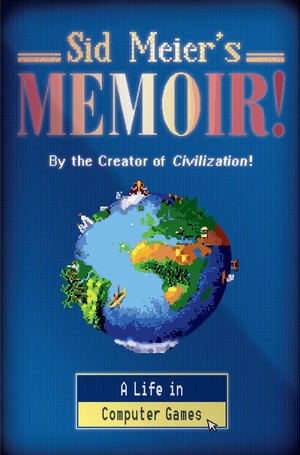
Sid Meier’s Memoir!, written with Jennifer Lee Noonan, moves game by game through the career. Read it for experiments and revisions as much as for origin stories. A retrospective account can give a finished design the appearance of inevitability; the more useful lesson is that a subject had to be tried, played and adjusted before its particular form could be found.
The living Civilization franchise now includes Civilization VII, released in 2025. Its developer diaries identify Ed Beach as creative director and explain the team’s own design decisions. This page does not add that game to a shelf of Meier’s personal designs. Instead, the diary sits beside his talks as a conversation across generations: which choices remain interesting, which structures have grown cumbersome, and how can a new team make the next turn inviting again?