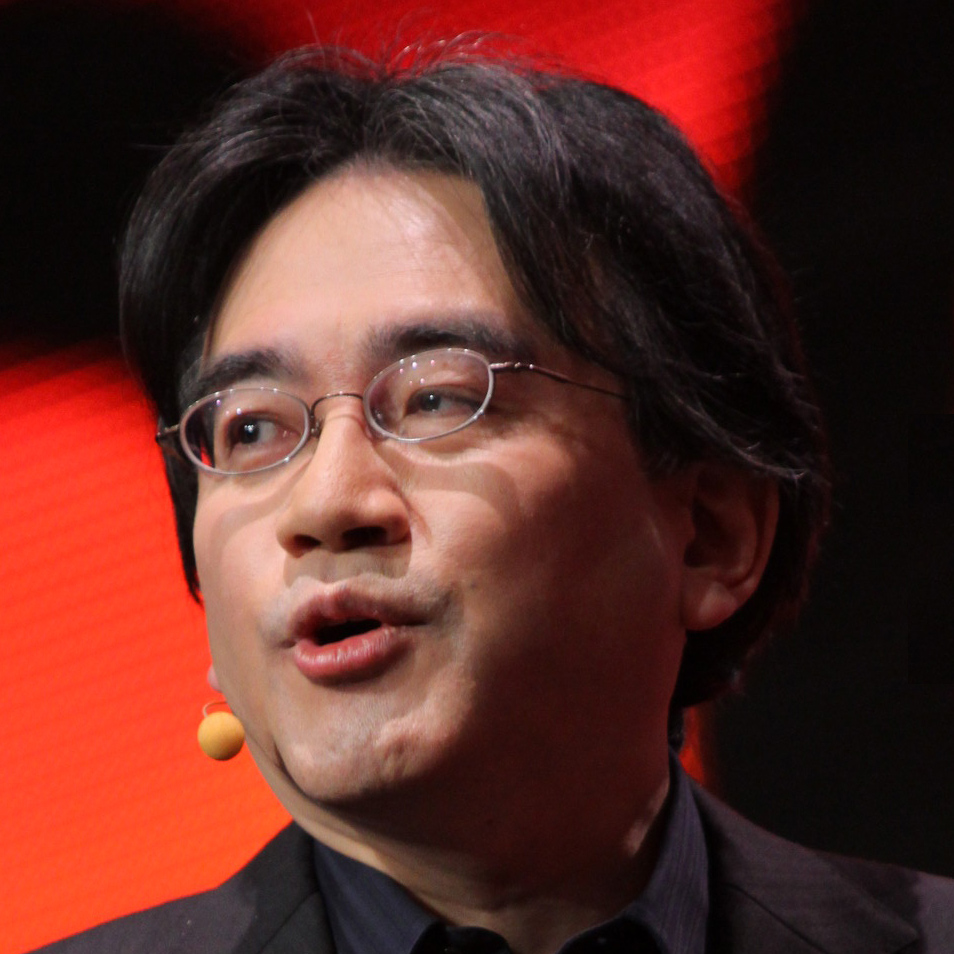
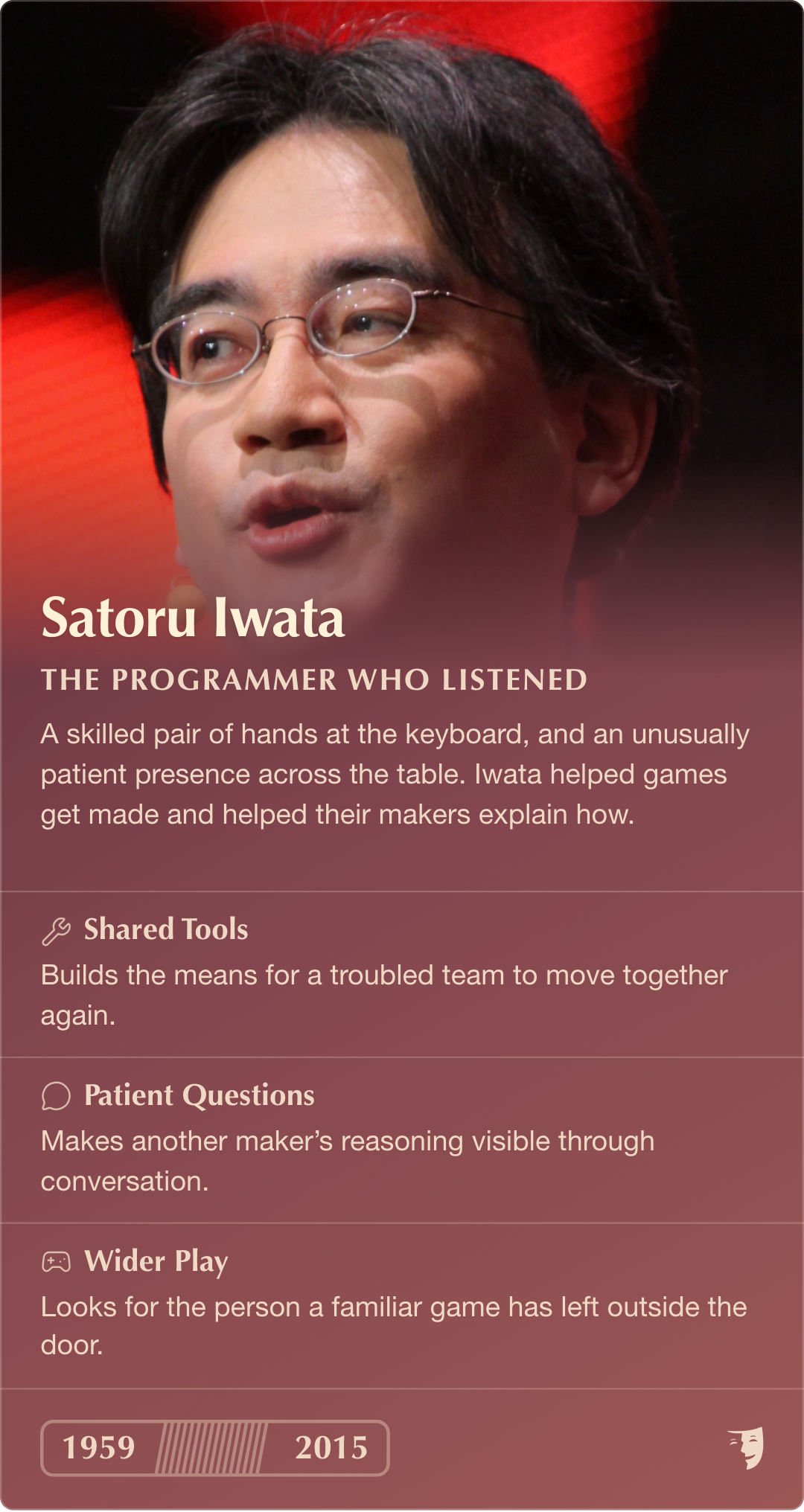
A skilled pair of hands at the keyboard, and an unusually patient presence across the table. Iwata helped games get made and helped their makers explain how.
Shared Tools
Builds the means for a troubled team to move together again.
Patient Questions
Makes another maker’s reasoning visible through conversation.
Wider Play
Looks for the person a familiar game has left outside the door.
Satoru Iwata could read a difficult program closely enough to repair it, and listen to a person closely enough to find a better question. His path from HAL Laboratory to Nintendo’s presidency joined those capacities. The games below identify concrete development work; the conversations reveal the larger practice of helping other people’s ideas survive contact with a machine, a schedule and an audience.
1984–1985
Make the air feel right
At HAL Laboratory, Iwata programmed the NES version of Balloon Fight. Its floating fighters respond to repeated flaps and persistent inertia; control arrives through learning to anticipate the next drift. Yoshio Sakamoto designed the game and Gunpei Yokoi produced it. Nintendo’s later interview carefully distinguishes that version from the arcade program made by SRD.
Sakamoto remembers Iwata building the Balloon Trip mode rapidly and revising it with a speed that astonished Yokoi. The story is a colleague’s recollection, not a stopwatch record, but it reveals something precise: Iwata knew the program well enough for a design discussion to become a change at the keyboard. The attraction was the player’s new movement, with engineering making the suggestion tangible.
1992–1993
Let a small hero reach the end
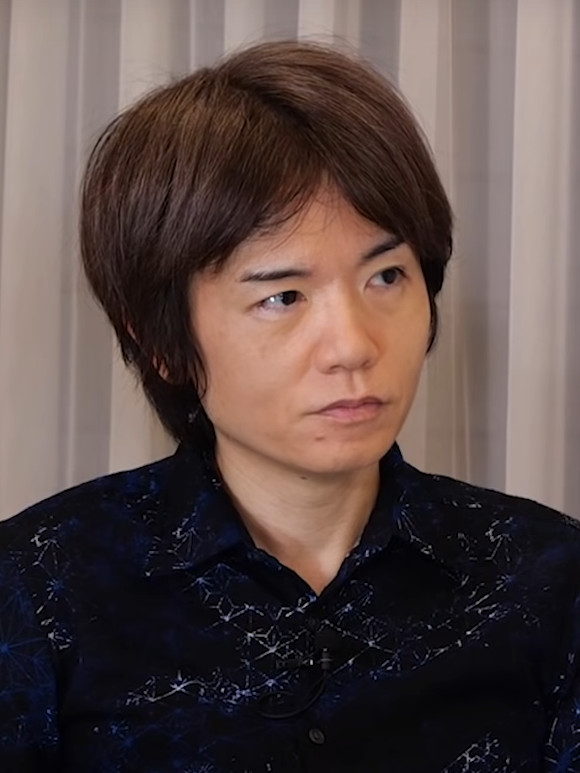
Kirby’s Dream Land emerged at HAL under director Masahiro Sakurai, with Iwata supporting development. In a later interview, Iwata recalls the debate around Kirby’s ability to inhale air and float: should a player be able to bypass difficulty and simply reach the goal? The answer allowed different approaches to coexist inside the same little world.
Kirby’s Adventure then expanded the character’s actions through Copy Abilities. Iwata’s recollection names Hiroaki Suga as the lead programmer who confronted that considerable workload. This is a useful glimpse of the producer’s role: support an ambition, understand the effort behind it and keep the conversation open. Kirby’s welcoming appearance carries a serious design question about how many kinds of player a game can accommodate.
1994–1995
Rescue the work without breaking the people
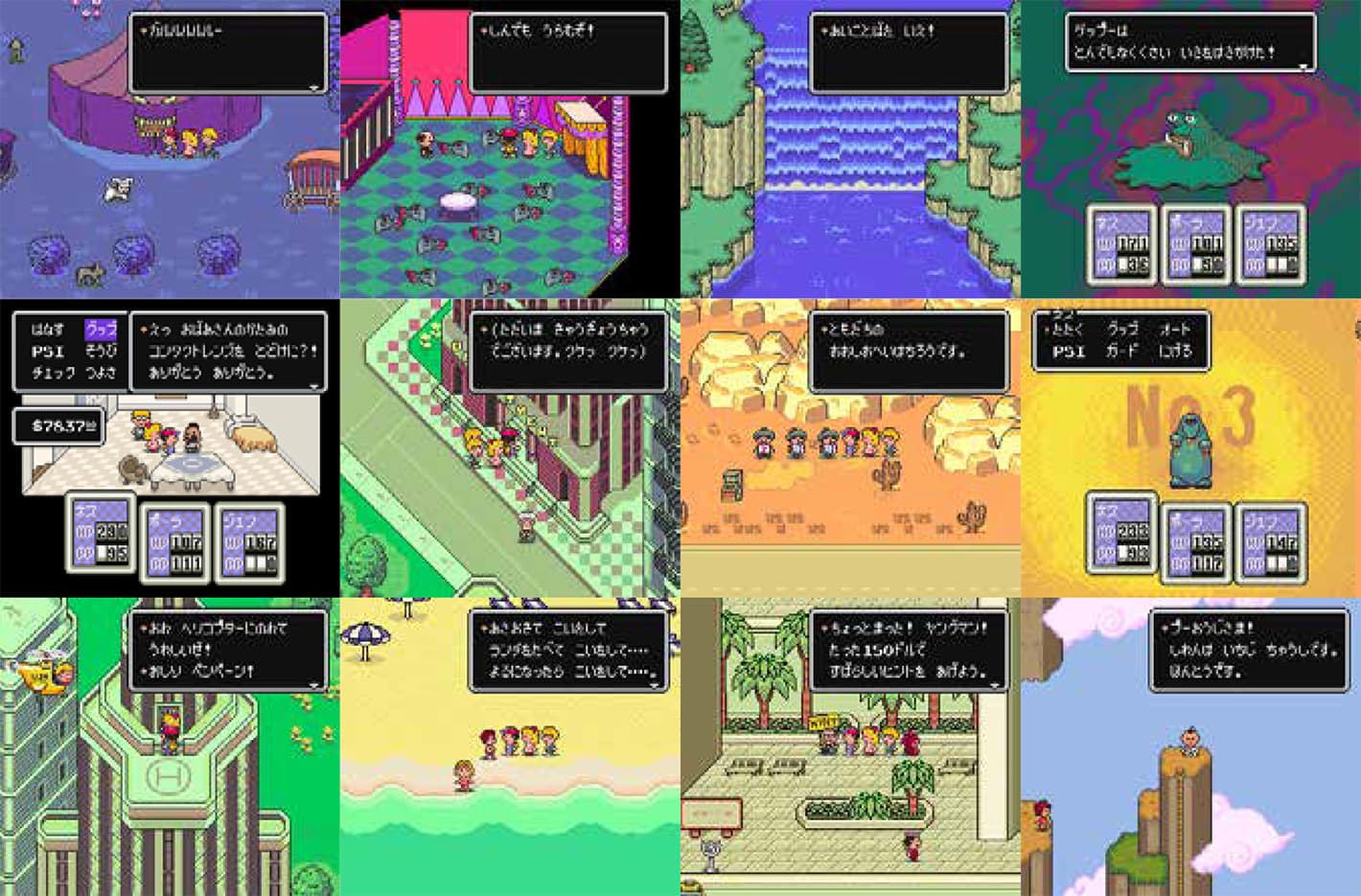
When MOTHER 2’s development was in difficulty, Iwata joined to help. In their 2007 conversation, Shigesato Itoi recalls two alternatives: repairing the existing structure would take longer than rebuilding. Iwata still offered the team a choice. He explains that arriving late and sweeping away everyone’s work could destroy the atmosphere needed to finish anything.
He began by making tools others could use, then helped the team divide and complete the remaining work. That account is more revealing than a legend of a lone programmer rewriting an entire game overnight. MOTHER 2 was released in Japan in 1994 and as EarthBound in North America in 1995. Its humane, eccentric world survived through a change in how people could work together.
Pokémon’s overseas expansion and Nintendo 64 projects arrived while Game Freak’s small programming team was still completing Gold and Silver. Iwata helped by analysing the original Game Boy battle logic and working on its transfer to Pokémon Stadium. Morimoto remembers his surprise at how quickly a company president understood that intricate program.
The same first-person interview credits Iwata with tools for compressing Pokémon graphics. It supports that concrete contribution; it does not prove the later folklore that his compression alone fitted an additional region into the cartridge. His stated priority was to protect Gold and Silver’s development from competing demands. The achievement is large enough without embellishment: remove technical bottlenecks so another team can finish its own ambitious game.
2000–2006
The audience can grow by changing the invitation
Iwata joined Nintendo as a director in 2000 and became president in May 2002. The company’s 2006 annual report presents a strategy of widening participation through intuitive hardware and software. The DS and Wii belong to many engineers, designers and producers; his leadership helped give that shared effort a clear direction.
The question was practical: what would make someone who rarely plays want to try? In his conversation with Itoi, Iwata relates the organisation of DS development to the shared tools of the MOTHER 2 rescue. Creating a team with a useful new responsibility could make previously difficult work possible. The move from code to leadership enlarged the scale of his method, while leaving its concern for real obstacles recognisable.
Iwata Asks lets developers speak at length about prototypes, discarded ideas and the decisions inside finished games. Iwata often knows enough about the machinery to ask a consequential follow-up, but the conversation leaves room for an artist, composer or programmer to explain something he does not know. The archive’s accumulated details make the collaboration visible.
Iwata died on 11 July 2015, aged fifty-five. Nintendo’s notice records both his dates and his appointments. The interviews remain a distinctive legacy beside the hardware and games: not merely a public executive’s presence, but a record of the questions that help a team understand what it has made. His laughter is part of the record too, alongside a willingness to keep thinking when the answer is awkward.
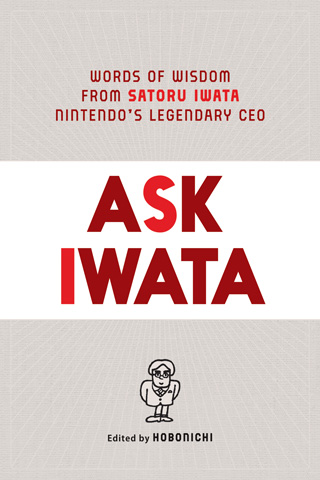
Hobonichi assembled Iwata’s words into a posthumous book, published in English by VIZ in 2021 as Ask Iwata. It draws on earlier conversations and interviews and includes other people’s memories. The credit is edited by Hobonichi; its construction is an act of preservation rather than a claim that Iwata sat down to write this final volume.
Read a short passage, then return to the longer conversation from which it comes. There, a useful principle still has the texture of people working out what it means. The official interview archive and Hobonichi’s bilingual discussions remain routes into his thinking. They leave a generous lesson for a maker: the quality of a finished thing depends partly on whether the people around it can explain, disagree and try again.