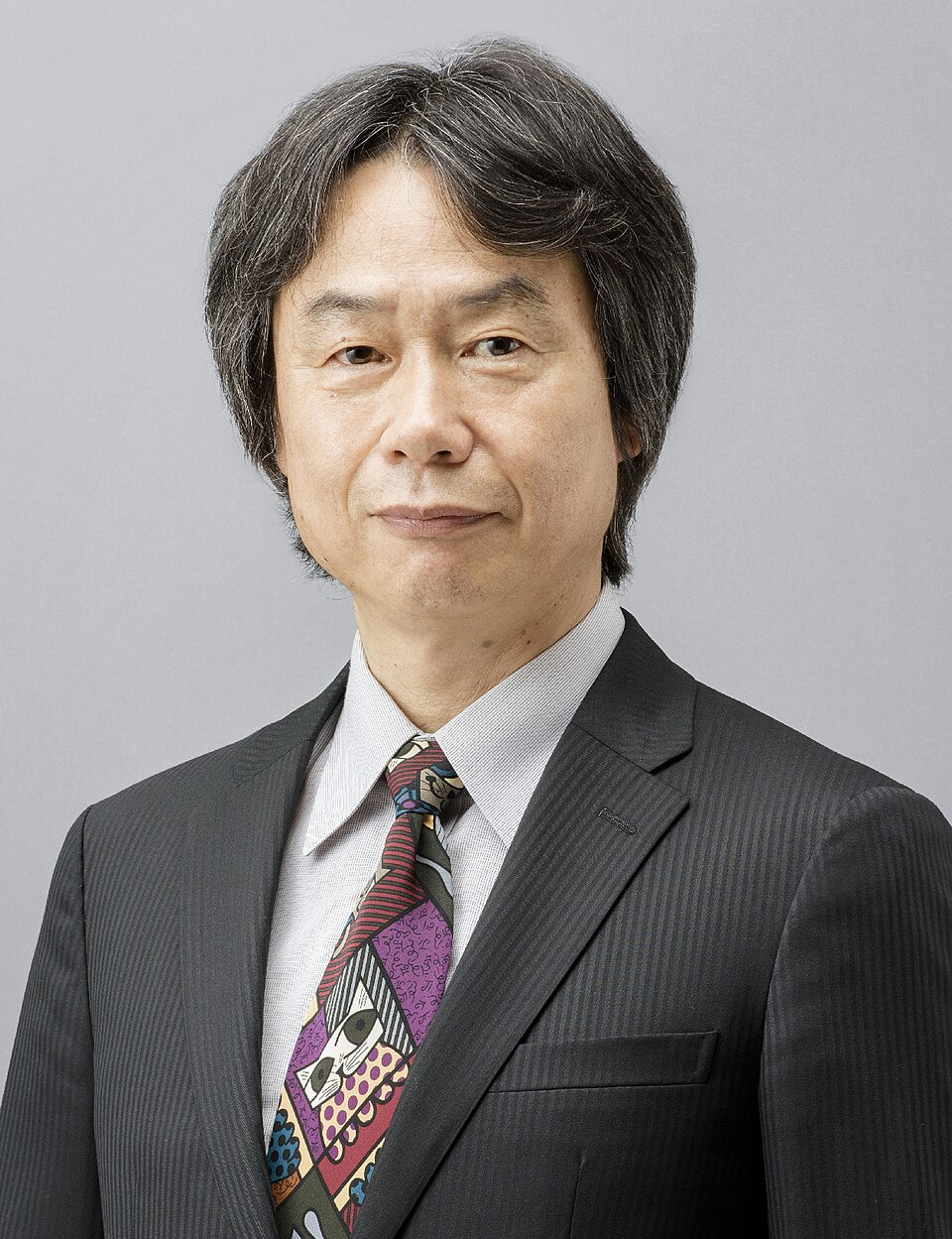
An industrial-design graduate hired to draw arcade cabinets, he gave Mario a moustache to save pixels, drew Zelda’s map beside Mario’s levels and rescued Pikmin with one flowchart.
Moustache Fix
Solves a 16-by-16 face with a moustache, cap and overalls.
First Enemy
Teaches timing with one walking threat and no tutorial.
Producer’s Flowchart
Saves a stalled Pikmin by drawing its loop: throw, carry, fight, grow.
A jump, a doorway, a path disappearing into the grass: Miyamoto makes curiosity playable. His worlds teach through the pleasure of trying something.
1952–1981
An artist joins a toy company
Raised in Kyoto Prefecture, Shigeru Miyamoto studied industrial design and joined Nintendo in 1977, when the company still drew on its long experience with toys. He began with arcade graphics and cabinet art. In a Nintendo interview, he remembers that senior colleague Gunpei Yokoi helped him think about why players wanted another try after losing. The question carried him from making a game attractive to shaping what a player could learn by acting.
When Miyamoto was given a full game assignment, the result was Donkey Kong. Its ladders, platforms and rolling barrels make a rescue story readable as a sequence of choices. The little figure has to be understood at a glance; his appearance and the arrangement of hazards are part of the same design problem. This was a team production within Nintendo R&D1, with Yokoi’s advocacy helping the young designer’s proposal reach the company president.
1981–1986
Sixteen pixels, a whole character
Mario’s appearance grew out of practical limits. In Nintendo’s Iwata Asks interviews, Miyamoto describes trying to make a face readable in a 16-by-16-pixel image; a moustache saved pixels, while the hat and overalls clarified the figure’s shape and movement. The character could travel from Donkey Kong into new games because his form made actions easy to recognise.
For Super Mario Bros., Miyamoto and Takashi Tezuka drew the levels together while Toshihiko Nakago and SRD helped turn those plans into a scrolling game; Koji Kondo wrote its music. The developers recall first testing a moving square, then working out landforms and enemy placement on paper. A short run from a safe platform toward a moving threat teaches timing through motion, with no lesson screen needed.
The same core group worked on The Legend of Zelda at the same time. Where Mario urges forward movement, Zelda lets a player test a map, discover a hidden entrance and remember a path. Nintendo’s surviving planning sheets show Miyamoto and Tezuka drawing the early land map side by side. The two games grew from shared experiments but offered different rewards for curiosity.
The grammar of a jump
Super Mario Bros.1985 · shown in the Wii U Virtual Console reissue
Pipes and Goombas give the opening jump a readable purpose. Mario’s small silhouette stays clear against the sky.
Super Mario 64 made movement in a three-dimensional space the immediate pleasure: Mario can circle a landmark, gather speed and judge a jump from changing viewpoints. Miyamoto directed the project, but the transition to 3D was a studio problem involving controls, level design and the camera. Ocarina of Time made that problem sharper when Link had to face and fight another character. Yoshiaki Koizumi and colleagues describe devising Z-targeting so the camera and the player’s attention could follow an opponent together; Miyamoto produced the game rather than directing its many teams alone.
Pikmin began with directors Shigefumi Hino and Masamichi Abe exploring how many small autonomous characters might behave together. Junji Morii helped find their plant-like appearance. The team’s later account says the project still lacked a clear game loop until Miyamoto, as producer, drew a flow connecting throwing, carrying, fighting and growing a squad. Requiring enough Pikmin to lift an object gave the player an understandable reason to organise them.
Try one day in Pikmin after a Mario course and a Zelda exploration. Here curiosity has a cost in time and in fragile companions: choosing which group to send across a garden also means deciding what must wait. The change of scale makes an ordinary object into terrain while keeping the rules visible in what the creatures do.
A world you learn with your hands
Super Mario 641996 · shown in the 2015 Wii U reissue
A cannon, a path and a distant climb turn the grassy battlefield into a place to investigate.
As his role shifted toward producing and guiding other teams, Miyamoto’s name continued to signal a design conversation rather than sole authorship. Nintendo’s DS and Wii years asked how touch, a pointer and physical gestures might welcome different players; later games carried the same series through the work of new directors, artists and programmers. The 2023 Pikmin developers’ conversation is especially useful because it lets those colleagues explain where their ideas began and where Miyamoto changed their direction.
Follow the games in sequence as changes in what a player can notice and do: Donkey Kong’s readable obstacles, Mario’s momentum, Zelda’s remembered spaces, then Pikmin’s small acts of planning. Keep the credits beside the controls. Their ease is the result of many people testing how an action feels, what it teaches and when another possibility becomes visible.
GDC presentation with Bill Trinen2007
Miyamoto presenting with Bill Trinen at GDC in 2007. Keeping both men and the screen in the frame shows the work of bringing a designer’s ideas to another audience.
Source & credits
Vincent Diamante · CC BY-SA 2.0 · resized and converted to WebP