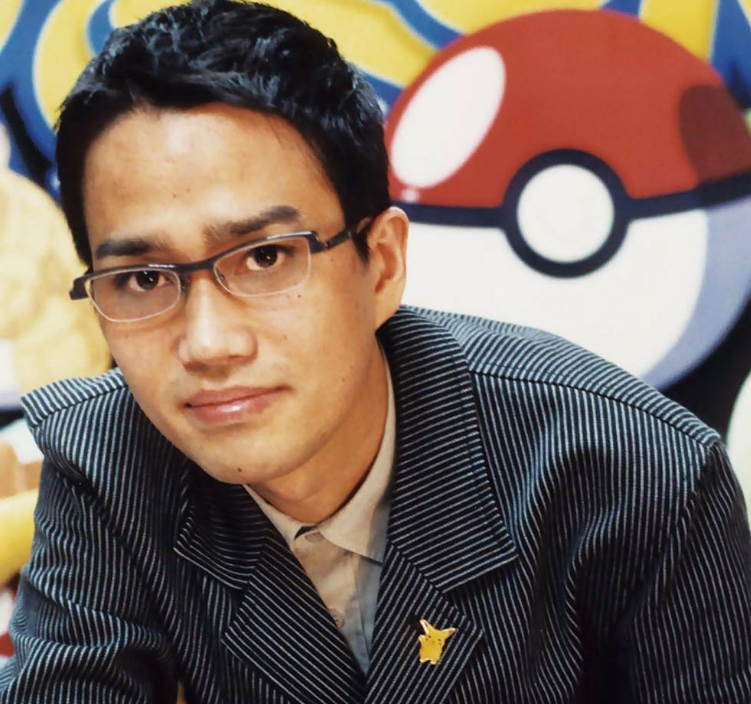
Satoshi Tajiri wearing glasses beside a Poké Ball graphic.

Satoshi Tajiri

Insect Collector Turned Game Maker

A Machida boy who caught beetles under stones grew up to direct Pokémon, a Game Boy game in which some creatures could only arrive by cable from a friend.

Stone Under the Tree
Caught sleeping beetles under stones while other children used honey.
Creatures on the Cable
Saw living things, not falling blocks, crossing the Game Boy link cable.
Faint, Not Die
Made beaten monsters faint rather than die, by deliberate design.

Satoshi Tajiri

Game Designer & Game Freak Founder

Start hereThe Ultimate Game FreakA rare long interview, conducted at Game Freak’s Setagaya office just after Gold and Silver were finished. The live TIME Asia page is gone; the Internet Archive preserves two pages of it.Read interview

Satoshi Tajiri grew up catching insects in a Tokyo suburb that was being paved over, wrote a stapled arcade-tips magazine called Game Freak, and turned its circle of friends into a studio. When he saw the Game Boy’s link cable, he imagined living creatures crossing it. Making that idea fit on a cartridge took about six years, a handful of programmers, a patient producer and, at the very end, 300 bytes of spare memory.

1965–1980

Dr. Bug and the stone under the tree

Tajiri grew up in Machida, on Tokyo’s western edge. As he described it to TIME in 1999, the area still had rice paddies, rivers and woods, and he was “really interested in collecting insects.” His father told the interviewer that other children called him “Dr. Bug.” Then development arrived: trees came down every year, the insects thinned out, and, in Tajiri’s words, “a fishing pond would become an arcade center.”

What he remembered was a method as much as a hoard. Most children caught beetles by smearing honey on bark. Tajiri noticed that beetles slept under stones by day, so he set a stone beneath a tree and lifted it in the morning. “Tiny discoveries like that made me excited,” he said. He also told TIME that the swirl on the tadpole-like Nyoromo came from remembering how a tadpole’s insides show through its transparent skin.

Pokémon keeps that habit of looking closely. A patch of tall grass is worth walking through because something particular lives there, and knowing where to look is a kind of expertise. Tajiri linked the game to that loss: places to catch insects had become rare, children played indoors, and when he was making games “something clicked.” “Everything I did as a kid is kind of rolled into one—that’s what Pokémon is.”

1978–1988

A stapled magazine called Game Freak

Space Invaders hooked him around 1978. There was little published information about games, so he made his own: a magazine called Game Freak, handwritten, photocopied and stapled, full of techniques and secret tips. Accounts date its first issue to the early 1980s, variously 1981 or 1983. Its best-selling issue, he told TIME, was a special on Xevious that sold 10,000 copies at 300 yen. “At first I used a photocopy machine—more important than style was selling information.”

Contributors gathered around it. Ken Sugimori, then hoping to become a manga artist, made the magazine with Tajiri; after high school he rented a flat near Tajiri’s home that served for a while as the magazine’s office. Sugimori recalled in 2014 that playing Famicom there and visiting arcades together made the group want to build games themselves. Tajiri put the turn more sharply: “The more I learned about games, the more frustrated I became because the games weren’t very good.”

Neither of them knew how. Sugimori remembered that some of the magazine’s members, a group of programmers in Ehime, said they could analyse anything, including the Famicom. Junichi Masuda, who joined through a friend, recalled studying the console’s chip on an Apple II, which used the same 6502 processor, and poking at it through Nintendo’s Family BASIC keyboard. There were no development kits for outsiders; the first tool was curiosity.

Directed and created games

  • 1989 · Director & designer

    Quinty / Mendel Palace

    Explore & play

    Amazon affiliate links support Dæmon at no extra cost to you. As an Amazon Associate I earn from qualifying purchases.

    About this object

    NES cartridge · Mendel Palace USA edition. A Dæmon display study using artwork from the work, rather than a reproduction of its retail label. A physical edition of this work is represented. The printed face uses existing work artwork as an interpretation, rather than claiming to reproduce that edition’s original label. This NES shape represents the North American Mendel Palace edition, rather than the smaller Japanese Quinty Famicom cartridge.

    Artwork source · Physical edition

  • 1996 · Creator & director

    Pokémon Red & Green

    Explore & play

    Amazon affiliate links support Dæmon at no extra cost to you. As an Amazon Associate I earn from qualifying purchases.

    About this object

    Game Boy cartridge · Japanese Red representative. A Dæmon display study using artwork from the work, rather than a reproduction of its retail label. The paired work is represented by Japanese Pokémon Red: a grey Game Boy cartridge with official Red package artwork interpreted as its face. This is not an original cartridge-label scan and does not imply Red and Green occupied one cartridge.

    Artwork source · Physical edition

  • 1999 · Director Satoshi Tajiri; sub-director Junichi Masuda

    Pokémon Gold & Silver

    Explore & play

    Amazon affiliate links support Dæmon at no extra cost to you. As an Amazon Associate I earn from qualifying purchases.

    About this object

    Game Boy Color cartridge · Japanese Gold representative. A Dæmon display study using artwork from the work, rather than a reproduction of its retail label. The paired work is represented by Japanese Pokémon Gold: a dark blue cartridge front with official Gold package artwork interpreted as its face. Original Japanese Gold has a grey rear half; a single uniform display colour approximates the front. This is not an original cartridge-label scan and does not imply Gold and Silver occupied one cartridge.

    Artwork source · Physical edition

The makers describe the work