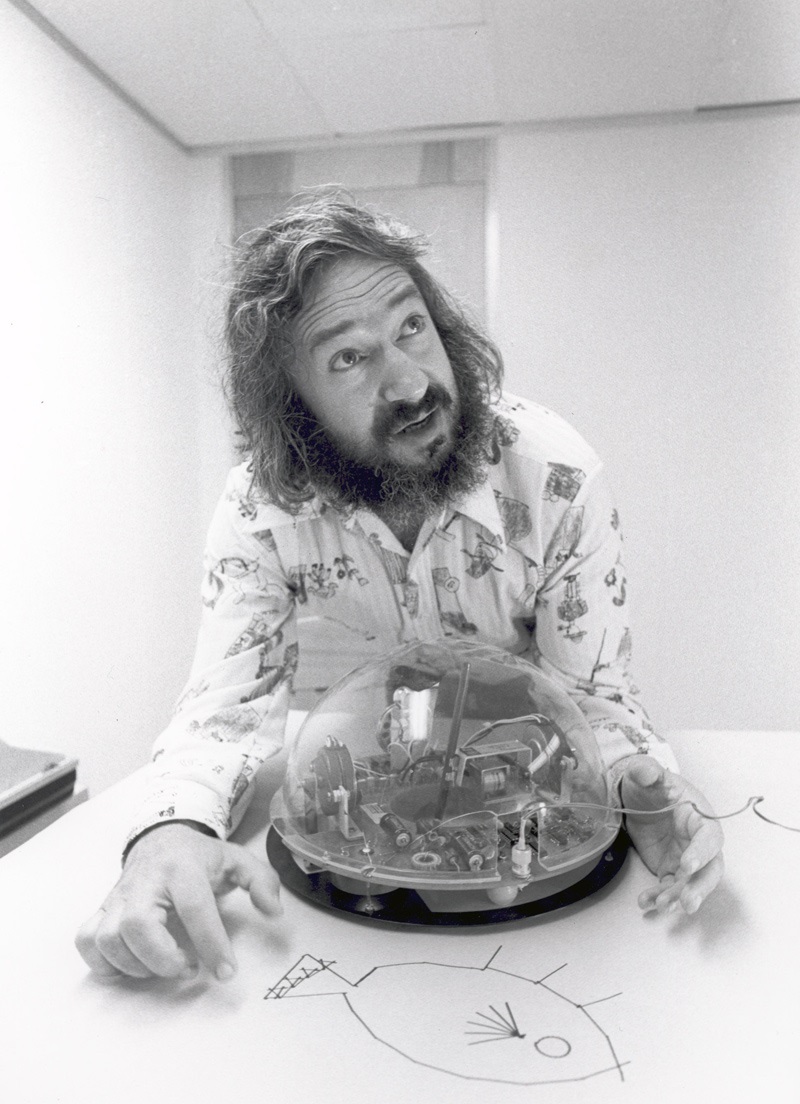
Ray Peat (1936–2022) was a Blake scholar, painter and teacher of humanities who went back to the University of Oregon in his thirties, wrote a biology doctorate on the ageing hamster uterus, and spent the next fifty years building a physiology of his own from a post-office box in Eugene. In it, thyroid hormone and progesterone are protectors; estrogen, stress hormones and the polyunsaturated fats in seed oils are the damage; sugar, orange juice, milk, gelatin and coconut oil are everyday medicine. He published it himself in books, essays and a mailed newsletter, patented progesterone dissolved in vitamin E, and after his death became a cult figure online. This page follows the life, explains how the system fits together, and checks two of its central claims against independent clinical trials. It is not medical advice, and where the evidence is missing it says so.
1936–1968
Blake, Mexico and a school without a curriculum
Peat came to biology late and sideways. In his own short account he took bachelor’s and master’s degrees and “taught various humanities subjects in the late ‘50s and early ‘60s”; as a teenager, he said, he had experimented with the effect of coloured lights on plants. His master’s thesis, as listed in a fan-compiled chronology, was on William Blake (“William Blake and the Mysticism of Sense and Non-Sense”, 1960), and Blake stayed with him: he named his school after the poet and later wrote an essay casting Blake as a biological visionary. The teaching posts on his own website run from Urbana College and Montana State University to the Universidad Veracruzana and the Universidad Autónoma del Estado de México. For a few years, he wrote, he “taught art and painted portraits”, and he showed his paintings in the United States and Mexico. He thought painting was “an essential part of grasping the world scientifically”.
In 1962 he opened Blake College in Mexico, which he later described as “a school with a critical attitude rather than a curriculum”. A fan history that gathers the school’s surviving newspaper notices places it first in Mexico City and then in Valle de Bravo, and its lecture list tells you what kind of place it was: “Wilhelm Reich’s Theory of Orgasm”, “Religion – Psychedelic and Historic”, “Linguistics After the Structuralists”, “Biological immortality”. The same history quotes the biography Ungodly on how it ended: the atheist campaigner Madalyn Murray denounced the college to the Mexican authorities as a drug den, a veterinary needle used on a student’s dog became “the smoking-gun evidence of a heroin shooting gallery”, and the niacin from Peat’s nutrition classes became “illicit drug stockpiles”. The school closed in 1965. In 1966 Peat moved to Eugene, Oregon, and reopened Blake College there as a looser circle of talks on learning and creativity; according to the same history, it never secured the right to award degrees.
In 1968, in his words, he decided “to return to the University of Oregon for a PhD (1972) in biology-biochemistry”, and began work on progesterone and related hormones the same year. The dissertation, Age-related Oxidative Changes in the Hamster Uterus, belonged to the study of reproductive ageing. His co-author on the one paper of the period indexed in PubMed, A. L. Soderwall, published through the 1970s on fertility, uterine collagen and blood flow in senescent golden hamsters. That 1972 paper, “Estrogen stimulated pathway changes and cold-inactivated enzymes”, appeared in Physiological Chemistry and Physics, a small journal launched in 1969; Peat also mentions a 1971 paper there that this review did not locate.
Peat’s own summary is much broader than the titles. In those papers and the dissertation, he wrote, “I outlined my ideas regarding progesterone, and the hormones closely related to it, as protectors of the body’s structure and energy against the harmful effects of estrogen, radiation, stress, and lack of oxygen. The key idea was that energy and structure are interdependent, at every level.” Nearly everything he wrote afterwards elaborates that sentence. It is worth seeing it for what it is: an organising hypothesis drawn from animal tissue, not a clinical result in women. Dæmon has seen only the dissertation’s catalogue record and Peat’s description of it, not the text.
Peat never took a research post. He taught at the National College of Naturopathic Medicine among other places, counselled private clients on nutrition, and published from P.O. Box 5764, Eugene, Oregon: Mind and Tissue, on Russian research into the brain; Nutrition for Women; Progesterone in Orthomolecular Medicine; Generative Energy; From PMS to Menopause. A printed newsletter, mailed to subscribers, carried new essays well into his eighties. He read older research closely, returning to Warburg, Szent-Györgyi and Gilbert Ling; the thread linked on this page traces that reading without implying the four shared one theory.
On 22 March 1982 he filed a patent, granted on 27 March 1984 as US 4,439,432, for progesterone dissolved in tocopherol, the oil form of vitamin E, at about 10 to 20 per cent by weight. The practical point was solubility: the patent says the mixture does not separate into “solvent and crystallized solute”, so it can be rubbed into skin, swallowed, or used as a pessary. Its list of uses runs from progesterone deficiency to psoriasis, eczema, warts, migraine, bowel spasm and contraception by a diaphragm left in place for about four hours. The oil was sold as Progest-E and became the signature product of his following; this review found no published controlled trial of it. Meanwhile his website warned that “hundreds of people sell their misconceptions with their products”. Read together, the patent and that warning show the tension in his career: a critic of health marketing whose most concrete legacy was a product.
The essays are long, allusive and densely referenced, but the system beneath them is simple to state. Cellular energy, driven by thyroid hormone, is health; whatever lowers it pushes the body towards stress hormones, estrogen and degeneration. The chief villain is the polyunsaturated fat of seed oils. In “Unsaturated Vegetable Oils: Toxic” he called interference with the thyroid “their best understood effect”, wrote that “Unsaturated fats directly kill white blood cells”, and went further still: “Cancer can’t occur, unless there are unsaturated oils in the diet.” Pig farmers, he said, had found in the 1940s that corn and soy fattened animals cheaply by suppressing their thyroids, while coconut oil kept them lean.
The diet follows from that. Sugar is not the enemy but the brake on stress: “Stress seems to be perceived as a need for sugar,” he wrote in “Sugar issues”, recommending milk and orange juice daily and more fruit juice or honey under strain. Muscle meat supplies tryptophan and cysteine, which he said “inhibit thyroid function and mitochondrial energy production”, so he balanced it with gelatin, which contains no tryptophan. Thyroid itself, usually a mixture of T4 and T3 (one example he gave: 40 micrograms of T4 with 10 of T3), was to be adjusted by the patient’s own temperature and pulse kept on a chart. Progesterone and pregnenolone opposed estrogen. The interlocking is the appeal: each recommendation explains the others.
The essays also show how he argued. He mined older physiology and Soviet research, read mainstream silence as institutional blindness, and wrote about who gets to decide what counts as knowledge in “How Do You Know?” and “Physiology Texts and the Real World”. In “Thyroid: Therapies, Confusion, and Fraud” he dismissed evidence-based medicine and meta-analysis as biased substitutes for clinical judgement. That move matters, because it shields the system from exactly the kind of test that follows.
Peat’s cancer sentence cites C. Ip and colleagues in Cancer Research, 1985. That study fed rats diets of 20 per cent fat, mixing coconut and corn oil so that linoleic acid, the main polyunsaturated fat in seed oils, ranged from 0.5 to 11.5 per cent of the diet, and gave them the carcinogen dimethylbenz(a)anthracene. Mammary tumours increased in proportion to linoleate up to about 4.4 per cent, then levelled off. In that chemically induced rat model, dietary linoleate promoted tumours. But no group ate a diet free of polyunsaturated fat, every rat was dosed with a carcinogen, and nothing in the paper concerns people. “Cancer can’t occur” is not what it shows.
Human trials exist. A 2020 systematic review in the British Journal of Cancer by Hanson, Hooper and colleagues at the University of East Anglia pooled 47 randomised trials, 108,194 participants, that raised omega-3, omega-6 or total polyunsaturated fat for at least a year. Raising total polyunsaturated fat “may very slightly increase cancer risk”: a risk ratio for diagnosis of 1.19, with a confidence interval from 0.99 to 1.42, roughly one extra diagnosis for every 125 people, in trials where some doses were very high. That is a faint signal in Peat’s direction, and nowhere near his claim.
On heart disease the independent record is more awkward for his opponents. When Christopher Ramsden’s team at the US National Institutes of Health recovered unpublished data from the Sydney Diet Heart Study (1966–73) and the Minnesota Coronary Experiment (1968–73), swapping saturated fat for safflower or corn oil had lowered cholesterol without lowering deaths; in Sydney the men given safflower oil died more often (BMJ, 2013 and 2016). The 2018 Cochrane review of omega-6 fats found they may make “little or no difference” to all-cause mortality or cardiovascular events, with a possible small reduction in heart attacks. So Peat was right to distrust confident advice to replace butter with vegetable oil. The evidence does not show that seed oils are the master toxin his system requires.
The claim with the most direct consequences for readers is about thyroid. Peat argued that blood tests miss hypothyroidism, that symptoms, temperature and pulse are the real signs, and that a “therapeutic trial was the final test of the validity of the diagnosis”. He called “the failure to treat sick people because of one or another blood test” unacceptable. His authorities were older clinicians and textbooks, among them Broda Barnes, whose 1976 book with Lawrence Galton, Hypothyroidism: The Unsuspected Illness, he cited, and Thomas McGavack’s The Thyroid (1951).
Independent trials have asked his question directly. In Glasgow, Anne Pollock and colleagues gave 25 people with hypothyroid symptoms but normal thyroid tests twelve weeks of thyroxine and twelve of placebo, in random order and without anyone knowing which was which (BMJ, 2001). Thyroxine did no better than placebo; healthy volunteers reported lower vitality on it; and the patients responded more strongly to placebo than the controls on three of fifteen measures. That last result explains why an open therapeutic trial feels conclusive: people in real, unexplained misery improve when someone takes them seriously and hands them a pill. The much larger TRUST trial (New England Journal of Medicine, 2017) gave levothyroxine or placebo to 737 adults over 65 with mildly raised TSH and found no difference in symptoms or tiredness after a year.
One qualification cuts in Peat’s favour: Pollock used T4 alone, while he favoured preparations containing T3, and no trial has tested his exact protocol. The nearest evidence, a 2006 meta-analysis of eleven trials with 1,216 patients who had diagnosed hypothyroidism, found T4 with T3 no better than T4 alone for fatigue, mood or quality of life. Too much thyroid is not harmless: in a Scottish cohort of 17,684 people on long-term thyroxine, those whose TSH was suppressed had more cardiovascular disease, arrhythmias and fractures (Flynn and colleagues, 2010). On the evidence available, treating symptoms with thyroid despite normal tests is unsupported.
Peat died on Thanksgiving, Thursday 24 November 2022, aged 86. The tributes show where his readers had gathered. An obituary in the online magazine IM—1776 said his passing “marks a most tragic day for medicine”. The founders of CytoLED, a maker of red-light panels, credited his writing with leading them to light therapy, while saying they did not agree with all of his suggestions. Volunteers keep a searchable archive of his recorded radio and podcast interviews at bioenergetic.life. Online, his name had become shorthand for a way of eating: orange juice, milk, sugar, gelatin, coconut oil, no seed oils.
Part of that audience is political. Writing for the Global Network on Extremism and Technology in October 2022, Joshua Molloy and Eviane Leidig described Peat’s writing on estrogen as a forerunner of far-right “anti-xenoestrogen” activism, and his works being shared alongside Bronze Age Pervert’s content on manosphere sites. They describe adoption by others; they do not attribute those politics to Peat.
What survives is an odd and interesting mind: a Blake reader who wanted biology to be as attentive as painting, a sharp critic of scientific fashion, and a man who sold a theory of nearly everything from a post-office box. Read him for the questions; check the answers.