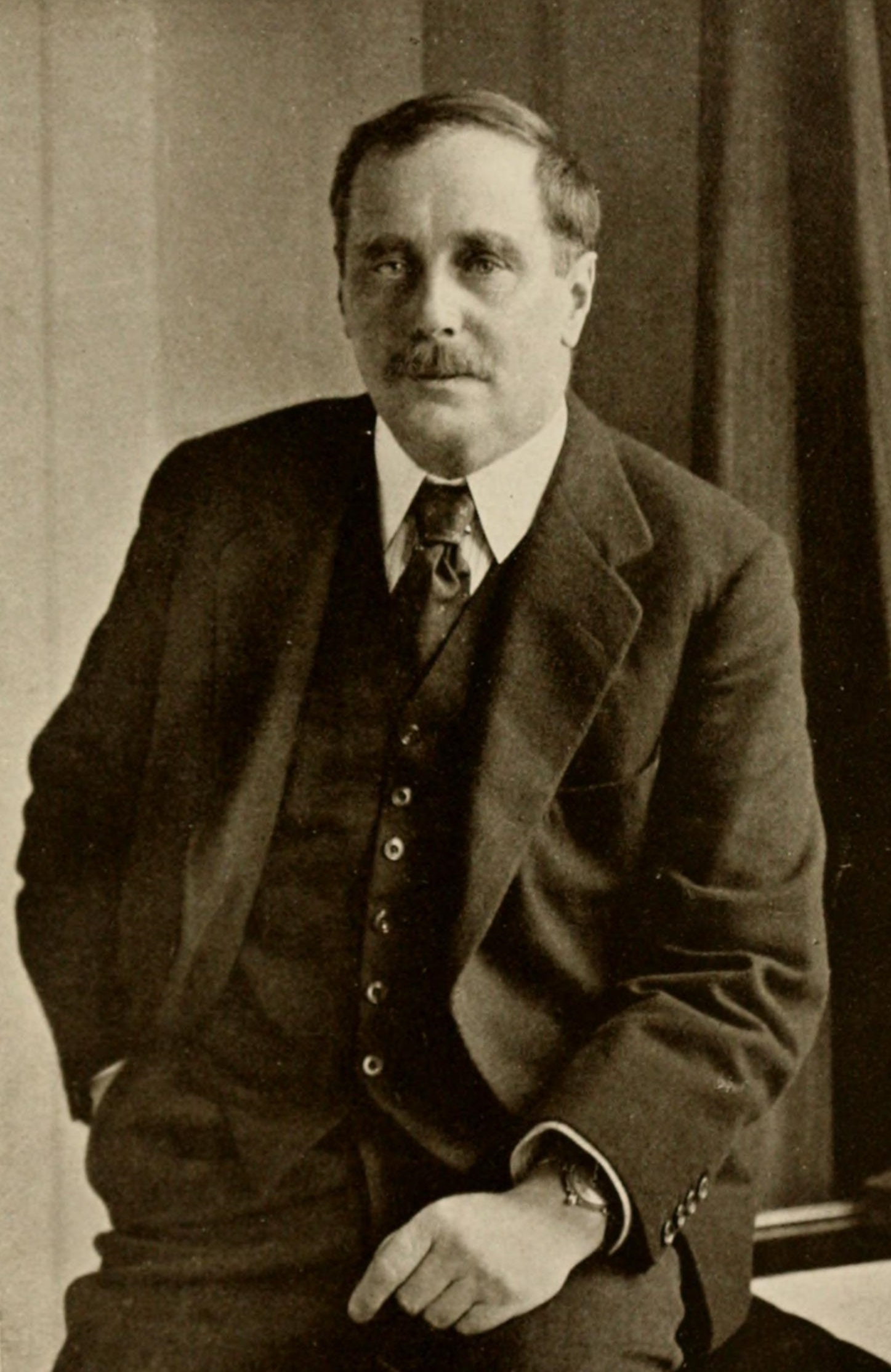
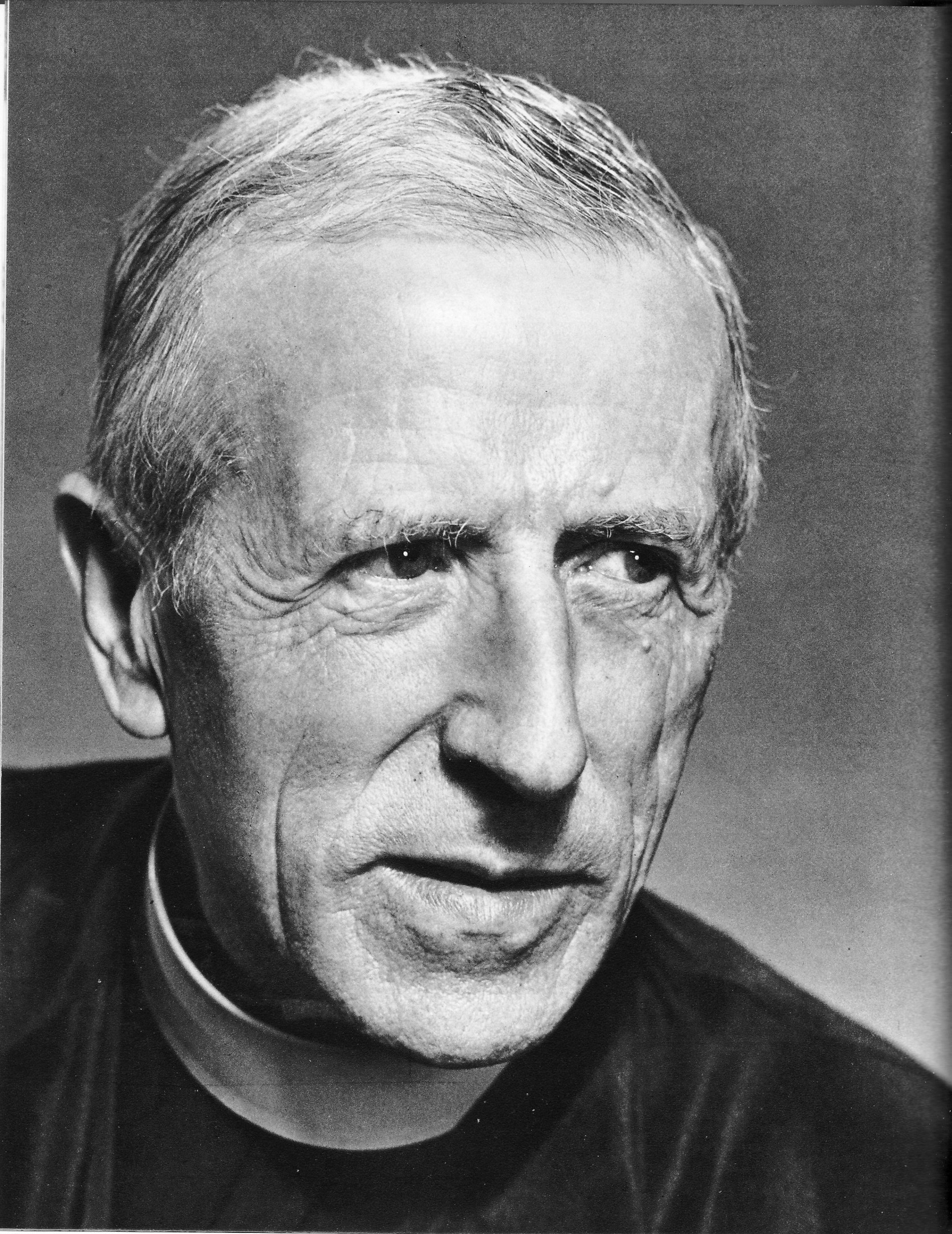
Portrait of Pierre Teilhard de Chardin.

Pierre Teilhard de Chardin

Exiled Jesuit of the Noosphere

Jesuit, stretcher-bearer and fossil geologist. Rome sent him to China and barred his books; his noosphere and Omega Point reached print only after he died.

Six Propositions
Signed Rome’s formula in 1925, then kept writing what Rome would not print.
Layer by Layer
Read Zhoukoudian’s cave fill layer by layer and dated it by its fossil animals.
Omega Point
Bet that evolution converges on one centre of all minds, and called it God.

Pierre Teilhard de Chardin

Jesuit Palaeontologist & Philosopher of the Noosphere

History of computing · A world that thinks together Start hereThe Formation of the NoösphereStart here: thirty pages that run the whole machine. Reflection lets human lineages fold together instead of branching apart; schools, libraries and machines become an outside heredity; radio and computers a “Brain of brains”; and the curve ends at a point of convergence where the essay turns, openly, to God. Borrowing needs a free Internet Archive account.Borrow the 1964 edition

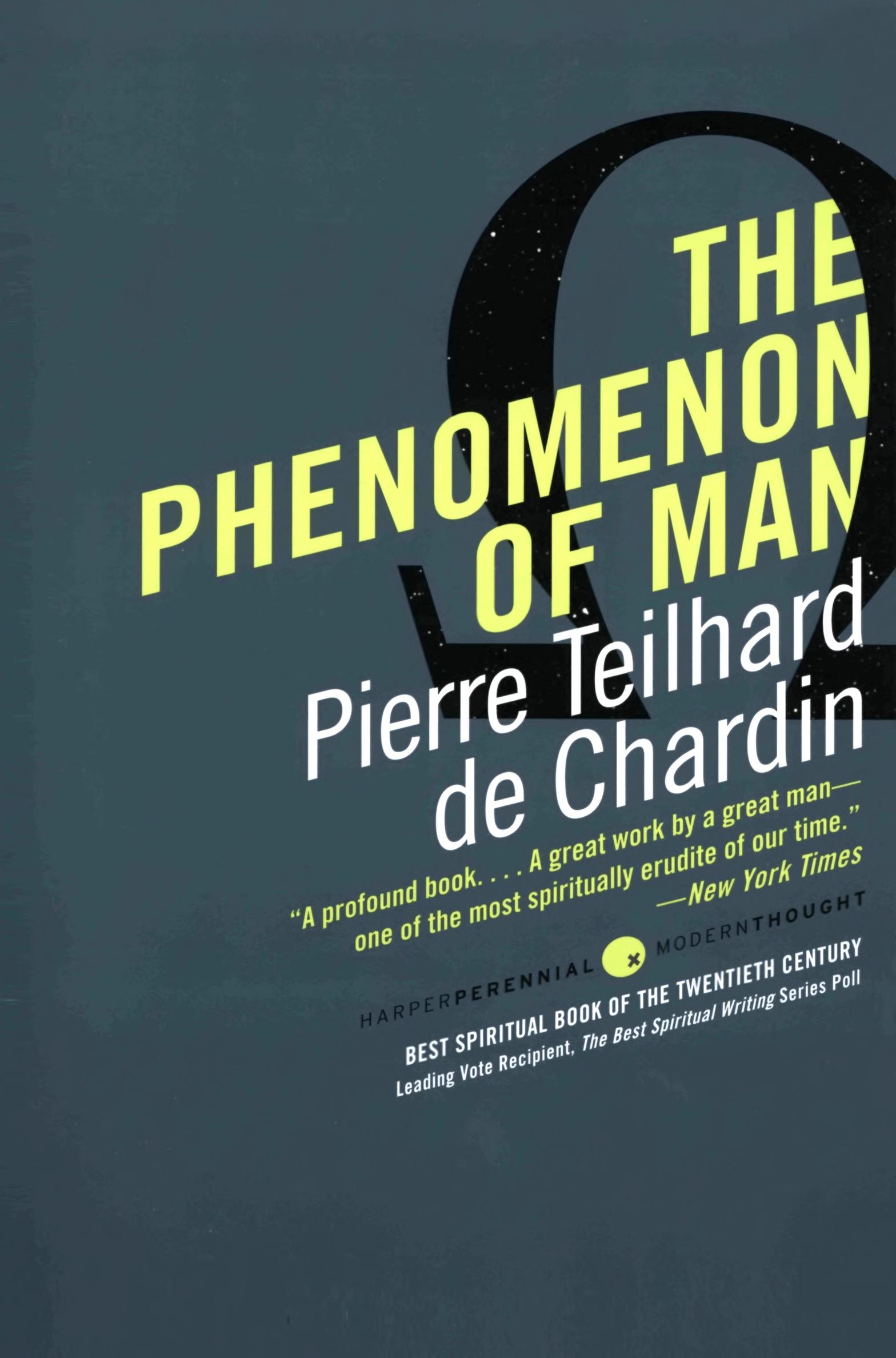
Pierre Teilhard de Chardin did two jobs that his Church thought could not be done by one man. As a geologist he was one of the pioneers of Old Stone Age archaeology in China and helped fix the layers of the cave where Peking Man was dug out. As a Jesuit priest he wrote, mostly for drawers and friends, that evolution is the shape of creation itself: matter knots into life, life into thought, thought wraps the planet in a layer he called the noosphere, and the whole movement converges on a final centre he named Omega and identified with Christ. In 1925 Rome made him sign six propositions on original sin and took away his Paris teaching post, and for the rest of his life it refused to let him publish his philosophy. The books appeared after his death in 1955, sold in huge numbers, and drew a Holy Office warning and Peter Medawar’s famous demolition. Start with the 1947 essay on the noosphere, short enough to watch the argument move, then read The Phenomenon of Man with Medawar’s review open beside it.

1881–1912

Fossils at Sarcenat, Bergson at Hastings

Teilhard was born on 1 May 1881 at Sarcenat, a country house at Orcines in the volcanic hills above Clermont-Ferrand, the fourth of eleven children. His father Emmanuel was an amateur naturalist and fossil collector who taught the boy to label and catalogue specimens; Teilhard said he owed him “a certain balance”. His mother Berthe-Adèle, a great-grandniece of Voltaire, was devoutly Catholic, and he credited her with lighting his “childish soul”. At eleven he went to the Jesuit college of Mongré, and in 1899, just short of eighteen, he entered the Jesuit novitiate at Aix-en-Provence.

France’s anticlerical laws pushed the Jesuits out, so his training took place in exile: Jersey from 1901, three years teaching physics and chemistry at the Jesuit college in Cairo (1905–1908), then four years of theology at Ore Place in Hastings, Sussex. There he read Henri Bergson’s Creative Evolution and went fossil-hunting in the Weald, where he met Charles Dawson, a Lewes solicitor and antiquarian who encouraged him and put him in touch with the British Museum’s Arthur Smith Woodward, to whom Teilhard sent his fossils. His sister Françoise died of smallpox shortly before he was ordained priest on 24 August 1911. In 1912 he went to Paris to study palaeontology under Marcellin Boule at the natural-history museum.

1913

A tooth at Piltdown

In December 1912 Dawson and Woodward announced Eoanthropus dawsoni, “Dawson’s dawn man”: a thick, human-looking braincase and an ape-like jaw from a gravel pit at Barkham Manor, Piltdown. Teilhard dug there with them. His biographer Mary Lukas counts three visits in Dawson’s lifetime: 21 May 1912, the weekend of 8–10 August 1913, and 30 August 1913, when, stopping on his way back to France, he spotted in the spoil the worn canine tooth that Woodward had predicted the jaw should carry. It seemed to tie jaw and skull together. In 1915 Dawson reported a second set of remains from a second site, which he never precisely located; Lukas places it in a field at Sheffield Park, about two miles away. The second find made the “man” look like a population rather than an accident. Teilhard himself wrote in 1920 on “the case of Piltdown man”, a paper the 2016 investigators list among early suggestions that an ape fossil had been mixed in with a human skull.

In 1953 Kenneth Oakley, J. S. Weiner and W. E. Le Gros Clark proved the whole thing a forgery: a human skull, an orang-utan jaw with filed teeth, everything stained to match the gravel. In 2016 a team led by Isabelle De Groote, with Natural History Museum scientists including Chris Stringer, ran DNA, CT and spectroscopic tests on the specimens. They found a single orang-utan and at least two humans, and the same method throughout, brown stain, packed gravel fragments and filling material, at both sites; they attribute the work to one forger, Dawson, the only person known to be directly associated with the finds at the second site. “Whether Dawson acted alone is uncertain,” they add, and they list Teilhard, the finder of the canine, among the long-standing suspects.

The accusation came from Stephen Jay Gould, who floated a version in his Natural History column of March 1979 (“I can easily imagine Dawson and Teilhard, over long hours in field and pub, hatching a plot”) and argued it in earnest in August 1980. He reprinted that essay, as “The Piltdown Conspiracy”, in Hen’s Teeth and Horse’s Toes (1983), correcting factual slips only in footnotes. He did not make Teilhard the mastermind: “J. S. Weiner’s elegant case virtually precludes Dawson’s innocence,” he wrote, and Dawson had made the first finds before Teilhard arrived. He ranked his arguments by strength and rested the case on two. The first was a letter. On 28 November 1953 Teilhard, answering Oakley, wrote that Dawson “just brought me to the site of Locality 2 and explained me [sic] that he had found the isolated molar and the small pieces of skull in the heaps of rubble and pebbles raked at the surface of the field.” Dawson announced those finds in 1915, and Teilhard had been mustered into the French army in December 1914. “He could not have seen the remains of Piltdown 2 with Dawson,” Gould wrote, “unless they had manufactured them together before he left.” Pressed by Oakley in January 1954, Teilhard answered that his “souvenirs” were “a little vague”, and in March he told Mabel Kenward of Barkham Manor that Dawson had shown him the field but “I cannot remember whether it was after or before the find.” Gould read this, together with smaller misstatements (Teilhard dated his first meeting with Dawson to 1911, not 1909, and described himself at Hastings as “not allowed to leave much his cell”), as “a subtle attempt to direct suspicion away from himself.”

His second argument was silence. After one short article in 1920, “Le cas de l’homme de Piltdown”, in which Teilhard sided with anatomy against geology (“We must suppose that the Piltdown skull and jaw belong to two different subjects”), Gould found “fewer than half a dozen references” to Piltdown in the twenty-three volumes of his collected works, nearly all a footnote or a dot on a family tree. Yet the skull, which looked more modern than Neanderthal man and was older, was the best fossil support for the parallel lineages that Teilhard’s evolutionary philosophy needed. In the 1920 article Teilhard remarked that the jaw’s missing hinge made it impossible to test whether jaw and skull fitted: “As if on purpose [comme par exprès], the condyle is missing!” Gould read those words at two in the morning and could not shake them: “I think that Teilhard was trying to tell us something he didn’t dare reveal directly.” He added Oakley’s recollection that Teilhard changed the subject whenever Piltdown came up, and walked “glumly” through a British Museum display of the exposure “as fast as he could, eyes averted”. On motive he guessed at a prank that “went too far”: “a delicious joke for him — at first”, which became impossible to confess once the war had taken Teilhard away, Dawson had died in 1916 and a scientific career had opened for him. Gould graded his own evidence. The North African animal teeth in the gravel (a Maltese hippo, a Tunisian elephant; Teilhard had taught in Cairo from 1905 to 1908) were “suggestive, but not compelling”, and Teilhard’s luck in finding the canine was “the weakest point of all”. He called the whole case circumstantial, “as is the case against Dawson or anyone else”, and wrote: “I believe that the burden of proof must now rest with those who would hold Father Teilhard blameless.”

The replies came within weeks. The press carried the charge from the New York Times to Time, which quoted Teilhard’s friend George Gaylord Simpson: “I don’t think it was in his character.” In Natural History in June 1981 the anthropologist S. L. Washburn, who had known Teilhard, wrote that Gould “cites no direct evidence against Teilhard” and that “to be shown a fake does not make a person a faker”: Dawson, who wanted fame, had every reason to enlist a friendly young priest to make some of the finds, Teilhard “had nothing to gain by being a secret conspirator” and risked everything, and a Jesuit wary of acrimonious controversy might simply have kept out of the Piltdown quarrel. Gould answered that Washburn and Edward Dodson spent most of their space on his subsidiary points. Mary Lukas, Teilhard’s biographer, argued in America (May 1981) and in the Teilhard Newsletter that Teilhard really had stood in the Sheffield Park field in 1913: Dawson drove him past it, and on 3 July 1913 Dawson wrote to Woodward of a skull fragment from a new plough field far from Piltdown. Teilhard, she suggested, later fused what Dawson said that summer with the 1915 announcement; “he had only seen the site; he had heard from Dawson about the fossils.” Gould replied that he had never doubted the visit, only the claim of foreknowledge. He went to the British Museum in February 1982 prepared, he wrote, to give up that part of his case, and read the letter: “I have picked up the frontal part of a human skull this evening on a plough field covered with flint gravel. It is a new place, a long way from Piltdown.” That fragment, he argued, was a thin frontal bone, not part of the Piltdown 2 material, so “the smoking gun turned out to be a red herring”. He granted that a muddled memory forty years on could still exonerate Teilhard, but called it “special pleading”, and he had earlier rated it the only alternative to complicity he found “at all plausible”. On Peter Costello’s Antiquity article, which published Teilhard’s warm farewell letter to Dawson of 10 July 1912, Gould said conspirators can be loyal and grateful too.

Nobody settled it. Oakley told the Times in July 1980 that Teilhard’s letters gave him “strong indications” of collusion; Weiner replied that there was “no positive unequivocal evidence of Teilhard’s connivance”. Gould reports that Oakley later urged, in print, that Teilhard be given the benefit of the doubt, and that a friend told him he had established “the grounds for an indictment, but not for a conviction”. In 1983 Gould wrote that no good arguments had been raised against him, but that “nothing of great consequence has turned up in my favor either”; he had half hoped for a confession in a bank vault. In 2016 Francis Thackeray suggested Teilhard may have been in on a joke played against Dawson by someone who knew Dawson was a fraud. What is evidenced is narrow. Teilhard found the canine; the 2016 tests point to Dawson’s method, and say nothing about who else knew; no specimen or contemporary document ties Teilhard to making any of the fakes; and the case against him is an inference from a pattern of late letters and a silence that the two sides read in opposite ways.
1914–1919

Stretcher-bearer with the Moroccan rifles

Teilhard was mobilised in December 1914. Priests in the French army usually served as stretcher-bearers or in the ranks rather than as chaplains, and although a chaplaincy was open to him he stayed a stretcher-bearer, with a regiment of North African troops, until the war ended. He won the Croix de guerre in 1915 and later the Médaille militaire and the Légion d’honneur. On leave in May 1918 he took his solemn Jesuit vows at Sainte-Foy-lès-Lyon.

He wrote in the gaps. His cousin Marguerite Teillard-Chambon sent him notebooks, and he drafted essays in longhand in them and made a few hand copies of each. Cosmic Life, begun in 1916, is the first attempt at what he would spend his life on: one account in which matter, life and Christ are the same story. In The Priest (1918) a priest at the front with no means of saying Mass offers the world itself instead: “Since today, Lord, I your Priest have neither bread nor wine nor altar”, and the host becomes “as vast as the world, as insatiable as a furnace”. Five years later, in the Ordos desert, he took up the same image in The Mass on the World. The essays were collected after his death as Writings in Time of War, and the letters from the front as The Making of a Mind.

Writings in Time of WarThe stretcher-bearer’s notebooks: Cosmic Life, The Priest and the other essays written during his years at the front, where many of his later themes first appear.Borrow the 1968 edition
1920–1926

Seven typed pages on original sin

After the war Teilhard finished a doctorate on early Eocene mammals of France in 1922 and taught geology at the Institut Catholique in Paris. In April 1922, at the request of the Jesuit dogma professor Louis Riedinger, he wrote a seven-page “Note on Some Possible Historical Representations of Original Sin”. It names two problems. Science has no place for a single first couple: a species emerges through many lines, not one individual. And there was never a paradise without death: “As far back as the mind can reach, looking backwards, we find the world dominated by physical evil, impregnated with moral evil … we find it in a state of original sin.” His answer was to read Adam and Eve as images of humanity, and fall and redemption as processes running through the whole duration of the world rather than events at its start.

The note was meant for theologians. Teilhard circulated copies and left some in his desk at the Institut, and someone, still unidentified, sent them to the Jesuit curia and the Holy Office in Rome. The file, opened to researchers in 2006 and published by David Grumett and Paul Bentley in 2018, shows how it went. In autumn 1924 Teilhard, just back from China, apologised and called his ideas hypothetical; on 18 December the Jesuit superior general, Włodzimierz Ledóchowski, wrote that if he kept defending them he would be expelled from the order and denounced to the Holy Office, and told him to keep away from Boule. Two Jesuit theologians reviewed the note; one, Augustin Bea, found its theology close to pantheism. On 13 April 1925 Ledóchowski ruled that Teilhard could not go on teaching at the Institut, and on 15 May his provincial told him that the following Easter he must leave Paris for China.

The next day he wrote in his diary, in Grumett and Bentley’s translation: “Which is the more sacred of my two vocations?” and “I don’t accept the idolatry that makes the religious orders set up loyalty to themselves as the first commandment of God!” At the same meeting, it seems, he had been handed six propositions to sign. Three were canons of the Council of Trent on original sin, two came from the First Vatican Council on faith and reason, and the fourth, written for the occasion, said that “the whole human race takes its origin from one protoparent, Adam”. To his confidant Auguste Valensin he wrote on 12 June that he could accept it “in faith only with the implicit or explicit reserve that I regard the proposition as subject to revisions”, adding: “It is less diplomatic, but it is the only stance that would be truly honest.” On 1 July 1925 he signed, accepting the propositions “in the full sense that the Holy Church gives to them”. He chose obedience over leaving the order, and in April 1926 he sailed for China.

Teilhard de Chardin, Original Sin, and the Six PropositionsThe Jesuit archive file, opened in 2006, published here for the first time: the 1922 note, the general’s threats, the six propositions and the words Teilhard signed on 1 July 1925.Read the article
1923–1946

Reading the earth in China

China had been fieldwork before it was exile. In 1923 Teilhard joined Émile Licent, a Jesuit naturalist working from Tianjin, on expeditions into the Ordos. Together they found and excavated two Old Stone Age sites, Shuidonggou in Ningxia and Salawusu (Sjara-osso-gol) in Inner Mongolia, reported in 1924 as the discovery of a Palaeolithic industry in northern China. It was there, in the desert, that he wrote The Mass on the World. He was a co-author, with Boule, Henri Breuil and Licent, of Le Paléolithique de la Chine (1928), the first book devoted to the subject.

From 1926 China was home. That October the Swedish geologist Johan Gunnar Andersson showed slides of two hominin teeth from the cave deposits at Zhoukoudian, near Peking, and Davidson Black, the anatomy professor at the Peking Union Medical College, the Chinese geologist Weng Wenhao and Teilhard agreed to take on the study. Black named Sinanthropus pekinensis in 1927 from teeth alone, and Teilhard at first doubted the specimen was human. With Rockefeller money Black founded the Cenozoic Research Laboratory in 1929, with Teilhard as adviser. On 2 December 1929 the Chinese excavator Pei Wenzhong found the first skullcap. Teilhard’s part was the ground it lay in: with the palaeontologist C. C. Young (Yang Zhongjian) he used the fossil animals to build the site’s basic sequence of layers and dates, and with Pei he wrote the first systematic study of the stone tools in 1932. The palaeoarchaeologist Gao Xing credits him with an essential role in confirming both the tools and the evidence of fire. Black died on 15 March 1934 and Franz Weidenreich took over. The original fossils left the college packed for America on 4 December 1941 and have never been found; Teilhard argued that, being so thoroughly documented, their loss was more a sentimental than a scientific disaster.

Peking gave him a life outside the order’s houses. He joined the Citroën-funded Croisière Jaune across Central Asia, worked in India with the Yale–Cambridge expedition and in Java with Gustav von Koenigswald. In Peking he met Lucile Swan, an American painter and sculptor from Sioux City who lived there from 1929 to 1941; she made a bust of him and, under Weidenreich’s supervision, a reconstruction of a Sinanthropus skull that Teilhard nicknamed “Nelly”. They stayed friends for life, and his letters to her, running until 1955, are now at Georgetown University. War kept him in Peking from 1939 to 1946. He founded an Institute of Geobiology there in 1940, and wrote The Phenomenon of Man between June 1938 and June 1940.

A fossil woolly-rhinoceros skull displayed against a dark background in the Paris natural-history museum.
1947

The thinking layer

Back in Paris in 1946, Teilhard “plunged eagerly into European intellectual life”, in Huxley’s words. In 1947 he had a serious heart attack; his superiors told him not to write any more on philosophy, and in 1948 he was forbidden to stand for the chair at the Collège de France left by his friend Breuil. Some essays still reached print in scientific journals, among them The Formation of the Noösphere, in the Louvain Revue des Questions Scientifiques in January 1947, with a Jesuit’s note assuring readers that it did not replace theology. It is the clearest working model of the idea. Teilhard defines the noosphere, from noos, mind, as “an added planetary layer, an envelope of thinking substance” above the biosphere. Before humans, lineages of animals branched and diverged like a fan; reflection makes human lineages fold back onto one another and fuse across the whole globe.

He then dissects the noosphere like an organism. Its heredity is no longer mainly in chromosomes but outside the body, in “gesture and language, in schools, libraries, museums”, a heredity of example and education. Its tools stop being parts of bodies and become a single network: “all the machines on earth, taken together, tend to form a single, vast, organized mechanism.” Its nervous system is communications, radio and television, and “those astonishing electronic computers” that pulse with signals “at the rate of hundreds of thousands a second”: a “Brain of brains”. He even welcomes mass unemployment, since machines free hands for thought; putting the unemployed back to machine work would be “a biological absurdity”. “The Noosphere, in short, is a stupendous thinking machine.”

The last pages run the curve forward. Humanity is entering “a phase of planetization”; the two great power blocs will coalesce; the convergence must have an apex, a “focal point at the heart of the reflective apparatus as a whole”, and because reflection brings foresight of death it will demand that nothing of value is lost. There, he writes, “we come to the problem of God.” Read now, the essay is uncanny about computers and networks, untroubled in its closing vision of spiritual energy released by “a vast totalitarian mechanism”, and Christian by design. A computer network is one later analogy for the noosphere, not its definition.

The Formation of the NoösphereStart here: thirty pages that run the whole machine. Reflection lets human lineages fold together instead of branching apart; schools, libraries and machines become an outside heredity; radio and computers a “Brain of brains”; and the curve ends at a point of convergence where the essay turns, openly, to God. Borrowing needs a free Internet Archive account.Borrow the 1964 edition
1951–1955

Easter Sunday in New York

In 1951 Teilhard settled in New York with a research post at the Wenner-Gren Foundation for anthropological research, and travelled to South Africa to see the sites of the early hominins; in 1954 he saw Lascaux and his birthplace again. He had a practical problem: as a Jesuit he could not publish without permission, so what would happen to his manuscripts? A canon lawyer advised that they could legitimately be left to a lay person, and in a short, hastily written note he named Jeanne Mortier, who had kept his papers in order for years, as his literary legatee. Permission to publish, Huxley later explained, “is only required for the work of a living writer.”

He died of a heart attack on Easter Sunday, 10 April 1955, in New York, during a conversation at the apartment of Rhoda de Terra, his assistant since 1949, and was buried at the Jesuit novitiate of St Andrew-on-Hudson. Mortier, with his family, friends and colleagues, set up a committee to publish the writings; its advisers included Huxley, André Malraux and Arnold Toynbee. Le Phénomène humain came out from Éditions du Seuil later in 1955, the first of a long series of posthumous volumes, and became a bestseller.

1962–2015

A warning from the Holy Office

On 30 June 1962 the Holy Office issued a monitum, a formal warning, printed in the Church’s official gazette, Acta Apostolicae Sedis 54 (1962), page 526. It is one short paragraph of Latin. It begins by noting that “certain works of Father Pierre Teilhard de Chardin, some of them published after the author’s death, are circulating and winning no small favour” (“quae non parvum favorem consequuntur”). It then sets science aside (“praetermisso iudicio de his quae ad scientias positivas pertinent”) and rules on philosophy and theology: the works “talibus scatere ambiguitatibus, immo etiam gravibus erroribus, ut catholicam doctrinam offendant”, which in our translation means they teem with such ambiguities, and even grave errors, as to offend Catholic doctrine. The cardinals of the congregation therefore urge all bishops, the superiors of religious institutes, seminary rectors and university presidents to protect minds, “especially the young”, against the dangers of the works of Teilhard “and of his followers” (“eiusque asseclarum”). It is signed by the notary Sebastianus Masala. It cites no passage and names no proposition. In 1981, after a centenary letter from the Vatican’s Secretary of State, Cardinal Agostino Casaroli, was read as a rehabilitation, the Holy See’s press office stated that the warning had not been withdrawn. In 2015 Pope Francis’s encyclical Laudato si’ wrote of all creatures moving toward a “common point of arrival, which is God”, and added a footnote: “In this horizon we can set the contribution of Fr Teilhard de Chardin.” The man the Church sent away in 1926 is now cited in an encyclical; the 1981 communiqué is the last formal word on the warning itself that we have found.

His presence in this collection’s computing thread is as a question rather than a precedent: what would it mean for the earth to think collectively? Wells answered with an encyclopaedia, Bush with a desk of linked microfilm, and later researchers with networks. Teilhard’s answer was a cosmology that ends in God, and it should be read as one.

Bookshelf

Essays & wartime writings

Quarrels & verdicts