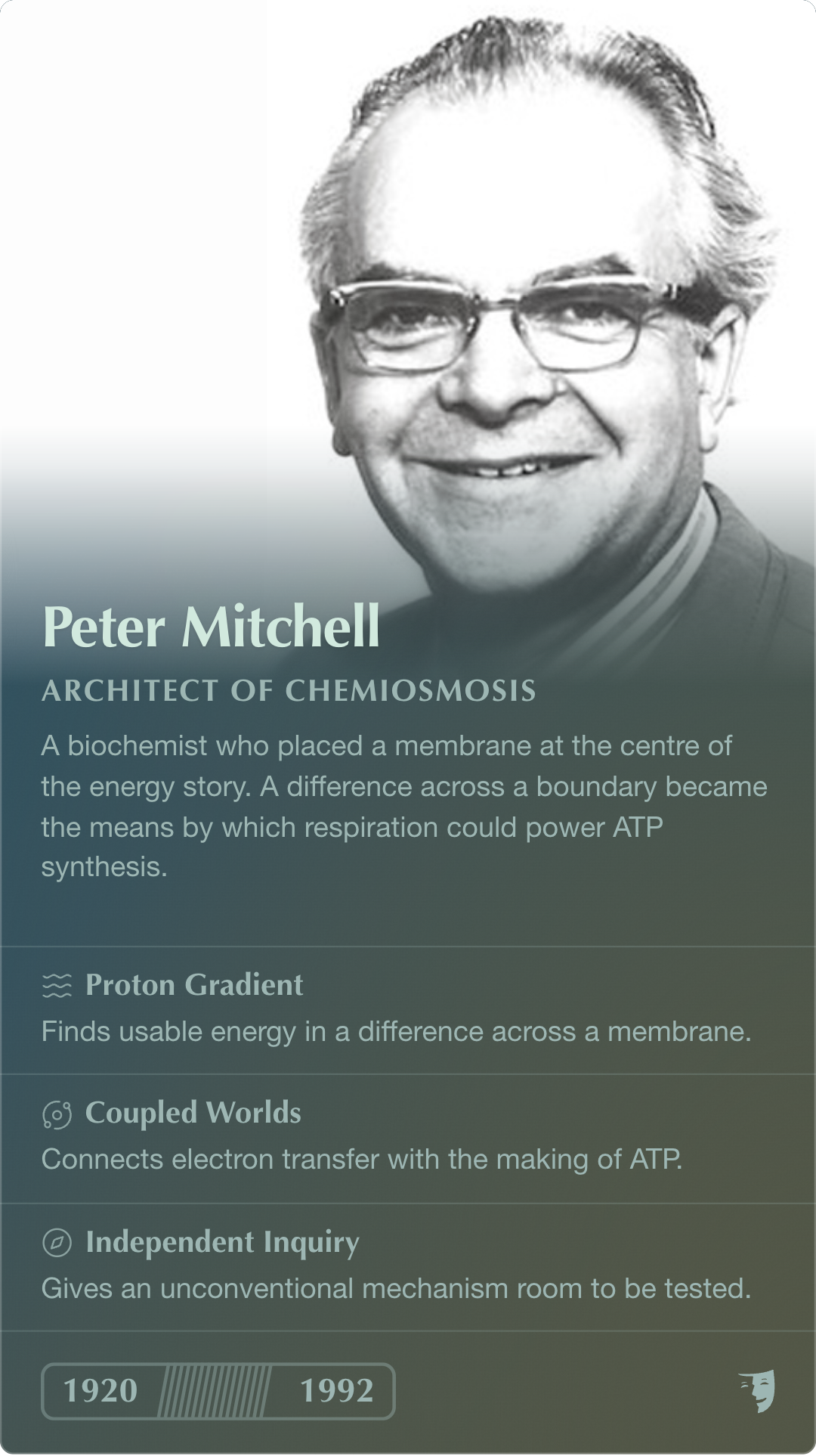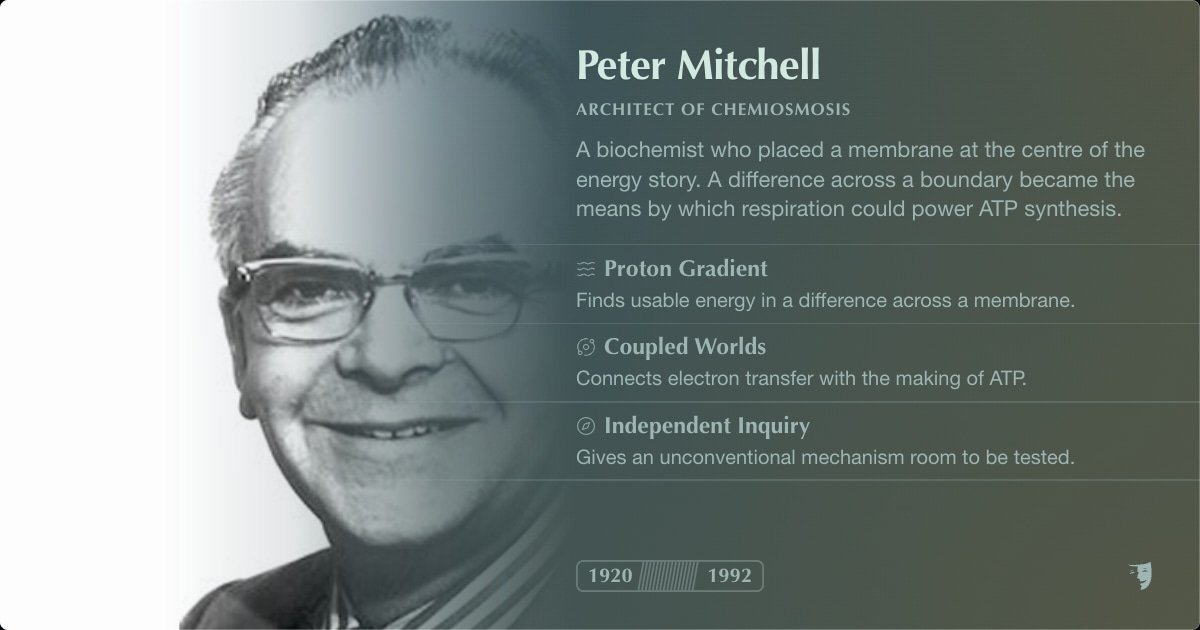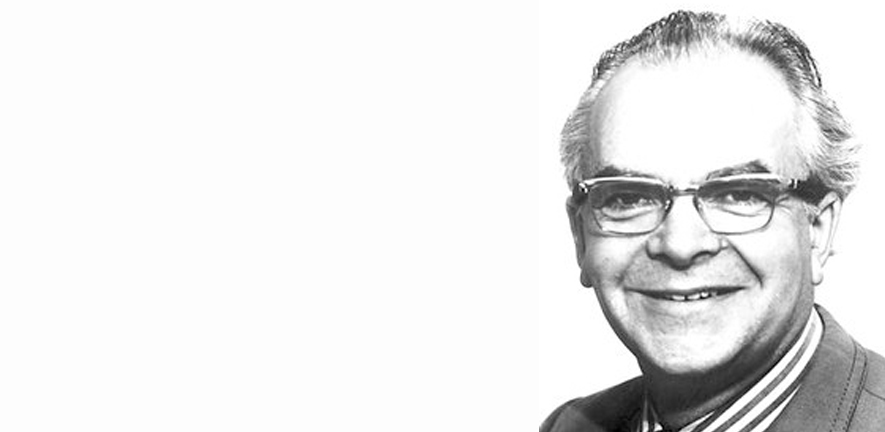
Portrait of Peter Mitchell.

Peter Mitchell

Architect of Chemiosmosis

A biochemist who placed a membrane at the centre of the energy story. A difference across a boundary became the means by which respiration could power ATP synthesis.

Proton Gradient
Finds usable energy in a difference across a membrane.
Coupled Worlds
Connects electron transfer with the making of ATP.
Independent Inquiry
Gives an unconventional mechanism room to be tested.
Peter Mitchell

Architect of Chemiosmosis

The Birth of Bioenergetics · A gradient becomes work
1961

Across a boundary

Mitchell proposed that electron transfer could drive the movement of protons across a membrane. Their electrochemical gradient could then provide the energy for ATP synthesis. The membrane became an active part of the mechanism.

1965–1967

The work at Glynn

At Glynn, Mitchell and Jennifer Moyle built a research programme around chemiosmotic coupling. Their collaboration belongs at the centre of this story, including the experiments that put the proposal under pressure.

1978

A mechanism becomes foundational

The Nobel Prize recognised Mitchell’s contribution to understanding biological energy transfer. Chemiosmosis became a foundation of modern bioenergetics.

This is also a useful point of comparison with Gilbert Ling: their accounts of cellular organisation should be read in their own terms, with their differing experimental support.