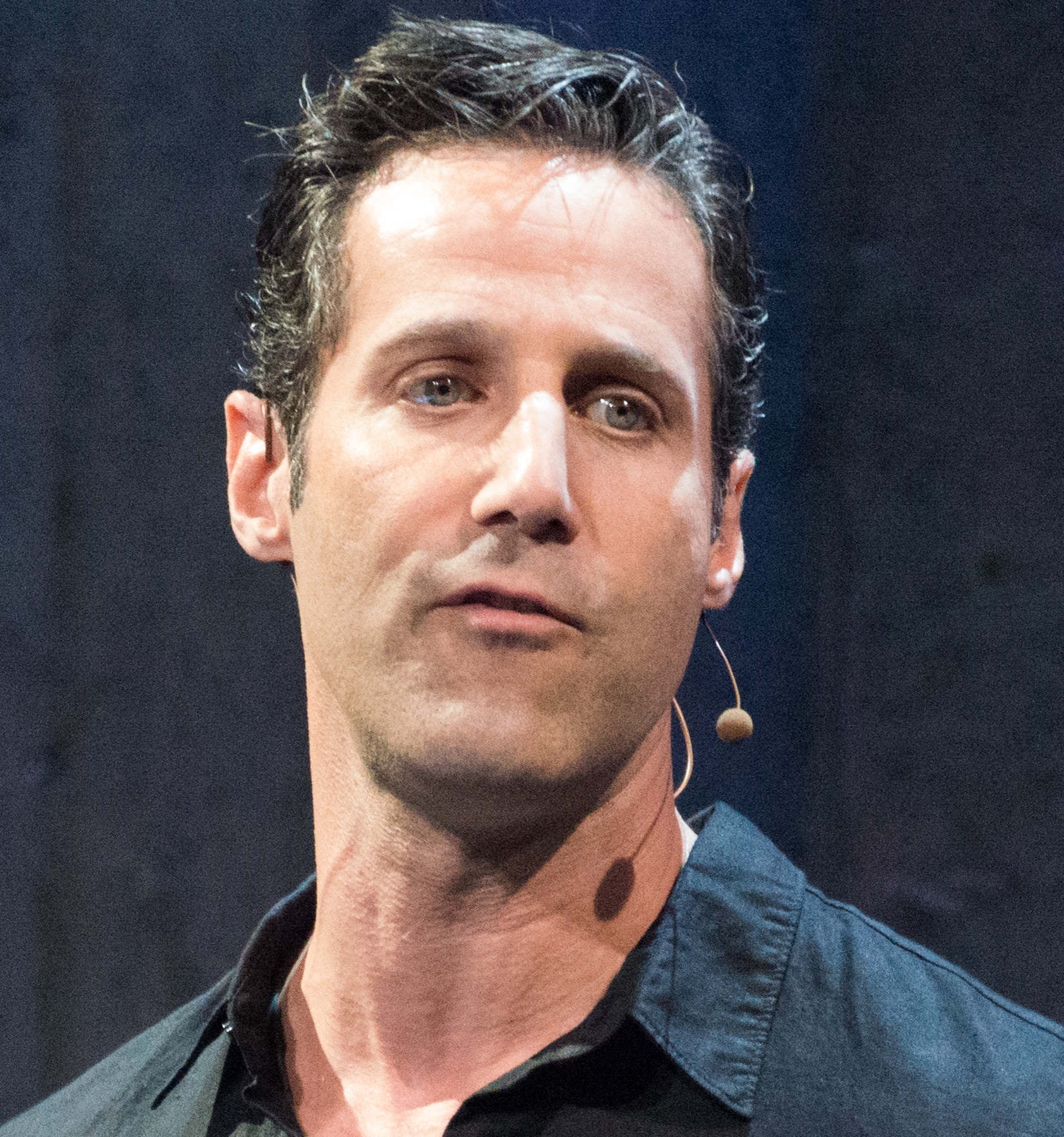
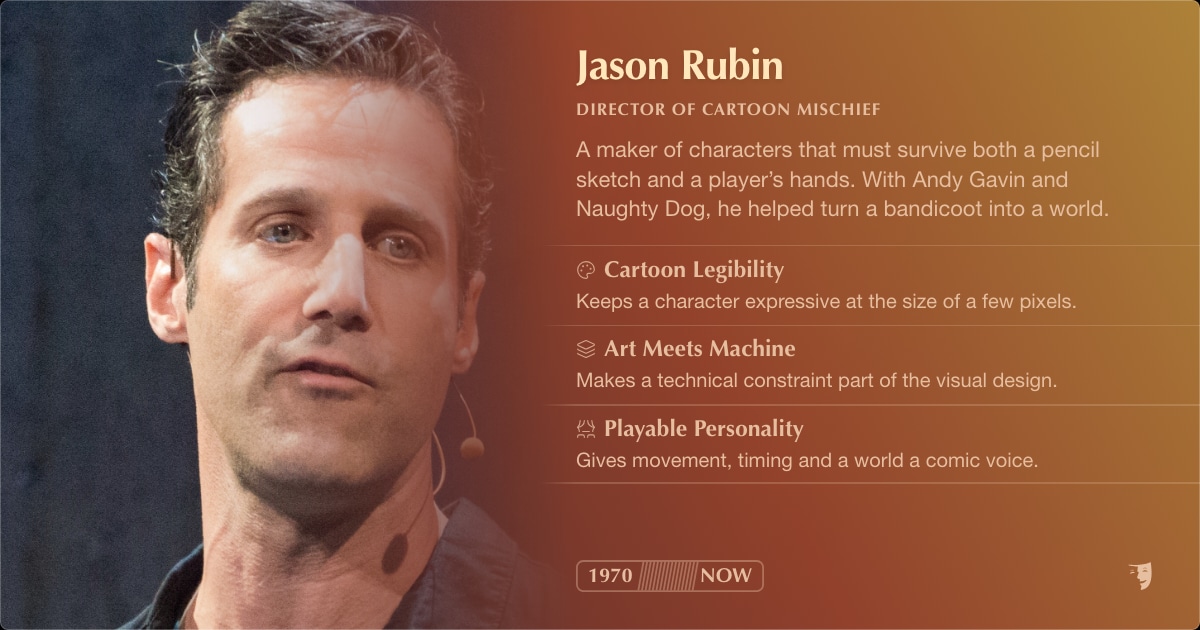
A maker of characters that must survive both a pencil sketch and a player’s hands. With Andy Gavin and Naughty Dog, he helped turn a bandicoot into a world.
Cartoon Legibility
Keeps a character expressive at the size of a few pixels.
Art Meets Machine
Makes a technical constraint part of the visual design.
Rubin’s part in Crash begins where a cartoon drawing meets a demanding piece of hardware. His commentary reveals a director continually translating between an artist’s imagination, a programmer’s budget and the player’s need to understand what happens next.
1980s–1994
A partnership formed around different strengths
Rubin and Andy Gavin began making games together as teenagers. Gavin’s recollection identifies the immediate bargain: one was an artist, the other a programmer, and both wanted to make games. Their early work became Naughty Dog. The later studio’s achievement grew out of that continuing conversation rather than a founder performing every job.
By 1994, a move toward PlayStation raised the stakes of visual invention. A character-action game in three dimensions needed more than an appealing mascot. It needed a view, readable movement and environments whose detail would fit into the console. Rubin’s contribution lives at that intersection, where a desired look becomes a series of decisions that can actually be built.
1994–1996
A drawing has to survive forty pixels
Charles Zembillas developed character drawings and Joe Pearson helped establish environments; Bob Rafei joined the growing art team. Rubin’s commentary credits their imagination while explaining his and Rafei’s task of turning sketches into workable game models. A striped hat or a flapping strap could disappear into flicker when a character occupied only a small area of the screen.
Crash Bandicoot’s 1996 release shows the result: a clear silhouette, exaggerated motion and a world that frames rather than buries its hero. That expressiveness depended on Gavin, Dave Baggett and Mark Cerny’s engineering as well as on drawing and animation. The story is most revealing when art and code are treated as mutual demands, with each forcing the other to become better.
1997–1999
Personality becomes a repertoire of actions
Cortex Strikes Back and Warped expanded Crash’s movement and situations. In Warped (1998), a time-travel premise supplies different settings and ways to move through them. The attraction is not simply more scenery: familiar comic personality must remain legible as the action changes.
Crash Team Racing followed in 1999, carrying the cast into a different genre. These games were made by a studio whose artists, programmers and designers had accumulated methods together. The founders’ accounts can be exuberant and selective; they are best read as participant testimony, especially where they name collaborators and admit the compromises between visual ambition, reliable control and the schedule.
2001–2004
Let the next world change its tone
Jak and Daxter: The Precursor Legacy opened a continuous platforming landscape in 2001. The follow-up, Jak II, arrived in 2003 with a city, weapons, vehicles and a newly speaking Jak. It shifted the series’ tone as decisively as its mechanics. Jak 3 continued that expansion in 2004.
Rubin’s directing role belongs within Naughty Dog’s collective development. Dan Arey, Evan Wells, Bob Rafei and many colleagues helped shape the games as their scale grew. The contrast between Crash and Jak II is a useful way to inspect the work: broader freedom and a more assertive story can create new pleasures while placing heavier demands on the player.
After Naughty Dog
From making a world to supporting other makers
Rubin’s subsequent career included leading THQ and helping establish Oculus’s content operation, later within Meta. Those roles concern the conditions under which other teams make games, and should not be confused with personally directing their work. His March 2026 departure from Meta makes the period historical rather than a current job title.
Return to the two voices in the making-of essays. Gavin describes the mechanisms; Rubin repeatedly points to what their images made possible. Neither account explains the whole studio, but together they let a reader see creative direction as a practical conversation—one in which a cartoon’s tiny outline and a team’s large ambition have to fit the same screen.