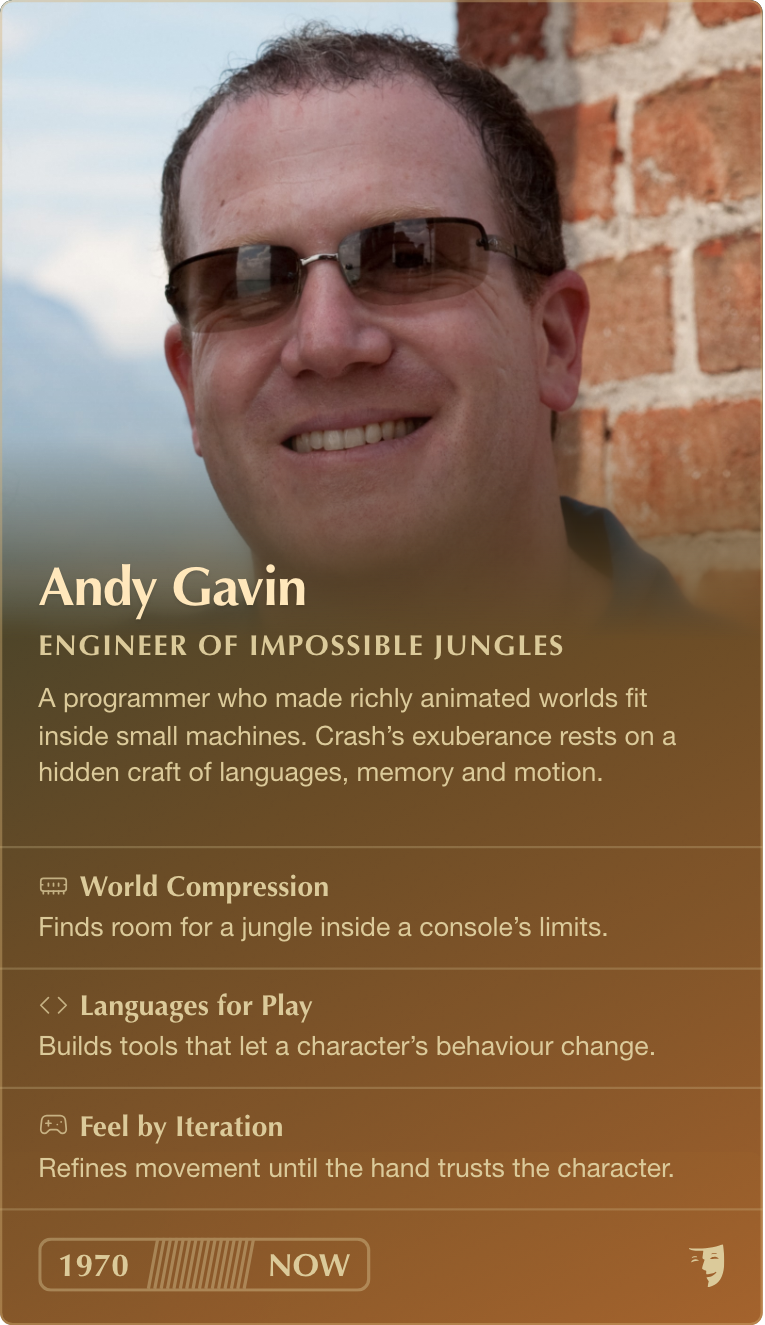
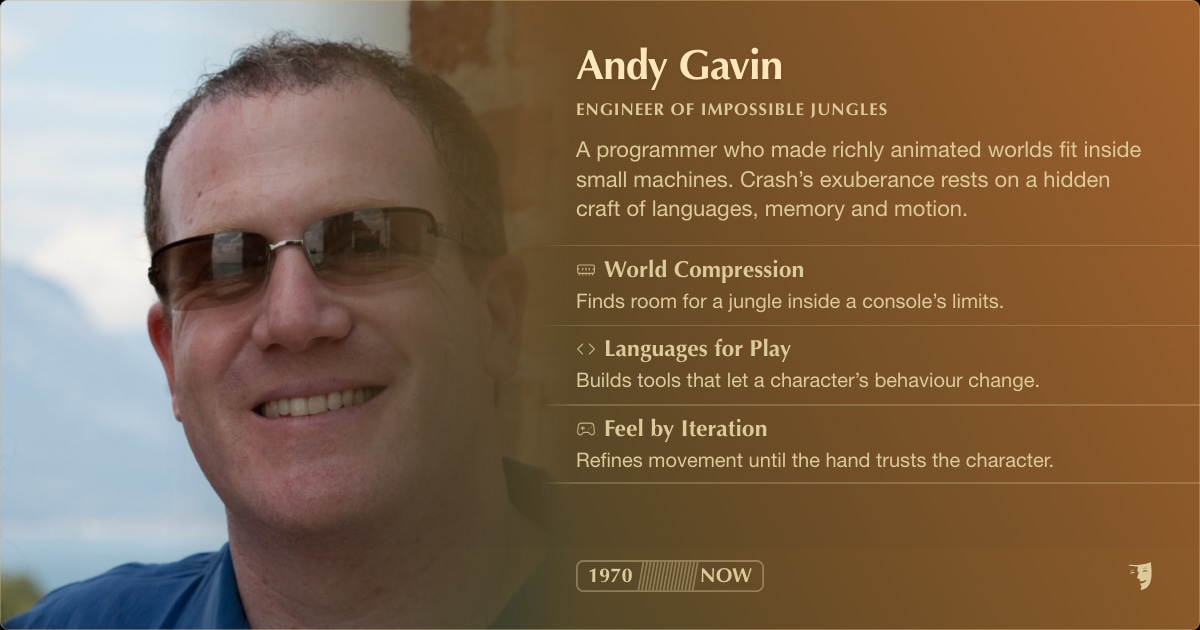
Behind Crash’s effortless bounce lies the opposite of effortless work. Gavin’s engines and languages made cartoon ambition possible on hardware that seemed too small for it, while his retrospective writing lets readers inspect the decisions beneath the spectacle.
1980s–1994
Two kinds of making meet in a basement
Gavin’s own biography recalls a Northern Virginia childhood divided between science fiction and an Apple computer. At twelve he met Jason Rubin, an artist with the same appetite for games. They began trying to sell their work as teenagers. The partnership that became Naughty Dog was already a negotiation between what could be drawn and what could run.
By the summer of 1994 they were moving beyond their earlier games toward a new console and a new problem: how should a platform character feel in three dimensions? Their road-trip recollections are entertaining, but the lasting subject is a concrete design decision. Looking from behind a character changed the camera, the level and the machinery needed to keep a jump readable.
1994–1996
The visible jungle and the invisible machine
Crash Bandicoot shipped in 1996. Gavin and Dave Baggett’s tools did substantial work before the game ran: a controlled camera made it possible to calculate visibility in advance, while compression and streaming fitted extravagant art into limited memory. Mark Cerny contributed both technical work and persistent criticism of the controls.
Those inventions served a team’s images. Rubin, Bob Rafei, Taylor Kurosaki and other artists and designers had to revise scenes whenever a gameplay change altered what the machine could display. This was not a single clever shortcut. It was a loop between making, measuring and remaking, with a bright cartoon world as the reward—and a complicated pipeline as the cost.
1996–1998
Give the creature a language
Gavin’s 1996 article on GOOL explains a second kind of engineering. A character must respond to events, move, animate and change state; expressing those actions cleanly makes experimentation easier. His Lisp-based game-object language sought to put the code closer to that problem.
Cortex Strikes Back (1997) and Warped (1998) let the studio revisit its technology and retain what worked. The later technical retrospective is especially revealing about the risks carried from one sequel into another. GOOL is an instructive historical design, not a recipe every modern team should adopt: custom languages gain expressive power while creating tools that their makers must maintain.
Jak and Daxter: The Precursor Legacy arrived in December 2001. Its connected landscape offered a different pleasure from Crash’s directed corridors: seeing a place in the distance and travelling into it. Gavin’s later account distinguishes the GOAL language used for the Jak games from GOOL; similar names conceal a new implementation.
Jak II and Jak 3 brought cities, vehicles and combat into the studio’s evolving vocabulary. The widening range belonged to an expanding team, not to its founders alone. Gavin’s own credit summary also makes an important exception: although involved in Crash Team Racing, he was not its lead programmer. Exact credit preserves the achievement better than a legend of universal authorship.
2011–ongoing
Let the finished illusion disclose its craft
Gavin’s development articles, many written with Rubin’s responses, make a valuable companion to the games. They preserve argument, discarded ideas and named collaborators. He also writes fiction and publishes on food and travel; the game archive sits within a wider life of enthusiastic observation.
Read the recollections beside the contemporary technical article. One reconstructs a shared history; the other shows how a programmer formulated a problem at the time. Their overlap is the useful lesson: tools acquire meaning through the experiences they let other people make.