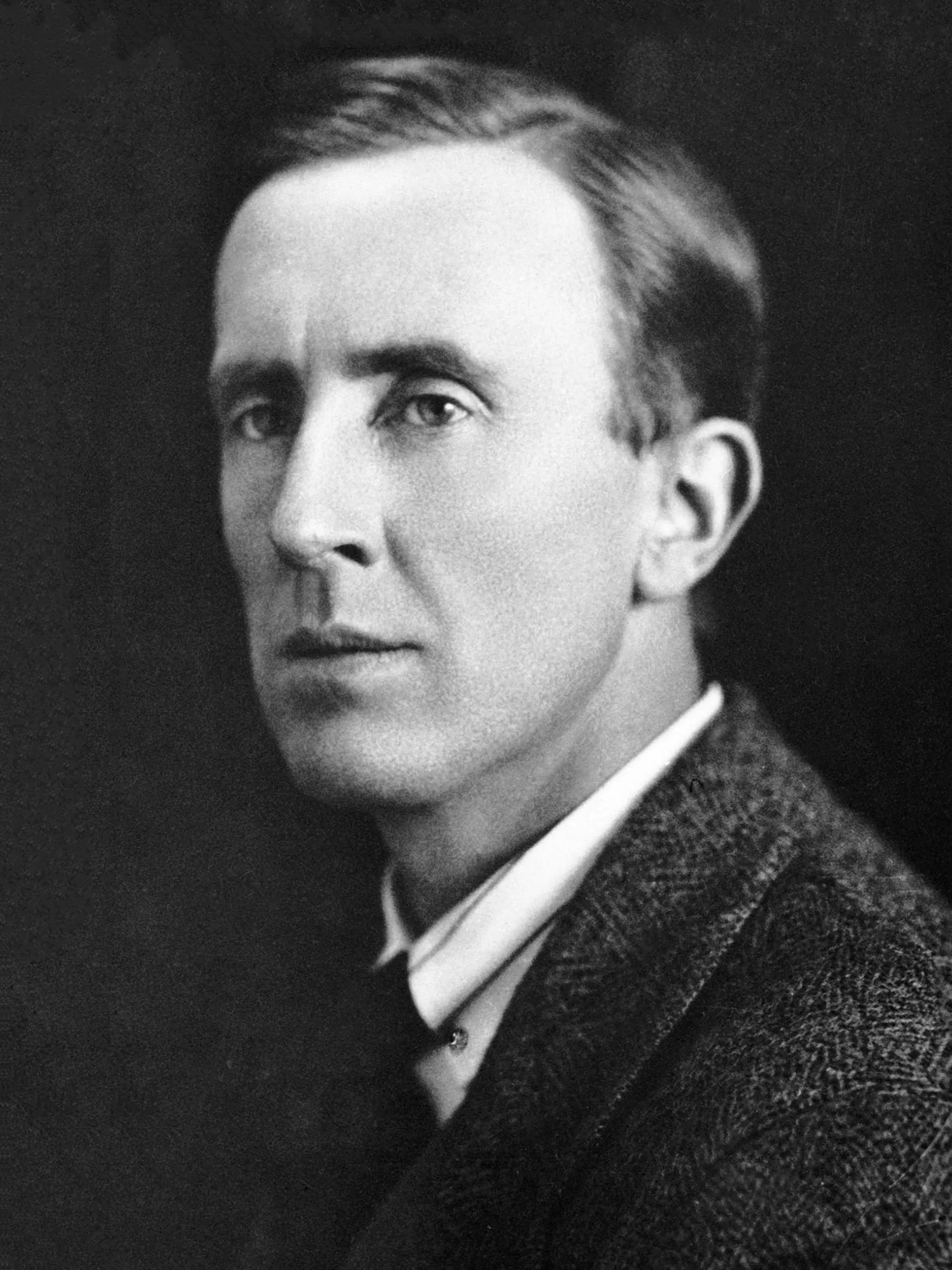
J. R. R. Tolkien in a studio portrait, about 1925.

J. R. R. Tolkien

Philologist of the Perilous Realm

A Somme signals officer who invented Elvish before he had a story to put it in. Oxford’s professor of Anglo-Saxon built Middle-earth so his languages had somewhere to live.

Elvish First
Invents a language, then the people and history it implies.
Monsters Matter
Tells scholars the dragon in Beowulf is the point, not a flaw.
Endless Revision
Redraws maps and calendars for years before letting go.

J. R. R. Tolkien

Writer, Philologist & Maker of Middle-earth

Start hereThe HobbitBilbo’s adventure is the welcoming entrance. Watch how a familiar home, songs, maps and hints of older history make the road beyond it feel inhabited.Explore the English edition

Tolkien’s Middle-earth grew across decades of language-making, medieval scholarship, family storytelling and patient revision. Begin with Bilbo’s small journey, then follow the older histories that gather behind it—and the manuscripts that show how unfinished that world remained.

1892–1916

Languages before a world

John Ronald Reuel Tolkien was born in Bloemfontein in 1892. After his father died, his mother Mabel settled with Ronald and his brother Hilary near Birmingham, first in the village of Sarehole. She taught them at home before Ronald went to school; after her death in 1904, Father Francis Morgan became their guardian. The loss and the Catholic upbringing belong to the record of his childhood, though neither explains the fiction by itself.

At school and Oxford he pursued languages for their sounds and histories, inventing Qenya while reading northern saga and the Finnish Kalevala. He married Edith Bratt in March 1916, then served as a signals officer at the Somme. Trench fever sent him home; Rob Gilson and Geoffrey Smith, friends from his school literary circle, died in the war. His fiction later returns to courage and loss, but Middle-earth should not be reduced to a map of the trenches.

An 1892 Tolkien family photograph on a handwritten Christmas card, with the infant Tolkien at the right.
1917–1925

The legendarium begins

During and after his recovery Tolkien began The Book of Lost Tales, trying out histories for the peoples and languages he had imagined. Language came with change through time: names suggested migrations, kinship and stories that a single adventure could only glimpse. This was a working archive, repeatedly rewritten, rather than a finished mythology waiting for publication.

He worked on the Oxford English Dictionary, taught at Leeds, and in 1925 became Oxford’s professor of Anglo-Saxon. With E. V. Gordon he edited Sir Gawain and the Green Knight. Philology meant attending to how words and stories changed in use; that patient attention also gave his invented past its texture.

1973 and after

The unfinished world

Tolkien continued revising the older tales after The Lord of the Rings, but died in 1973 without making them into the book he had long imagined. Christopher Tolkien selected and reconciled drafts for The Silmarillion in 1977. The resulting narrative has the force of an ancient history, yet its finished shape is also his son’s substantial editorial work.

Christopher later published Unfinished Tales and the twelve-volume History of Middle-earth, exposing alternatives, abandoned paths and changes in the legendarium. Read The Silmarillion after The Lord of the Rings for the elder ages it invokes; then take a manuscript volume as a look inside the workshop. The choice of route matters: the published mythology gives a continuous tale, while the drafts restore the long uncertainty through which Tolkien made it.

The SilmarillionThe mythology behind Middle-earth, presented through a consequential posthumous editorial collaboration.Explore the work

Middle-earth & beyond

Writing, art & voice