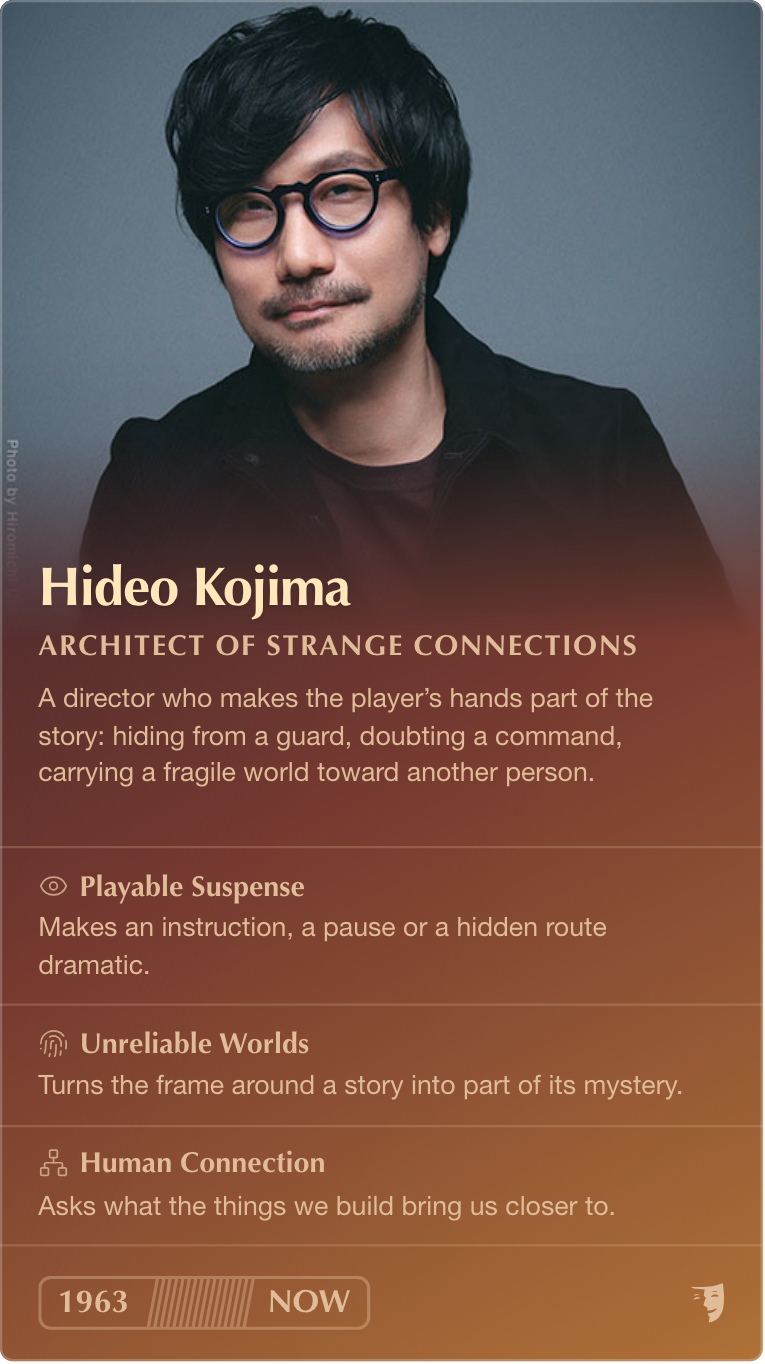
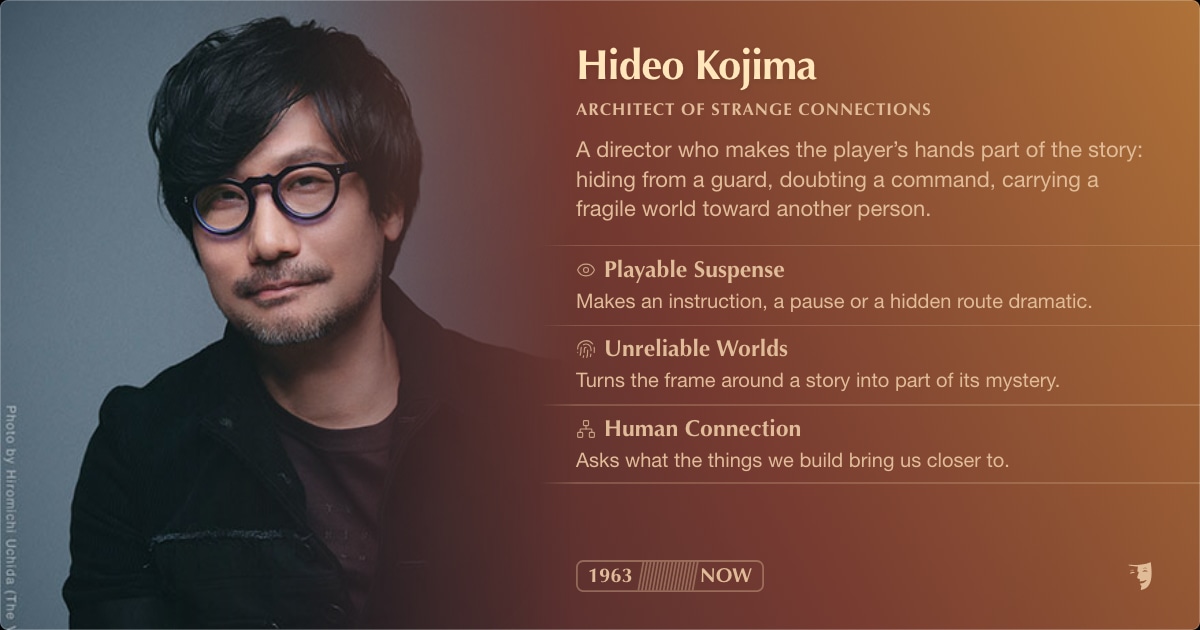
Kojima builds stories that reach out of the screen: a controller becomes a prop, orders become suspect, a ladder left on a mountain becomes a message. His grand narratives work most sharply when an ordinary action makes their questions tangible.
1963–1987
A film lover finds a different instrument
Born in Tokyo in 1963, Kojima joined Konami as a planner in 1986. Its contemporary staff biography records Metal Gear as his first directed game the following year. His appetite for movies did not simply result in longer scenes: he found a medium in which a viewer could be made responsible for what happened next.
The original MSX2 Metal Gear grew around a reversal of the dominant action-game objective. Getting past an enemy mattered more than defeating one. Konami’s archive ties this economy to hardware limits; the interesting result is how a restriction becomes a source of suspense. The player studies a patrol, waits and moves. Attention itself becomes an action.
1998–2004
The story notices the person holding the controller
Metal Gear Solid carried that premise into a fully polygonal world in 1998. Cinema supplied rhythm and spectacle, while the controller, radio conversations and even the game’s packaging could become parts of a puzzle. The player was simultaneously inside the espionage fiction and aware of the apparatus supporting it.
The signature belongs to a director working with many others. Yoji Shinkawa shaped characters and machines; writers, programmers, composers, translators and performers made the games’ tone possible. Sons of Liberty (2001) unsettled the relationship between hero, orders and information. Snake Eater (2004) made concealment physical again through camouflage, food and injury. Their pleasures include theatrical excess, but long explanations can also interrupt the act of playing.
2015–2019
From infiltration to the difficult work of connection
The Phantom Pain opened the stealth formula into a field of tools and changing conditions in 2015. That December Kojima established the independent Kojima Productions. Its first released game, Death Stranding, arrived on 8 November 2019, with Norman Reedus, Mads Mikkelsen and Léa Seydoux among its performers.
The carrier’s task gives the new fiction its most persuasive language. A slope must be negotiated, a load balanced, a bridge built. Other players’ traces make solitary movement quietly cooperative. The same game can be ponderous or moving depending on whether its repetition feels like labour worth doing; its argument is strongest when the player experiences a small act of help rather than receives an explanation of connection.
2021–2025
Follow the influences, then question the network
The Creative Gene gathers Kojima’s essays on the books, films and music that feed his work. It invites readers to encounter an enthusiastic reader alongside the public director. Glen Milner’s 2023 documentary Connecting Worlds offers another perspective on the independent studio, and should be approached as a sympathetic portrait rather than a complete account of every collaborator.
Death Stranding 2: On the Beach launched on PlayStation 5 on 26 June 2025. Its question about whether connection was desirable complicates the first game’s programme. Read the two together: a network can support people and still demand scrutiny. That willingness to turn a cherished premise back into a question keeps this body of work open.