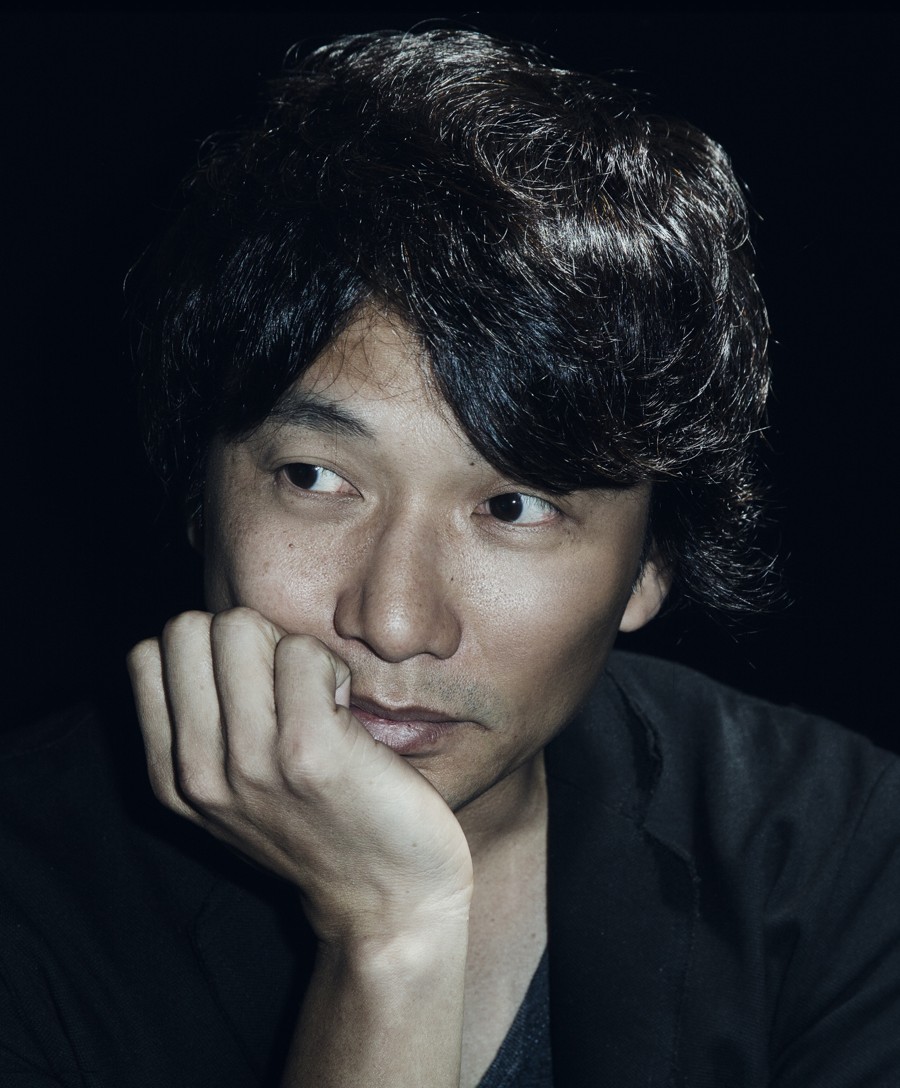
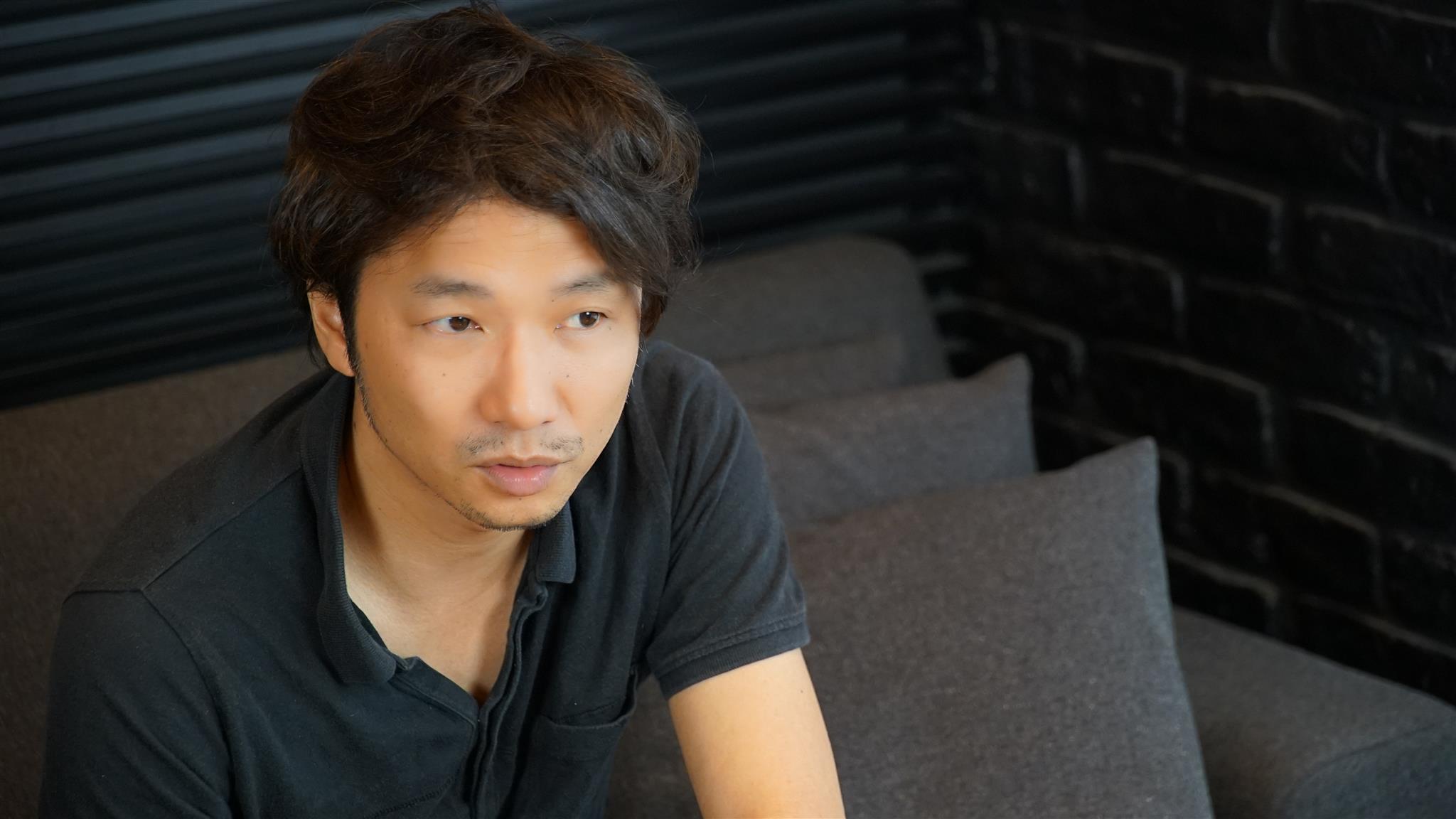
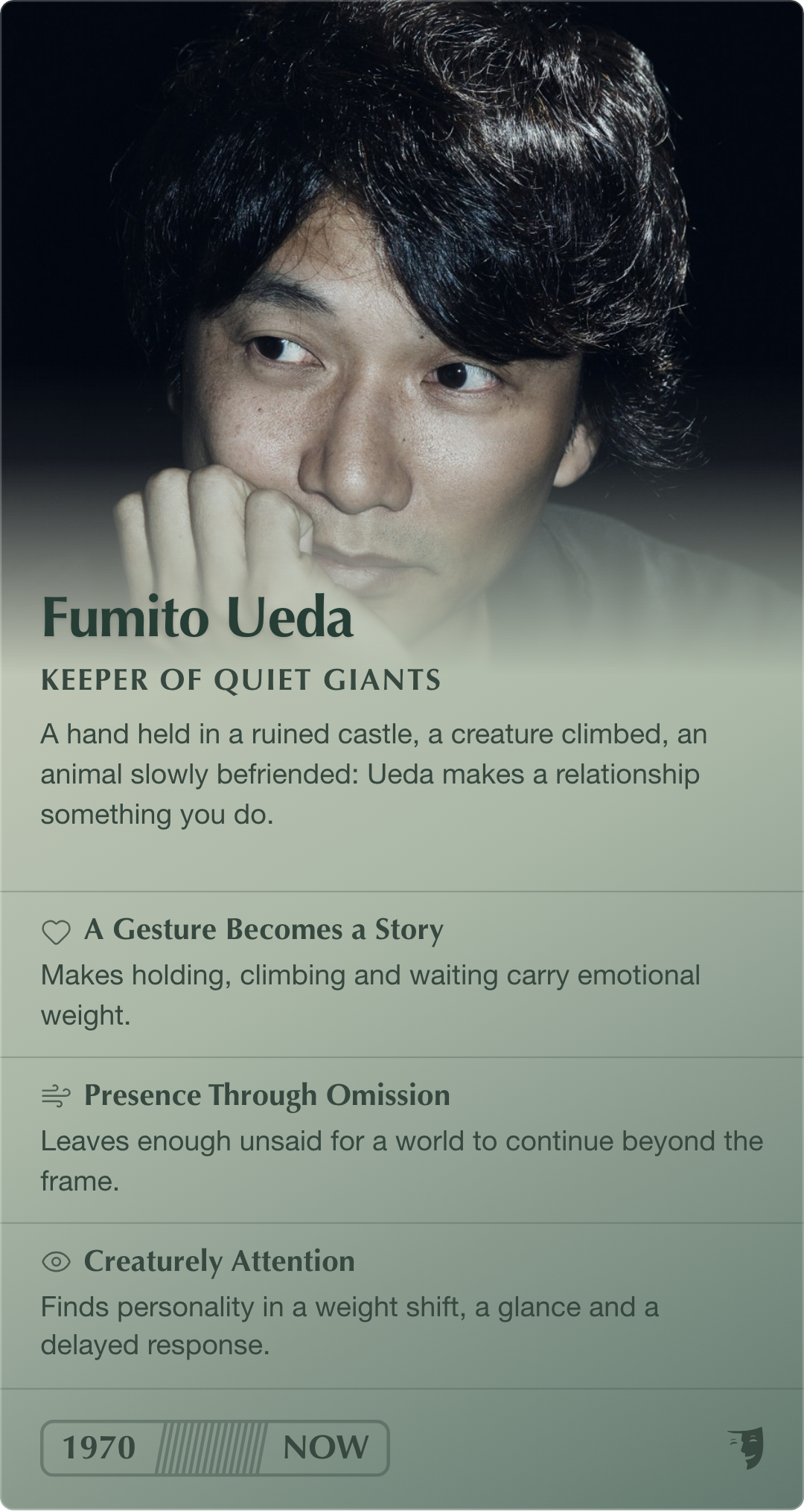
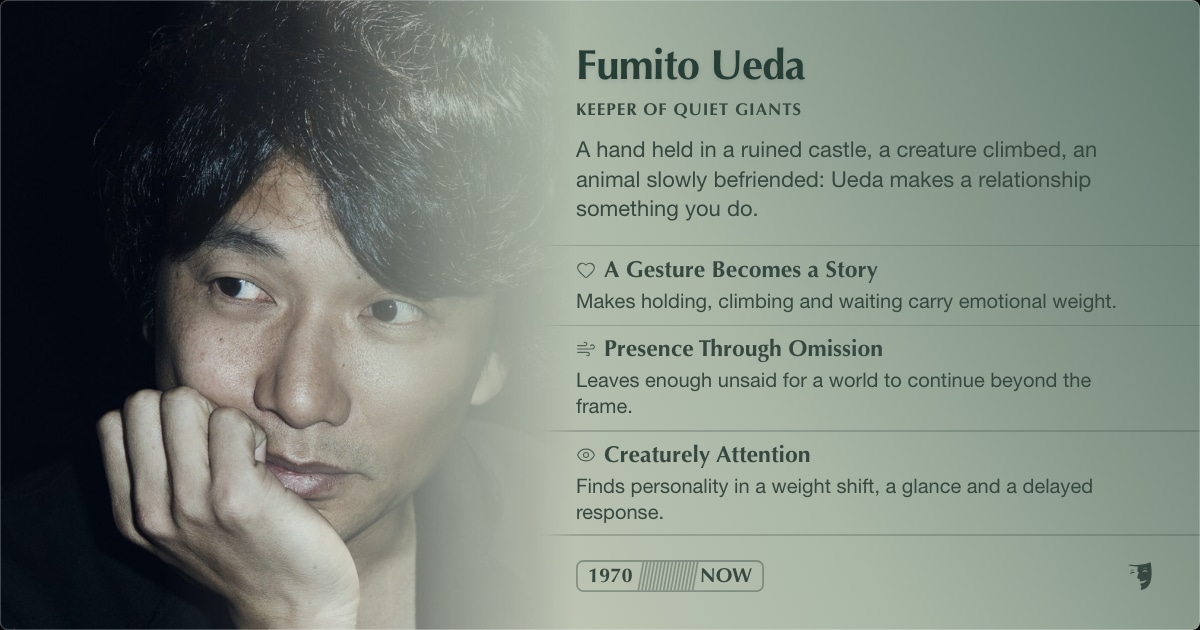
Ueda gives you a small body inside a world too large to explain. His games ask for an unusual kind of attention: to the tug of another person’s hand, the strain of a grip, the hesitation of a frightened animal. Their silence is carefully made by teams of artists and engineers; their emotional force grows through your own acts of care, persistence and sometimes harm.
1970–1990s
An artist learns to make an image answer back
Born in 1970, Ueda came to games through visual art and computer animation. The opening of genDESIGN’s staff symposium preserves a revealing small history: he and future colleague Masami Tanji knew one another through LightWave3D and their personal websites around 1995, when that online circle was still tiny. Before the familiar games, there was already a fascination with making a figure seem present inside a constructed space.
That background helps explain the distinctive mixture of sculpture, animation and play in his later work. A creature cannot merely look impressive; it has to react to a person approaching it. The studio’s recollections show an artist comfortable with both polygons and physical materials, eventually painting barrels and assembling an interactive exhibition. His method begins with an experience he wants someone to have, then asks what form and mechanism can give it weight.
ICO gives a horned boy and Yorda a castle to escape, while leaving much of their world obscure. Its central relationship arrives through an ordinary action: reach out, take a hand and lead another person across a space. A jump is no longer only a test of your own timing. It becomes a question of whether the other person can follow, and whether you will stay close enough to help.
The restraint is active work. Architecture, shadows, sound and animation have to guide attention without a constant explanation. Team ICO made the castle intelligible enough to traverse while retaining its mystery. Read the silences as invitations to notice rather than as an empty plot waiting to be supplied. The result is especially moving when you stop treating Yorda as an escort objective and begin to feel the practical responsibility of travelling together.
2005
The magnificent creature is also the thing you destroy
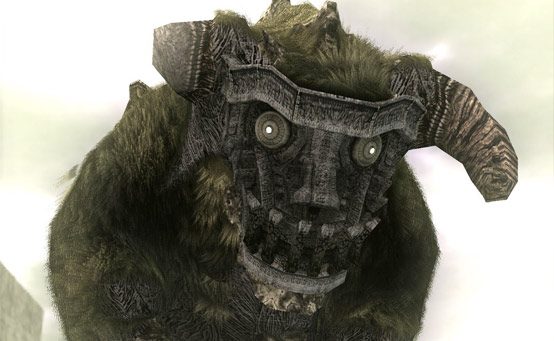
Shadow of the Colossus opens the landscape and changes the moral texture of the encounter. Wander crosses a largely quiet land on Agro to find enormous creatures. Each colossus is at once an animated body, a moving terrain and a problem of approach. You study its gait, find a surface to grip, and discover how small your own strength is against its movement.
The game binds exhilaration to unease without requiring a speech to tell you what to feel. Falling, climbing and striking make you a participant in the destruction of something extraordinary. In his 2010 PlayStation interview, Ueda is curious about the common claim that his games are art: which exact part makes people say it? That is a fruitful question to keep beside the game. Its power is less a label than the uncomfortable experience of having mastered a task and wondering about the task itself.
The Last Guardian was publicly shown for PS3 in 2009, reintroduced for PS4 in 2015 and released in December 2016. Ueda’s account identifies technical hurdles behind the long passage; the core boy-and-animal relationship survived the change of hardware. The finished game joins genDESIGN’s creative work with Japan Studio’s development. Its history is a collaboration and a difficult production, not simply a solitary artist waiting for inspiration.
Trico’s size offers safety and creates danger. The boy can climb onto a guardian that is also easily frightened, distracted and hard to direct. You learn where to stand, when to call and how to interpret a response. The slight uncertainty is part of the animal’s presence, though it can also frustrate the person holding the controller. The most interesting moments ask you to distinguish a creature’s hesitation from your own unclear instruction; trust accumulates through repeated encounters.
2018
A wet eye, a lifted foot, a world beyond the mountains
genDESIGN’s retrospective makes the apparently effortless animal disclose its craft. Lead animator Masanobu Tanaka explains that Trico used keyframe animation rather than motion capture, drawing on cats, tigers and other animals to combine agility with great scale. Character artist Yutaro Sakai describes placing feathers and repeatedly tuning the shine of the eyes. Those details allow an imaginary creature to feel vulnerable and alive.
Ueda connects omission with a sense of reality: a distant mountain should suggest life on its unseen side. He also discusses the practical logic behind architecture and level design. The team changed gripping controls late in production to stabilise the boy’s movement on Trico. Reading these conversations after playing reveals how many choices support a single emotional impression. Beautiful restraint depends on testing, discarded mechanisms and the patience of people working together.
genDESIGN announced its publishing partnership with Epic Games in 2020. The publisher’s current page now names the next game gen ATLAS and describes a solitary journey across an abandoned planet, with an enormous robot opening previously inaccessible routes. This is an announced new project rather than a fourth finished work; as of 5 October 2026, the store still marks it as coming soon without a confirmed release date.
The premise offers a reason to return to the earlier trilogy while waiting: different kinds of large bodies have continually changed the player’s relation to space. A colossus resists you; Trico carries and protects you; an immense robot promises a new transformation of reach and perspective. What gen ATLAS will ultimately make of that premise remains for the finished game to establish. The existing works already teach the useful habit: pay attention to what the body lets you do, and to what that action makes you feel.