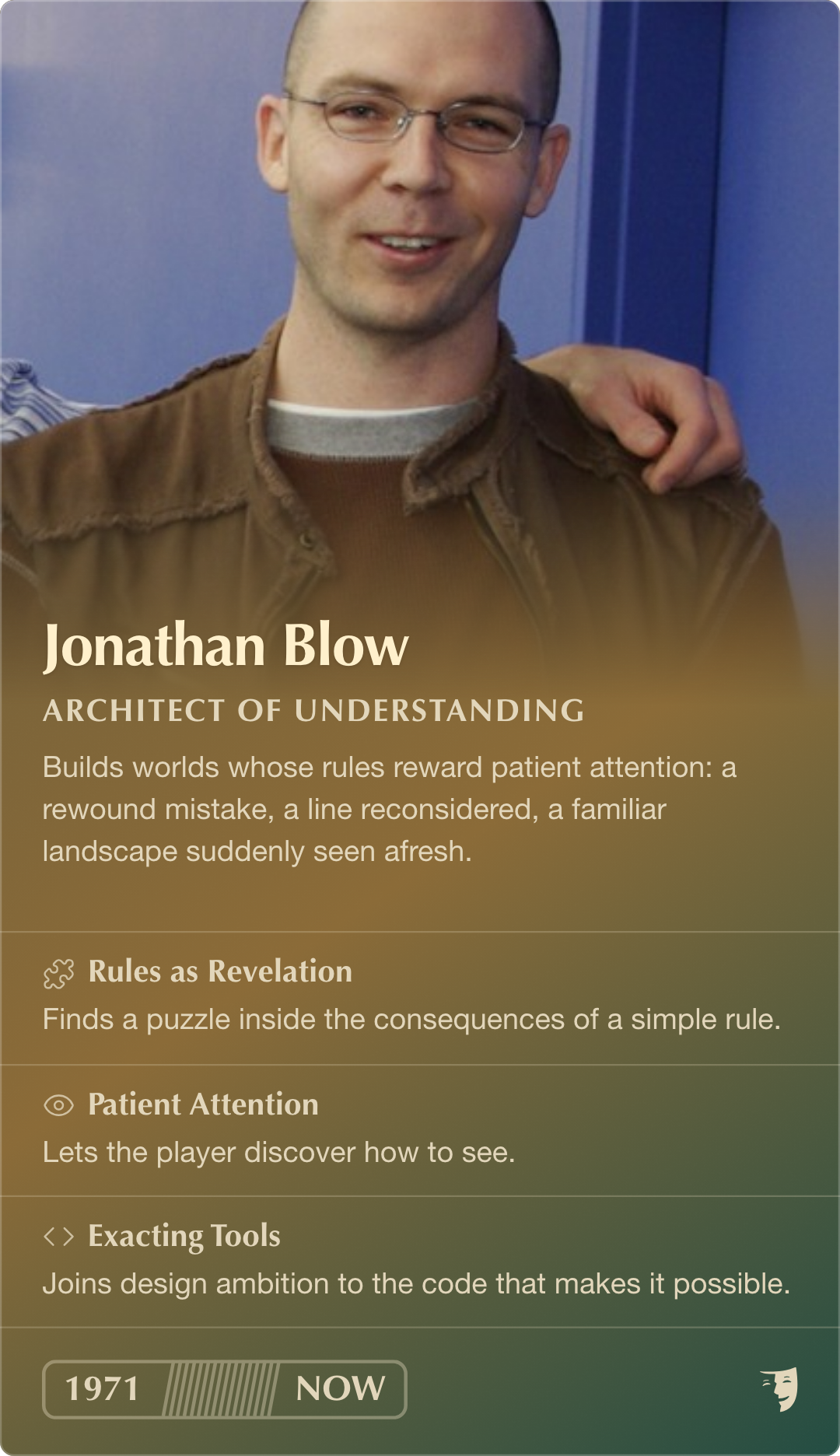
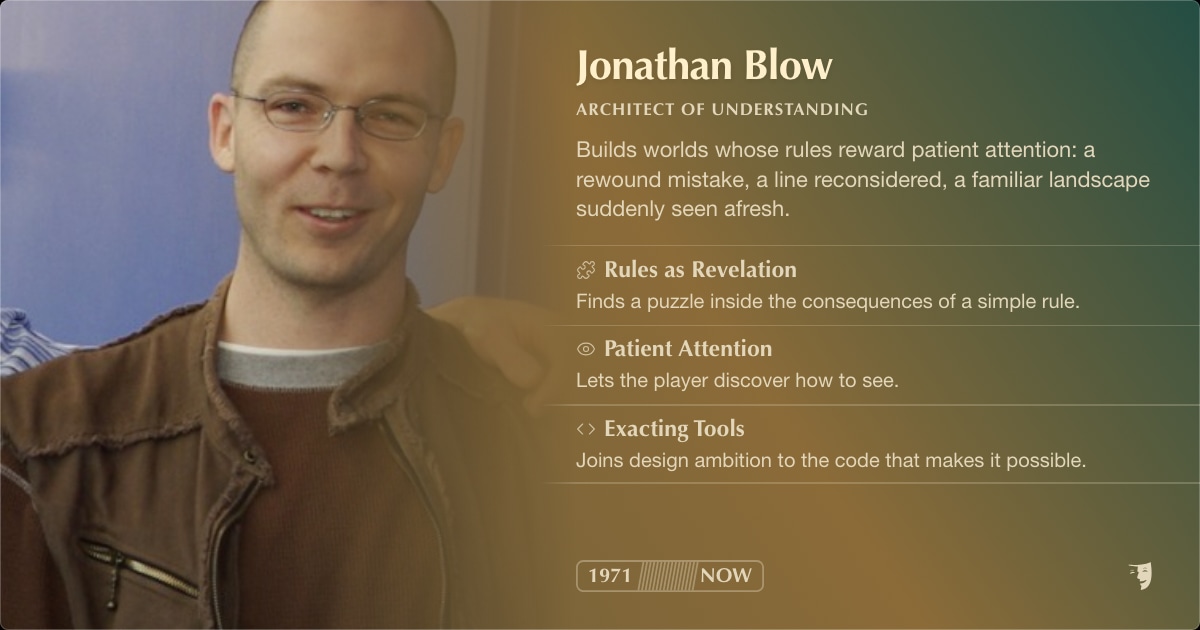
Jonathan Blow designs for the small, private moment when an idea becomes yours. Braid makes time available for experiment; The Witness makes looking itself a practice. His games ask for effort, but their deeper invitation is generous: the player can understand without being handed an explanation. Follow the engineering and the collaborators as well as the philosophy, and the apparent solitude of those worlds opens into a demanding collective craft.
2002–2007
Before the painting, the experiment
The earlier Blow can be found in technical columns and in a GDC talk about prototyping, delivered before Braid reached its public audience. This is a useful place to begin because it makes the celebrated game look like work: an idea has to survive contact with a controller, a camera and another person’s expectations. A prototype can answer a question that an eloquent design document leaves beautifully unresolved.
Read the programming column and then try a modest version of that method. Give a familiar action one unusual rule. Build enough situations to expose its consequences. The point is not to manufacture novelty on command; it is to notice whether the rule produces distinctions worth understanding. That habit gives Blow’s later puzzle rooms their unusual feeling of being discoveries as much as inventions.
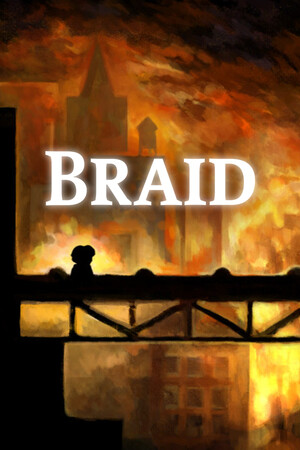
Braid takes the grammar of a platform game—walking, jumping, locked passages—and lets the player rewind. What first feels like relief from failure becomes the subject of the puzzle. If the world can be restored, the interesting question changes from whether you can execute an action to whether you understand the relation between actions. Time is no longer merely the container in which a level happens.
David Hellman’s art is crucial to that experience. The painted scenery and intimate scale give the mechanical argument a world to inhabit; they are not Blow’s illustration work. Play before reaching for an interpretation of the ending. A puzzle piece that once seemed impossible, and then suddenly becomes obvious, is already an encounter with the game’s central craft. Its meaning need not arrive as a single decoded message.
The rewind implementation talk exposes the precision beneath the dream. A game that invites you to reverse a long sequence must reproduce its earlier states reliably, within the memory of the machine running it. A loose implementation would undermine the very trust on which the puzzles depend. Here design and programming are joined at the hinge: an expressive possibility becomes useful only when its behaviour can be relied upon.
In Truth in Game Design, Blow proposes that systems can become instruments for discovering structure. This is his argument, not an established scientific result. Keep that distinction while taking the invitation seriously. Luis Antonio’s later account of The Witness supplies another necessary perspective: the island’s visual language emerged through the art team’s work with architectural and landscape thinking. Understanding was being designed into both the rules and the place.
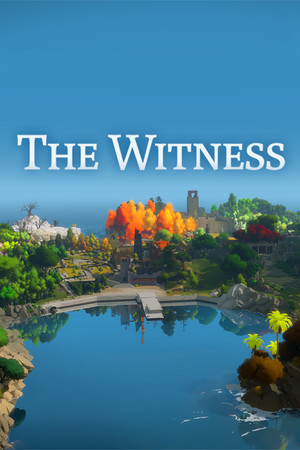
The Witness begins with a person alone in an unfamiliar place. Its panel puzzles establish little languages through examples, and the island lets you move between them. A sequence can quietly teach a distinction without naming it. The result is a landscape of partial understanding: you may be fluent in one area and a beginner a few steps away. That unevenness is part of the pleasure.
Thekla made the game as a team, with Blow directing its overall course. Notice how colour, sightline and placement contribute to a puzzle before treating scenery as decoration. When you are stuck, a walk can be a form of work. A return with fresh eyes may reveal that you had understood the wrong question. Keep its surprises intact; this is a game in which noticing can change what the entire world seems to contain.
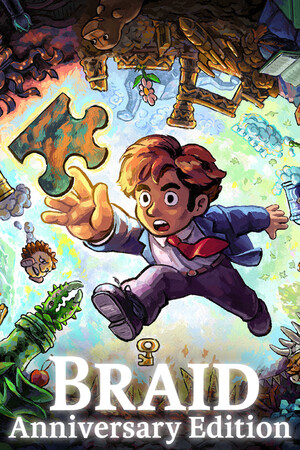
Braid, Anniversary Edition returns to the earlier work with repainted visuals, new puzzles and an extensive commentary assembled from conversations. The edition turns design into something a player can examine after experiencing it. Alternate versions of rooms are especially valuable: they let you feel a choice instead of merely accepting a retrospective explanation that it was the right one.
The accompanying podcast provides a free path into that workshop, including Hellman’s account of the art and conversations about puzzle design. Listen for separate voices. A coherent game is not evidence that one person supplied all its intelligence. The most useful way to revisit Braid is to move between solving and listening, allowing the concrete experience to test the makers’ account of how it came together.
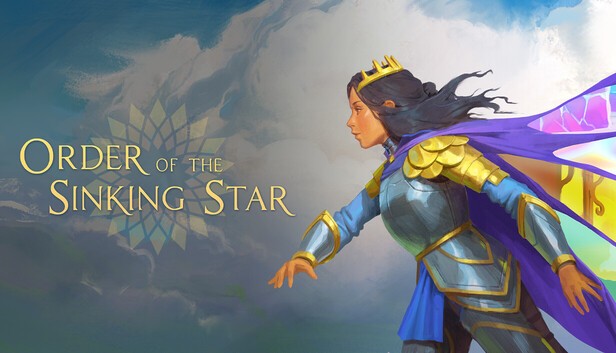
Order of the Sinking Star expands the project from learning a rule to exploring collisions between rule systems. The publisher describes four worlds that eventually meet, with a foundation drawn from earlier puzzle designs by Alan Hazelden, Sean Barrett and Jonah Ostroff. Naming those designers matters: the project’s ambition includes an explicit conversation with independent work outside Blow’s own catalogue.
On this page’s editorial date, 5 October 2026, the full game is still forthcoming, with an announced release of 8 October. Its promised scale is therefore an invitation rather than a verdict. Begin with the released Braid and The Witness; then approach the new worlds with the same practical curiosity. What does one mechanic let you know, and what becomes possible when another enters the room?