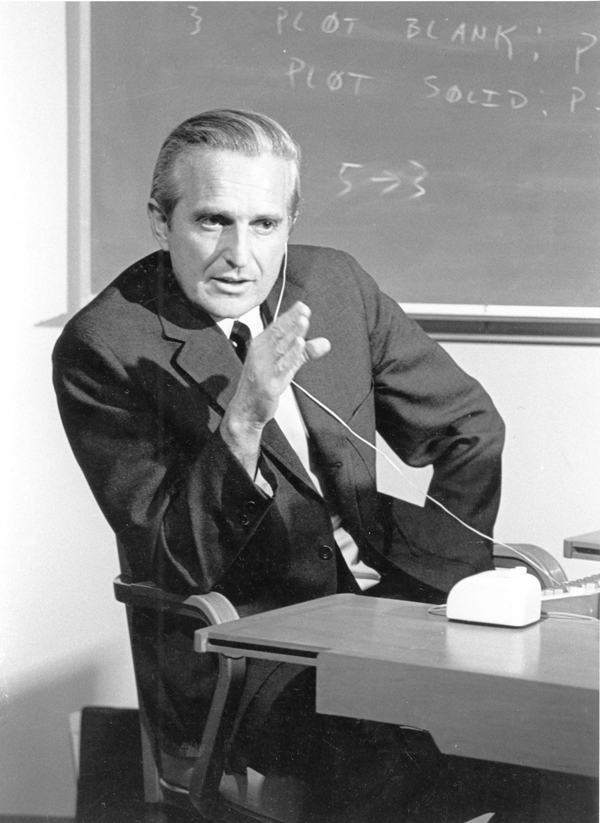
Portrait of Bret Victor.

Bret Victor

Interface Inventor, Dynamicland Lead

Ex-Apple interface prototyper whose demos made code, time and data visible, then the lead of a lab that moved programming onto paper, tables and walls.

Dial the Number
Drags a number in the code like a dial while the picture changes beside it.
Time as Space
Draws a character’s trail so changing the code visibly rewrites its future.
Rulecards
Prints “when you see this, say that” rules on paper, so objects run programs.

Bret Victor

Interface Designer & Lead of Dynamicland

History of computing · The inquiry continues Start hereInventing on PrincipleStart here and watch the first demonstration closely: JavaScript draws a scene with a tree, the code sits beside the picture, and a number in the code becomes a dial. Then the turtle in the platform game, where time is drawn as a trail. The argument that follows is Victor’s own; hold it against what you saw.Watch the talk

Bret Victor is an engineer and designer who keeps asking why people who make things on computers have to work blind. He prototyped interfaces at Apple (2007–2010), wrote essays a reader can push on, gave the 2012 talk in which a picture redraws itself as the code beside it is typed, and since 2013 has led the research lab that became Dynamicland, where programs are pieces of paper on tables and walls. The talks are his own; Realtalk, Dynamicland’s system, was built by a small team whose names are in the chapters below, and most of what we know about the lab comes from the lab itself.

1993–2004

Apple IIgs apps, a chip bus and a synthesiser

Victor grew up in the Bay Area, according to Carl Tashian’s 2019 profile, and his own CV opens in 1993 with independent software design: more than thirty programs, he says, for the Apple IIgs and other machines. He took a BS in electrical engineering at Caltech (1995–1999) and an MS at Berkeley (1999–2001). His master’s thesis, Bus Encoding to Prevent Crosstalk Delay, proposed “self-shielding codes”, ways of encoding data on a chip’s bus so that neighbouring wires do not slow each other down. The CV reports more than 300 citations; that count is his own.

Then came instruments. From 2002 to 2004 he worked at Alesis: he wrote the sound-synthesis engine for the Ion and the Fusion, and for the Micron he did the product design, interface, hardware and firmware himself. His page on the Micron states the aim: “Most synths focus on sound. I focused on music.” The engineer’s stance stayed with him. His bio still asks for an “electrical engineering” rather than a “computer science” perspective, in which “computation is for adding magic to real-world activities, not for interfacing with virtual simulations”.

2005–2010

Interactivity as a curse, and an empty box

In 2005 Victor built a trip scheduler for the BART rail system as a Mac widget; his CV says it won an Apple Design Award. On 15 March 2006 he released a draft of Magic Ink: Information Software and the Graphical Interface, an online book that explains the thinking. Its abstract argues that for “information software” interactivity is “a curse for users and a crutch for designers”. Software that shows information should instead infer what the person needs from three sources: the environment (the time, the place), history (what the person did before) and, as a last resort, interaction. His running target is the official BART trip planner, which in his account refused to divulge anything without menu selections and a button-push.

From August 2007 to November 2010 he worked at Apple. His own page says the job was to play with experimental hardware platforms and input technologies and to design and prototype apps that showed off new interface concepts; they were shown around internally, “presumably to inspire the people who did the real work”. His CV calls him an establishing member of the “HID Proto” future-interfaces prototyping team and counts more than seventy concept projects, among them reinvented interfaces for video editing, animation, drawing, mail and photos. Wired later described him as one of the first people to tinker with an iPad; his promotional bio goes further, claiming the earliest interface concepts for the iPad and that his work established Apple’s future-interfaces prototyping group, “whose inventions have shipped in billions of Apple products”. His CV is more modest (an establishing member of the team). Both are his own accounts, and we found no Apple record to check them against. His Apple page says he became known for direct-manipulation interfaces and for “being easily frustrated with the realities of corporate research”, and it ends with an empty box where the work he can show publicly would go. “The ones I cared deeply about mostly didn’t catch on.”

On 1 November 2010 he posted a poem, “Departure”, about burning “a hundred helpless nights” inside dark spaces trying to push his visions through the screen, and about a “mesh of people, straining tangled stakes and egos”: “The one machine I couldn’t hack!” It is a poem, so read it as his feeling about leaving, not as an account of events inside Apple.

2011

Explanations you can push on

Outside Apple, Victor spent 2011 turning essays into things a reader could push on. In Up and Down the Ladder of Abstraction he designs the steering rule for a toy car that senses only whether it is on the road, left of it or right of it: turn right when off to the left, turn left when off to the right. The reader drags a slider through time, then a second slider through the turning rate, then climbs a rung by drawing the car’s whole trajectory at once. That picture shows oscillation tightening around the road as the rate nears 2° a step, a pattern hard to see from the ground. Pointing at any part of the trajectory steps back down to the car at that moment, and at 8° the car almost pivots in place, an impossibility the trajectory had hidden. The lesson is to move deliberately between the concrete and the general, never living on one rung.

Explorable Explanations (2011) is the manifesto: an active reader should be able to question assumptions, so a reactive document lets them change the author’s numbers and watch the conclusion move. His example reworks California’s Proposition 21, a vehicle licence fee for state parks; the reader changes the fee and the share of cars paying it, and the sentences about whether the parks stay open rewrite themselves. The essay is candid that the proposition was real but its analysis was “made up for this example, and is probably wildly inaccurate”. On 8 November 2011 he published A Brief Rant on the Future of Interaction Design, attacking touchscreens as “Pictures Under Glass”: tools that ignore the two things hands do best, which are to feel and to manipulate. That complaint is the line from Magic Ink to the rooms of the last chapter.

2012–2013

A reply to Khan Academy, and a research hobo

The talk spread. John Resig’s post of 14 August 2012, introducing Khan Academy’s computer-science platform, says Victor’s talk changed how he approached the platform, and that building the real-time environment Victor proposed was very hard, “even harder in a browser”. Victor answered with Learnable Programming, which opens by noting that his work was cited as an inspiration for the Khan system. His verdict: live coding “as a standalone feature, misses the point”, and “JavaScript and Processing are poorly-designed languages that support weak ways of thinking.” It is a blunt public disagreement with a product built partly on his own idea.

The essay’s argument is that programming is “a way of thinking, not a rote skill” and that people understand what they can see. Against Alan Perlis’s maxim that to understand a program you must become both the machine and the program, he writes: “A person is not a machine, and should not be forced to think like one.” An environment should let a learner read the vocabulary (labels on mouse-over), follow the flow (a slider that scrubs execution, or all frames overlaid so a ball’s whole path is visible), see the state, and create by reacting and by abstracting. On state he borrows Edward Tufte’s one rule, “Show the data”: spreadsheets are popular, he says, because they show the data and hide the code, while ordinary programming does the reverse. The essay’s own scrubbable examples are the Inventing on Principle demonstrations turned into design principles.

The CV calls 2011–2013 independent research; in a 2014 talk he describes it as living on a train as a “wandering research hobo”. The work of those years includes Stop Drawing Dead Fish (2012), Drawing Dynamic Visualizations (Stanford HCI seminar, 1 February 2013), Media for Thinking the Unthinkable (2013) and The Future of Programming (DBX, 2013), whose reference notes collect early programmers’ hostility to assemblers and Fortran, including von Neumann’s “why would you want more than machine language?”, and credit Alan Kay with the talk’s message and style. In a short piece dated 3 July 2013, written on news of Doug Engelbart’s death, he argued that asking what Engelbart built invites worship; the better question is “What world was he trying to create?” The lab in the next chapter began that month.

Learnable ProgrammingA programming environment should help a person understand what their program is doing.Explore the essay
2013–2017

The lab that kept losing its parent

Dynamicland’s 2019 progress report dates the lab’s Year Zero to July 2013, when Victor started a research organisation from scratch and Alan Kay suggested the theme “Engelbart in the 21st century”. The Communications Design Group (CDG) was set up within, but largely independent from, the software company SAP. The lab’s archive says Kay and SAP’s Vishal Sikka instigated it and Sanjay Rajagopalan made it happen. Its San Francisco office was at 2 South Park, formerly the Wired magazine offices and before that a sink factory, with a second in Los Angeles. The principal investigators were Victor, Dan Ingalls (of Smalltalk) and Vi Hart, and it opened in February 2014. Tashian reports that 2013 went on building an insulating layer between the researchers and SAP, including their own office and the right to keep their IP; it was Victor’s first management job, and he took on much of the red tape.

The archive credits the new researchers’ work by name: Toby Schachman’s Shadershop (December 2014), an interface for composing mathematical functions the way a drawing tool composes shapes; Glen Chiacchieri’s Eyes on the Prize (August 2014), an “active video” of the PBS civil-rights documentary with summaries, a timeline, a map and links to sources; and Serengeti (June 2015), a diorama by May-Li Khoe, Victor and the rest of the group in which you point a laser at a cut-out animal to hear its sound. Victor and Robert Ochshorn turned the lab’s earlier work into a research gallery where pointing a laser at an index poster brings the project up on a nearby display (Tashian). The family of ideas was called Hypercard in the World: authors program by pointing at physical objects.

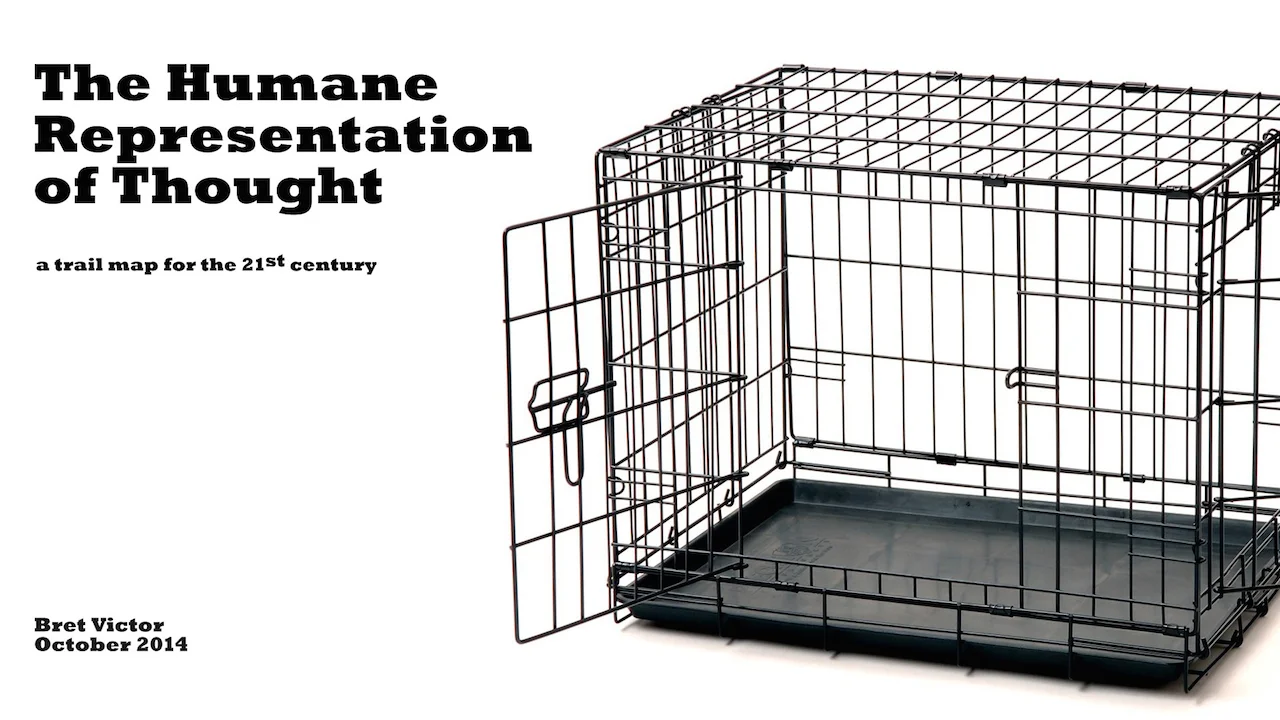
In October 2014 Victor presented The Humane Representation of Thought at UIST and SPLASH; the lab calls it its founding document. Its argument is that representations (Playfair’s 1786 plot of trade data, the first data graphic; place-value numerals; Heaviside’s recasting of Maxwell’s equations in vector calculus) put human capacities that tables of numbers leave idle to work. Screens are dynamic, he argued, but ignore hands and bodies, so a humane dynamic medium should live in the physical world.

SAP was the first parent to fail. Sikka left abruptly in 2014, a few months after the opening party; by early 2016, Tashian writes, the relationship had broken down and CDG needed a new home. Around then Victor told the group to build one system rather than separate projects, and some researchers who did not want that left. In May 2016 the lab moved into the Human Advancement Research Community (HARC), a nonprofit formed inside Y Combinator’s YC Research; Sam Altman, Tashian reports, paid for it out of pocket while other promised funding was pending. The anthropologist Götz Bachmann, then doing fieldwork in the lab, described HARC as an industry-financed lab for open and foundational research. Tashian and Bachmann are both listed by Dynamicland among its volunteers and collaborators, so neither is a disinterested witness.

Realtalk grew from the prototypes of 2016, by the lab’s account: La Tabla (Chaim Gingold and Luke Iannini), Token Table (Paula Te, Toby Schachman and Josh Horowitz), and another system that introduced “claims and wishes”. Victor wrote the Kernel, a distributed store through which processes share statements. By June 2017 the team had live-coded the core of the operating system together on a wall, and at first walking in front of the wall crashed the system, because it could no longer see its own code. The lab’s FAQ explains the model with a board game: each player holds a rulecard, “When you see this, say that.” In Realtalk, printed pages recognised by cameras notice things and make statements about them; a page may also wish that the world were different, that two objects be lit or an object move, and a projector or robot arm performs it. Realtalk does not track people. Everyone at the table sees the same objects and statements, and any page can be picked up and edited while it runs.

The lab’s archive credits Realtalk, in June 2017, to Victor, Toby Schachman, Paula Te, Josh Horowitz and Luke Iannini, with Virginia McArthur as producer (Tashian); Victor’s promotional bio says simply that he led the team that “invented Realtalk”. Two weeks before the group learned HARC was ending, Tashian reports, Realtalk had run for the first time, at about one frame a second. In July 2017 the funding stopped. Dynamicland’s own report says only that “our parent organization abruptly shut down”; Tashian says Altman defunded the lab and that it is unclear why, noting that a person close to Altman told him Altman’s excitement had shifted to OpenAI. That is one unnamed source. Dynamicland’s people page lists Altman among its special thanks.

2017–present

Oakland, a pandemic and a science lab

The group stayed in the renovated Old Oakland building, 469 9th Street, and raised its own money. Dynamicland’s 2019 report calls that year a fight to survive: tours for hundreds of potential funders, corporate workshops, fundraising dinners, membership schemes, ending with “enough ongoing support to mostly kind of survive. We were also burnt out.” It says the lab was funded by annually renewing corporate memberships (90 per cent) and individual donations (10 per cent). The space ran as a community workshop; the FAQ counts about a thousand participants and hundreds of projects before COVID, and the report catalogues five hundred projects made by local teachers, students, artists, scientists and others. Tashian, who first visited an early-2018 open house, wrote that Victor had left the Bay Area in autumn 2018 for a sabbatical to recover from the intensity of fundraising and managing the lab, and that “he seems tired”, a phrase Victor links from his own site.

The staff list is long and says nothing about who did what: Victor, Glen Chiacchieri, Toby Schachman, Chaim Gingold, Robert Ochshorn, Michael Nagle, Paula Te, Josh Horowitz, Virginia McArthur, Luke Iannini, Weiwei Hsu and Omar Rizwan, with five or six full-time at any moment. The archive credits particular projects: Te’s Beats of the World, a rhythm sequencer played with felt tokens; Rizwan’s Geokit, a wall-sized interactive map; Horowitz’s camera-projector autocalibration. Victor’s own 2019 anecdote shows the method. A visitor who led an infrastructure initiative for the company that owns the building described her work over lunch at a table where Geokit was laid out; he dealt a transit card to show Oakland bus routes, and she turned a “zoom-and-pan dial” to find a hole in West Oakland’s coverage she had never seen. He says the dial was assembled from parts: at a game jam someone wrote a card that claimed which way it faced, someone taped it to a turntable, and a visiting designer who “didn’t program” combined it with Geokit’s zoom lenses in an afternoon. It is one story, told by Victor.

Realtalk-2020, by Victor, Horowitz, Iannini and Rizwan according to the archive, rebuilt the system so that its insides could be seen. A process viewer shows a program’s heap growing when it allocates memory and its stack growing when it recurses; a struct viewer decoding bytes showed a gap that should not have been there, an off-by-one error caught by looking; Horowitz’s autocalibration can be acted out like a board game with cards. In 2020 the lab’s four people worked from home, each with a Dynalamp, a lamp-like projector unit that lights up whatever space is needed. By his 2021 letter it was “mostly just me and Luke”, which he called “a bit lonely”. The same letter says the Dynamicland Foundation had become its own 501(c)(3) after “seven years of ill-fitting corporate embeddings”, and that the Oakland space, mostly unused for two years, would be packed up when its lease ended in December 2021.

From 2022 the work moved into Shawn Douglas’s DNA-nanotechnology lab at UCSF. In Victor’s 2022 report, proteins were designed on the table, DNA origami blocks snapped together as three-dimensional scale models, test tubes showed what was inside them, and an analysis pipeline for simulated microscope images took a few pages of Realtalk written among the test tubes. When they first tried the pipeline, he says, Douglas said “I’m getting a bit emotional”, because apparently he could have saved a couple of years on an earlier project. Realtalk also went portable: Dynalamps and a small version on a Raspberry Pi travelled to London, Paris, Berlin and Somerville. A 2024 booklet made in collaboration with Douglas, The communal science lab, sets out the vision, and the latest dated entry we found in Dynamicland’s archive, Cloning Kit (January 2025), is Victor’s prototype environment for molecular cloning.

As far as its own pages say, Dynamicland is now an independent 501(c)(3) “supported entirely by donations and grants”. The next space, a “dynamic library” in Berkeley, is “not yet open to the public”, and the FAQ hopes to open it gradually in 2027; Realtalk-2024, with a language readable as prose, is in progress. Victor’s homepage says: “I am (now and forever) making Dynamicland.” We found no 2026 reporting, so those plans are the lab’s, not confirmed facts. The limits are mostly the lab’s own admissions. Realtalk cannot be downloaded and is “not a product”; a detailed account of how it works is promised after Realtalk-2024; the 2019 report says people need “significant amounts of hands-on time and coaching” to get it; the 2021 letter says there is no public presentation because “this thing is beyond my ability to present it”. The evidence is therefore mostly the lab’s videos, posters and letters, and accounts by people inside or near it. Victor is also blunt about machine learning: his homepage says “Do not talk to me about AI”, and the FAQ calls many generative tools “outsourcing understanding” in its most virulent form.
Talks & demonstrations

Essays to explore

Experiments & environments