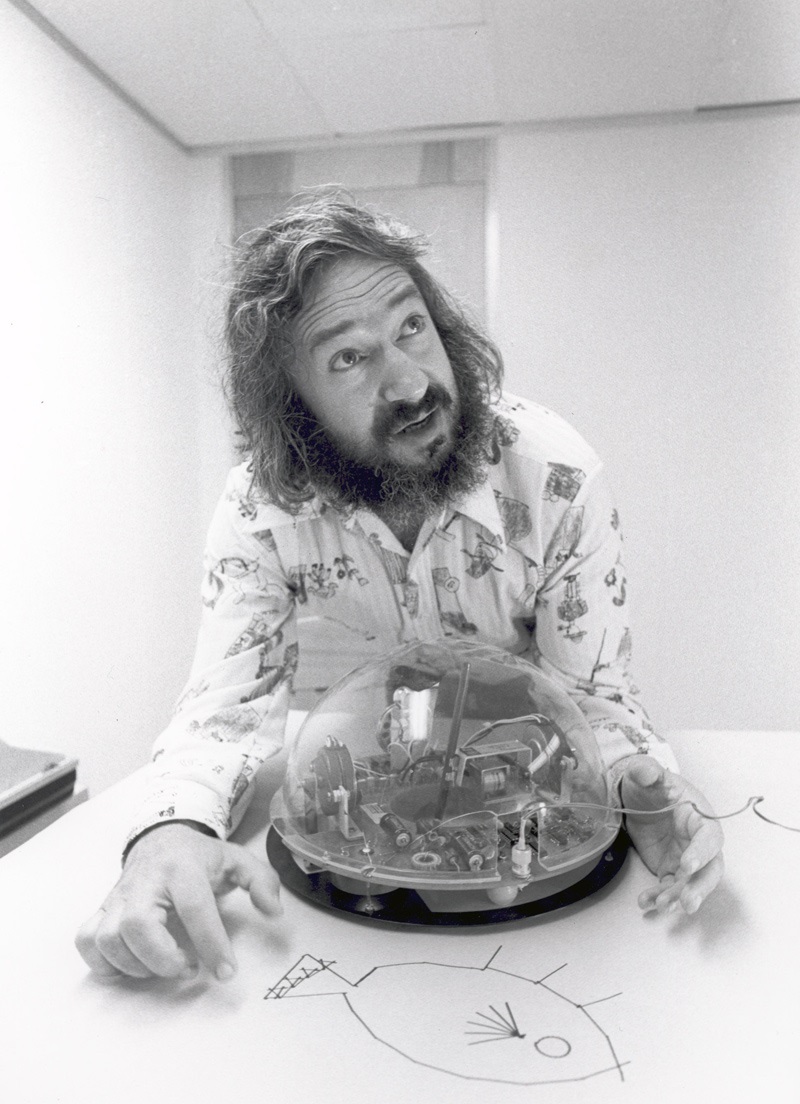
Portrait of Andy Matuschak.

Andy Matuschak

Patron-Funded Interface Researcher

Built iOS interactions at Apple, led R&D at Khan Academy, then left in 2019 to rethink reading. Quantum Country, Orbit and a public notebook, paid for by his Patreon members.

Mnemonic Medium
Questions in the text return after 5 days, then stretch toward 4 months.
Evergreen Notes
Atomic, densely linked notes revised for years, published as a notebook.
Garage Door Up
Posts half-built prototypes and what is not working to his patrons.

Andy Matuschak

Researcher in Tools for Thought & Learning

History of computing · The inquiry continues Start hereWhy Books Don’t WorkStart here because the essay states the problem behind Matuschak’s experiments: fluent reading can feel like understanding while leaving “a few sentences” behind. He admits it rests on intuition, since his literature review found no formal study. Quantum Country is the designed response you can try, and the 2019 Transformative Tools for Thought essay reports what its readers did.Read the essay

Andy Matuschak spent about five years on the iOS team at Apple, then led R&D at Khan Academy, and in early 2019 left salaried work to ask what might replace the book as a way of learning. Since then several hundred Patreon members have paid his living expenses while he publishes his experiments, his failures and much of his thinking notebook as they happen. The best known result is Quantum Country, a quantum-computing primer written with Michael Nielsen that quizzes you on a stretching schedule. This page follows what that experiment measured, what its authors say it did not, and how the research has changed since.

To about 2015

The engineer who designed sideways

By his own count Matuschak had been programming for about thirteen years, roughly two thirds of it on Apple’s platforms, when he joined Apple, and he spent roughly five years on the iOS team. He says he came to design “sideways, as an engineer”, and the projects he lists are interaction problems: the 3D page curl, multi-touch gestures, physics-based interface animation and gyroscope-driven parallax. David Perell’s introduction to an interview adds inter-app coordination. He recalls Craig Federighi sitting in his office to talk through gesture-recogniser heuristics, a detail Federighi cared about while, in Matuschak’s account, leaving most other software decisions to others.

He was good at it, and says so: “I was much better at what I was doing then than I am at what I’m doing now”, because the problems were well understood and other people decided what to build. Then a friend, Mills Baker, sent him David Deutsch’s The Beginning of Infinity, whose claim that any problem not forbidden by physics is soluble turned “what problems should I be working on?” into an urgent question. On the bus to Apple he would think, “What am I doing? What am I doing here? This is of no cosmic significance whatsoever.” He now calls that reaction unhealthy, though it “really shoved me onto a different track”. Writing in January 2024, he put the dissatisfaction more calmly: the work felt good day to day, but if someone else had done his projects, “the results would have been different, but not in a way that mattered”.

Before he quit, his plan was to save enough to pay himself a graduate student’s stipend from the interest, which he reckoned would take another five years. He was by then so uninspired by the work, he says, that waiting might have “done some permanent damage”.


2015–2019

A research lab inside a nonprofit

He moved to Khan Academy, where by his account his income fell by two thirds, and led its R&D group; published profiles variously say he co-founded it and co-led it. May-Li Khoe, who came over from Apple, led design, and Ben Kamens led engineering. The group’s public reports cover 2015–2018: open-ended online activities that give students rapid feedback by choreographing their ideas, expert-authored model work and light teacher facilitation (the long project, he told Russ Roberts, centred on AP Humanities); dynamic number toys; and sketches for a playful world of creative math.

One small habit he credits with changing the group’s thinking came from noticing that colleagues described teaching as something done to students. He and Khoe began repeating plans back with the student as the grammatical subject. In his example, “we’re gonna make the students understand this particular law by having them do this exercise” becomes “your plan is to make it possible for students to realise that there’s this relationship by you creating this particular context”. He believes the group moved from an instructionalist toward a constructivist outlook; that is his own assessment, and he adds that he “could have been a better leader at the time”.

The money was the sour part. Khan’s fundraising, he says, depended on a small number of huge-value donors, and the team would “regularly fret about appeasing them”. At the start of 2019, when he left, those fundraising experiences were, he wrote later, “still raw”.

2019

What comes after the book?

He and his wife made a rough plan: in 2019 do the work and do not think about funding; in 2020 find some way to last; by the end of 2021 stop burning cash. He had planned to live on savings from his Apple years, but a grant from Tyler Cowen’s Emergent Ventures (a couple of hours’ application, a half-hour conversation, a decision within days) covered his first year’s expenses instead.

The essay that stated the problem, Why Books Don’t Work, opens with a confession most readers will recognise: he has finished serious non-fiction and, asked a probing question in conversation, found he had absorbed “what amounts to a few sentences”. His diagnosis is that books, like lectures, rest on “transmissionism”, the notion that reading sentences transmits knowledge. Readers who do absorb a book are doing invisible extra work (asking questions, summarising, checking their own understanding) that the medium neither teaches nor supports. The essay is open about its footing: “my literature reviews have turned up no formal studies of this question, so I can only appeal to your intuition.” It is a design argument, not a measurement.

Why Books Don’t WorkStart here because the essay states the problem behind Matuschak’s experiments: fluent reading can feel like understanding while leaving “a few sentences” behind. He admits it rests on intuition, since his literature review found no formal study. Quantum Country is the designed response you can try, and the 2019 Transformative Tools for Thought essay reports what its readers did.Read the essay
2019

A text that quizzes you back

Quantum Country, by Matuschak and Michael Nielsen, looks like a long web essay. Its introductory essay, “Quantum Computing for the Very Curious”, takes about four hours to read and has 112 questions embedded in the prose; you make an account and are quizzed on each as you go. Every question then returns on a schedule that stretches when you answer correctly (five days, two weeks, a month and so on, reaching four months after five successful reviews) and steps back one level when you miss. Nielsen’s 2018 essay on long-term memory supplied the phrase for the aim: make memory “a choice” rather than luck. The authors write the questions so readers do not have to, and the guide Matuschak published in December 2020 says what he looks for in a good one: focused, precise, consistent, tractable and effortful.

Neither author claims the schedule teaches quantum mechanics. The target is narrower: a “tsunami of unfamiliar concepts and notation” that defeats many learners, which memory support can relieve, while “learning those subjects is about much more than memory”.

Quantum CountryAn experimental text that combines explanations of quantum computing with memory practice.Try the medium
2019–2020

Counting remembered answers

The authors’ October 2019 essay measures “demonstrated retention”: the longest gap between a successful review of a card and the review before it, summed across cards. After six repetitions most users sat near 6,000 days summed over the 112 questions, about 54 days per question, after roughly 95 minutes of review on top of about four hours of reading, which the authors call under 50% overhead. Six months after release, 195 users had demonstrated a month of retention on at least 80% of the cards. Matuschak’s later notes on the first-half-2019 cohort give two months of retention for about 90 minutes of review (35–50% overhead), suggest a more aggressive schedule may already have cut that cost by about a quarter, and record that 29% of readers who finished the in-text pass reached the one-month level.

The one controlled comparison in the essay is small. For eight cards, 25 users were barred from reviewing for two weeks while 16 reviewed as normal. Accuracy in the delayed group fell from 91% to 87%; in the regular group it rose from 89% to 96%, with 95% confidence intervals of roughly three to five points. The authors call it “small-but-promising” and note that the test ran two weeks on an earlier schedule and that other cards overlapping the delayed ones probably muted the effect.

They also retracted a finding. An early claim that deliberately trivial opening questions help readers notice they are not paying attention was withdrawn on 9 December 2019 as based on “an error in our data analysis”. All of these figures come from the authors’ own analytics of people who chose to keep reviewing; we have not seen an independent replication.

How Can We Develop Transformative Tools for Thought?A research agenda grounded in working experiments, open problems and the limits of earlier visions.Read the essay
2020–2024

Remembering is not understanding

Matuschak’s working notes are franker than the headline numbers. A note on the medium’s effect on memory says readers “reliably develop detailed retention for embedded questions”, then concedes the data are correlative and asks whether it is just survivorship: would readers who kept going have retained this material anyway? He sorts his hopes into four claims: you remember reliably if you finish the reviews; you would remember much less without them; it costs little time; and it generalises to other subjects. For Quantum Country he rates the evidence strong, emerging, moderate and, for generalisation, none.

Orbit, the platform he began building in March 2020 to study these questions, shows the cost of the approach. Nine months in he had “made little progress on those research questions” because he was mostly building, and he wrote that a fair criticism of his year was that he had “built a grand new observatory before I’d come close to exhausting what I could see” with the one he had. Orbit is public now (a repository under his name, last updated in October 2024) and runs the prompts embedded in his own writing guide.

The deeper problem is what a recalled answer proves. What we “really care about”, he writes, is “not just your ability to answer those specific questions, but how that practice affects your utilizable understanding of the topic.” In April 2024 his coarse impression, after several years of observation, was that knowledge reinforced by the mnemonic medium is “pretty brittle; doesn’t transfer very well”. The research he collects is mixed: one meta-analysis finds an average transfer effect of d = 0.4, while a classroom review leaves him thinking it is nearer 0.1–0.2 when questions are rephrased.

The Mnemonic MediumThe author’s running assessment of Quantum Country’s evidence, including what he thinks the medium does badly. Follow its links to the notes on effects on reader memory and on retrieval practice and transfer.Read the notes
2020–ongoing

Notes that keep growing

The second pillar of his practice is a way of taking notes. Evergreen notes, as he calls them, are written to evolve and accumulate across projects rather than to be filed after one. Each should be atomic (one idea), concept-oriented rather than tied to a source, and densely linked, with associative links preferred to folders and categories, and written for himself first. He acknowledges the debt to the Zettelkasten tradition (Niklas Luhmann’s slip box and Sönke Ahrens’s How to Take Smart Notes) and says the point is “better thinking” rather than better note-taking.

Unusually, he publishes the notebook itself: a densely linked public site, “mostly written for myself”, shared as an experiment in what he calls working with the garage door up. The price is that notes can baffle outsiders, and he states plainly that he has not made the underlying system available to anyone else.

Evergreen NotesA note about writing concept-oriented notes that accumulate through revision and links; best read inside the surrounding note system it describes.Explore the notes
2019–ongoing

A grant from several hundred strangers

Nielsen suggested setting up a Patreon, and Matuschak agreed, “not thinking much of it”. By the end of 2020 members had crowdfunded “roughly a graduate student’s fellowship grant”, on tiers of $5, $20 and $100, with most revenue coming from the $5 tier. That year his median monthly intake of new patrons was 9% against 3% leaving. By 2021, with about 650 patrons, growth had stalled at around three quarters of an NSF CAREER grant, because fewer new visitors were finding the page and he had published no attention-getting work.

He is unusually candid about why it works. He had saved heavily at Apple, owns his home, has a spouse with a stable career, no children and no debt beyond a mortgage, and he says outright that his path does not generalise. In January 2023 he wrote that he would not recommend Patreon to new creators because it locks members into its platform. In 2023 membership rose 18% while his income fell 5%, leaving him “somewhere between that of a postdoc and that of junior faculty”; most of the 2023 growth came from one podcast appearance, with Dwarkesh Patel.

Why not a startup or a university? He wrote that a startup’s drive is growth while he wants insight, and that academic human-computer interaction, in his view, rewards analysis over ingenuity, a judgement he calls “subjective and inflammatory” and says he would love to be wrong about. He also guards against the audience: members mostly say they pay to enable future work, and he tries to practise what Nielsen called “anti-marketing”, publicising what is confusing or not working.

Reflections on 2020 as an independent researcherThe fullest first-hand account of why he did not found a startup or join a lab, how the Patreon grew and churned, and which conditions made it possible. Its sequel, Three Years of Crowdfunded Research, follows in January 2023.Read the letter
2022–ongoing

Sitting beside one reader

By late 2022 he felt his experiments had drifted from the aim. He “could tell you plenty about forgetting curves and usage patterns—but very little about how those things connected to anything anyone cared about.” In 2023 he swapped surveys and telemetry for sitting beside individual learners for hours with one-off prototypes made for them. The first weeks taught him more than all of 2022, he says, including a hypothesis that consumed the year: “what seems like a problem of forgetting is sometimes a problem of reading comprehension—never having understood in the first place—and we can’t reliably tell the difference.” He grants that this is not rigorous research as the word is usually used: it gains discovery and loses generality.

He now works with others. Matthew Siu, the winner of his research fellowship, spent an afternoon a week with him from February 2023 on a project neither had planned, and Derrek Chow worked weekly with him on BookBridge, a prototype prompt Matuschak suggested.

In July 2024 he wrote that he wanted to “exorcise” himself of the Primer, the interactive schoolbook in Neal Stephenson’s The Diamond Age, which he calls his field’s most canonical vision and came to see as “fundamentally unworkable”. In March 2026 he told MIT’s HCI seminar that coding agents might help break two “accidental tyrannies”, the one-size-fits-all app and programming as a specialism. His site, checked on 9 October 2026, says that as of late 2025 he is on “para-academic leave”, helping make Pico, “a conservatory for human attention”, while remaining Patreon-funded. It does not say what Pico is, and the public site at withpico.com showed only a four-line list of feelings at a funeral, so this page describes the project no further.

In Praise of the Particular, and Other Lessons from 2023Why he moved from large experiments to single-user studies, what that cost in rigour and what it gained; also notes on collaboration, focus and the 2023 crowdfunding numbers.Read the letter

Essays & guides

Experiments & working notes

In conversation