The lagoon on Lesbos
After Plato died, Aristotle left Athens for Assos in Asia Minor, where Hermias was his host and patron, and married Pythias, a niece of Hermias. There he began research on marine animals. After about three years he moved to the nearby island of Lesbos and worked with Theophrastus, who later became his successor: broadly, Aristotle took the animals and Theophrastus the plants. Their collaboration is one of the founding partnerships of biology.
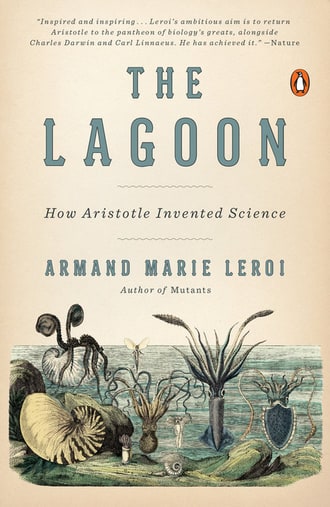
The animal books show the method in use. Aristotle, or people working under his direction, dissected a wide variety of animals; the treatises refer to diagrams that are now lost. He consulted bee-keepers, fishermen and sponge divers, and he usually says who said what. In the History of Animals, fishermen call the starfish “a great pest in the Strait of Pyrrha”; a sea urchin from the same straits is best eaten in winter. On the octopus he reports that “some assert” the male has a sexual organ in one tentacle, and that fishermen name it so, while keeping the claim at arm’s length. He followed a chick in the egg day by day: on the fourth day the heart appears as a small blood-spot.
How much was done on Lesbos is a scholarly question, not a settled fact. In 1948 H. D. P. Lee set Werner Jaeger’s late dating of the zoology against D’Arcy Thompson’s view that it belonged to Aristotle’s middle years; the research probably continued at the Lyceum. A 2018 survey in Mediterranean Marine Science finds his marine groupings arranged on at least three levels, many of them still matching modern classes, with names that passed into scientific nomenclature. The Loeb volume gives these books in Greek with Peck’s English.