Darwin’s most famous idea grew from a habit of returning to a puzzle. A bird collected on one island, a barnacle dissected at his desk, an orchid touched by an insect: each could unsettle an easy account of how living things came to be.
1809–1831
Learning to notice
Darwin grew up in Shrewsbury with an appetite for collecting. Medicine at Edinburgh did not become his profession, but its natural-history circles mattered. John Edmonstone, a formerly enslaved naturalist from Guyana, taught him taxidermy; at Cambridge, the botanist John Stevens Henslow encouraged his field interests. A geological trip through Wales with Adam Sedgwick in 1831 supplied practical field training just before the Beagle invitation.
Henslow recommended him for the voyage. Darwin sailed as a self-funded gentleman companion to Captain Robert FitzRoy, with room to collect and study. His later authority did not spring from solitary genius on a ship: teachers, sailors, local informants, collectors and specialists all shaped what he could see and make of it.
1831–1836
A voyage full of questions
The Beagle surveyed coasts while Darwin spent long stretches ashore gathering rocks, fossils and living specimens. In South America, extinct mammals resembled living animals nearby; in the Galápagos he noticed mockingbirds differing between islands. He did not arrive home with natural selection in hand. The place labels on specimens and the later work of ornithologist John Gould helped turn those observations into a sharper question about whether species were fixed.
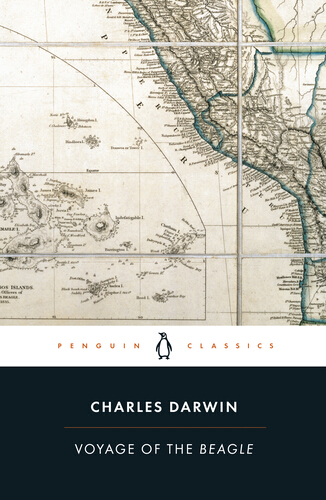
The Journal of Researches, published in 1839 as part of FitzRoy’s voyage account and later known as The Voyage of the Beagle, lets the reader meet Darwin before the famous theory. Follow his movement from description to comparison. The land and its people are present too, though the travel book is written from a British imperial expedition and should be read with that setting in view.
Back in Britain, Darwin opened his transmutation notebooks. His 1837 branching sketch asked how related forms might split and disappear over generations. In 1838, reading Thomas Malthus on population helped him frame a mechanism: more organisms are born than can persist, and inherited variations that help reproduction can become more common. He sketched the idea in 1842 and expanded it in 1844, while continuing to gather objections and evidence.
He married Emma Wedgwood in 1839; they moved to Down House in 1842, where family life and scientific work overlapped. Darwin also spent years on barnacle anatomy and classification. The close study of variation within a difficult group disciplined his eye for the boundary between varieties and species. Frequent illness limited his working hours, but neither the cause nor the timing of publication can be reduced to a simple illness story.
The branching sketch on page 36 of Notebook B, 1837. Above the diagram Darwin wrote “I think”; below it he considered how related forms and extinction might fit together.
Source & credits
Charles Darwin, Notebook B, page 36. Public-domain manuscript reproduced via Darwin Online and Wikimedia Commons.
Down House became a working laboratory: pigeons, seeds and garden plants supplied tests, while letters brought observations from around the world. Alfred Russel Wallace independently reached a theory of natural selection in the Malay Archipelago and sent Darwin an essay in 1858. Charles Lyell and Joseph Dalton Hooker arranged a joint presentation of Wallace’s essay with extracts from Darwin’s earlier writings at the Linnean Society. Wallace deserves credit as a co-discoverer, not a footnote to Darwin’s book.
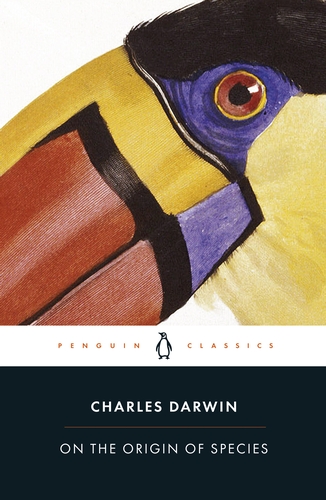
On the Origin of Species followed in 1859. Its opening move is wonderfully practical: breeders can accumulate inherited differences in pigeons and other domestic organisms. Darwin then asks what happens when the selecting conditions are survival and reproduction in the wild. No one example proves the whole account; he combines variation, struggle, distribution, fossils and classification into a historical explanation that invites further tests. Begin with the first four chapters, then follow the geographical argument in chapters 11 and 12.
After Origin, Darwin did not simply defend a thesis. In his 1862 orchid book he examined the fit between flower structures and visiting insects: pollen could be lifted, carried and placed on another flower by a sequence of movements. The intricate apparatus became evidence to explain through inherited change and selection, rather than a finished ornament to admire.
Botanical work depended on growers, specimens and correspondents beyond Down House; Emma and the children also helped sustain the household and its experiments. Reading the orchid book after Origin reveals how Darwin tested a broad account against stubborn details. It also shows a limit of the 1859 book: he did not yet know the later genetic explanation of inheritance, and some proposed mechanisms in his own writing did not endure.
The Descent of Man applied common descent to humans and developed sexual selection; The Expression of the Emotions used observation, questionnaires and photographs to compare people and other animals. Darwin argued against slavery and for the unity of humanity, yet Descent also carried Victorian hierarchies of race and sex. Those claims need historical scrutiny rather than automatic transfer into modern biology.
His later books kept narrowing the distance between grand theory and small trial: sundew leaves, the two floral forms of primroses, and plant movements studied with his son Francis. In 1881 he turned to earthworms, measuring how their repeated castings help make soil and bury stones. That final book is a second, charming entry point. Its scale is the point: unshowy actions, multiplied through time, can remake a world.
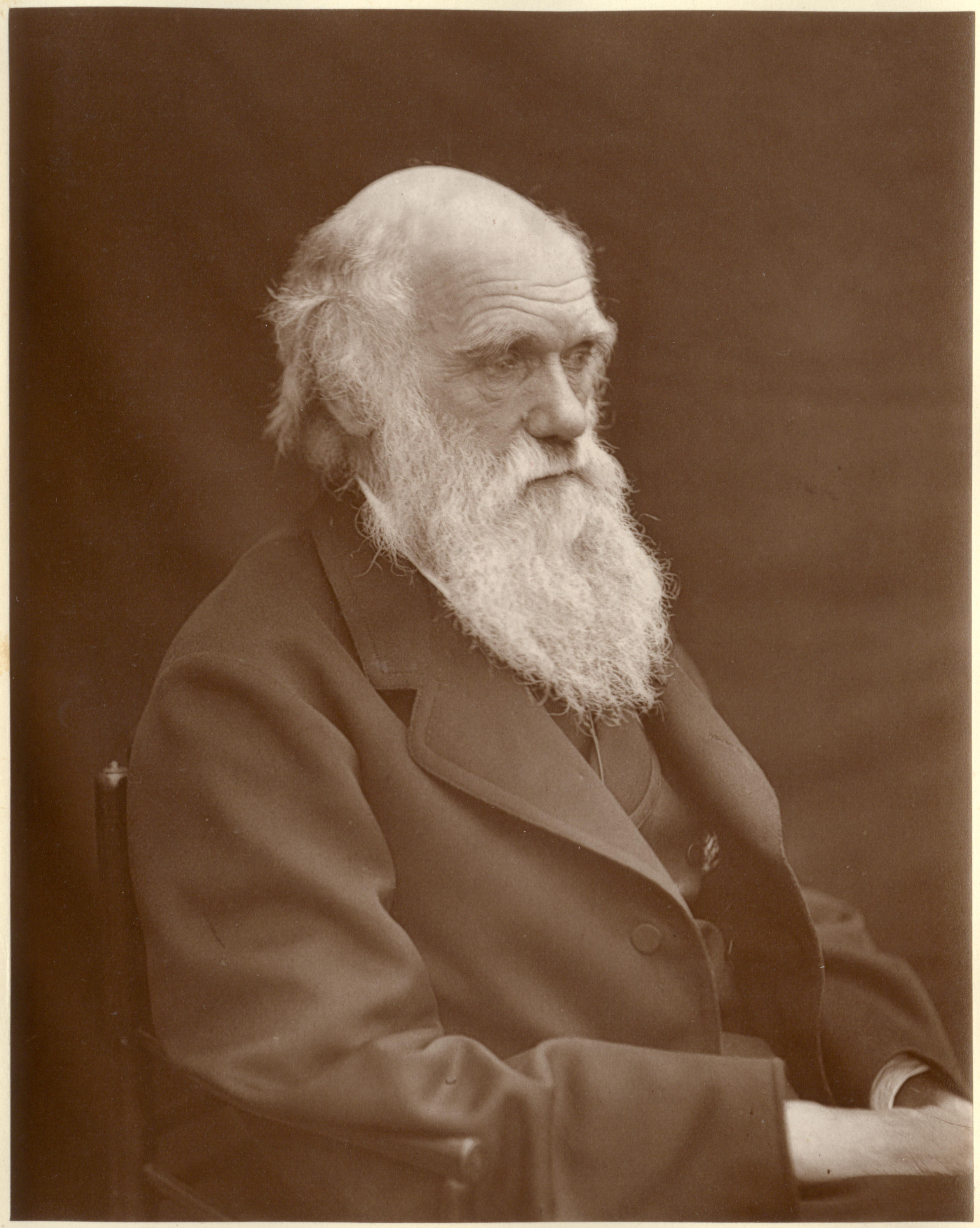
Julia Margaret Cameron photographed Darwin around 1868, between his orchid investigations and the publication of Descent. This carbon print was made in 1875.
Source & credits
Julia Margaret Cameron; Art Institute of Chicago, Alfred Stieglitz Collection. Public domain.