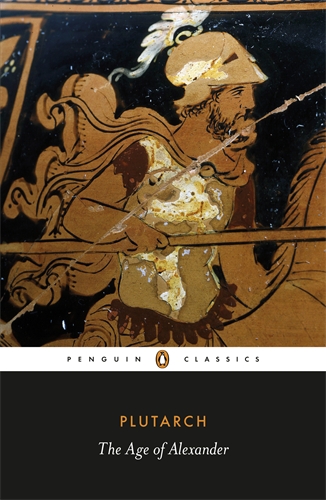
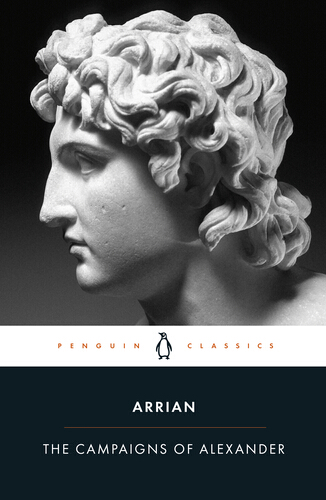
Alexander left no book, and no memoir. The histories we can read were written centuries after his death from eyewitness accounts that are now lost. Read side by side, they show a commander of unusual technical and logistical imagination, and a conquest that razed cities, sold their people into slavery and killed his own friends. Start with Plutarch, who says plainly that he is writing a life, not a history.
356–336 BC
A Macedonian education
Alexander was born in the summer of 356 BC, probably at Pella, to Philip II of Macedon and Olympias. Philip was making Macedon the strongest power in the Greek world, and his son grew up among its cavalry, its court rivalries and its plans for Asia. Plutarch’s best-known childhood story is a small lesson in looking closely: when no one could manage the horse Bucephalas, the boy saw that it shied at its own moving shadow, turned it toward the sun and calmed it. Plutarch tells it to reveal character. It is not an eyewitness record.
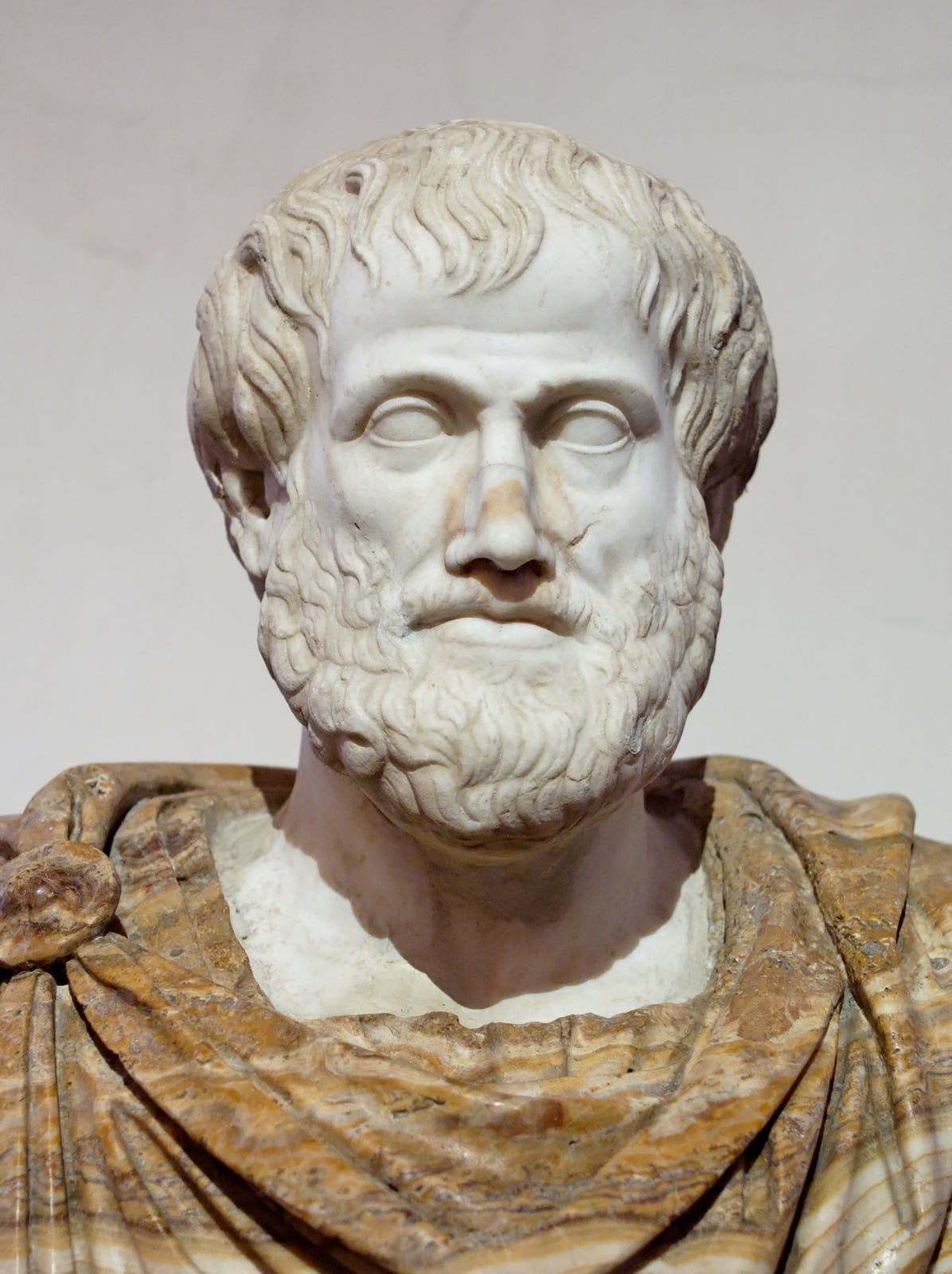
Between 343 and 340 BC Aristotle was his teacher. Plutarch says Philip gave master and pupil the precinct of the Nymphs at Mieza, where visitors in Plutarch’s day were still shown Aristotle’s stone seats and shady walks. Citing the lost memoirs of Onesicritus, he adds that Alexander kept Aristotle’s edition of the Iliad with his dagger under his pillow. At sixteen Alexander governed Macedon while Philip campaigned against Byzantium. In 338 he led a charge on the Macedonian left at Chaeronea, where Athens and Thebes were beaten. In October 336 Philip was murdered by one of his own guards in the theatre at Aegae. Plutarch records that suspicion fell mainly on Olympias, and partly on Alexander. At twenty, Alexander was king.
Philip’s death set off revolts. When Thebes rose in 335, Alexander took it by storm. Plutarch says the city was plundered and razed. The priests, the Macedonians’ guest-friends, the descendants of the poet Pindar and those who had voted against the revolt were set apart; more than thirty thousand other people were sold into slavery, and over six thousand had been killed. Plutarch’s explanation is calculation: Alexander expected the other Greeks to be terrified into quiet, and he was also pleasing Thebes’s Greek enemies, who had denounced the city.
In 334 the army crossed into Asia. Arrian has Alexander lay a garland on the tomb of Achilles at Troy, and adds, as hearsay, that Hephaestion did the same for Patroclus. At the Granicus river that June, Plutarch has a Persian commander’s battle-axe shear the crest from Alexander’s helmet before Cleitus, called the Black, killed the attacker with his spear. It is a debt that returns six years later. In November 333, at Issus, Alexander defeated the Persian king Darius III in person.
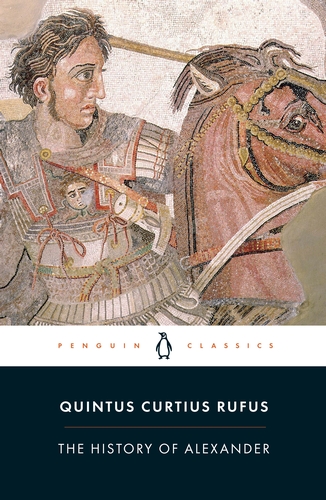
The most famous picture of the war was made more than two centuries later: a floor mosaic from a house in Pompeii, generally taken to copy a lost Hellenistic painting and conventionally identified with Issus. Alexander rides in bareheaded from the left; Darius looks back from a chariot already turning to flee. Read it as an ancient interpretation, not a record.
Alexander Mosaic (Naples National Archaeological Museum, inv. 10020)c. 100 BC; photographed 2013
The Alexander Mosaic from the House of the Faun, Pompeii, about 100 BC. A Roman-period floor mosaic after a lost earlier painting; it is not a portrait from life.
Source & credits
Berthold Werner / Wikimedia Commons; proportionally resized, full frame retained
After Issus Alexander went south along the coast instead of pursuing Darius inland, taking the Phoenician ports whose ships served Persia’s navy. Tyre refused him. It stood on an island ringed by high walls, and while Persia held the sea it could be neither starved nor stormed. Arrian describes the response: a mole driven out from the mainland, built of stone and timber, with stakes fixed in the mud. Near the shore the work went quickly. In deeper water, about three fathoms by the city, the builders came under fire from the walls and from Tyrian warships. The Macedonians raised two towers with hide-covered engines at the head of the mole; the Tyrians sent a fireship packed with dry wood, pitch and sulphur against them and burnt them.
What decided the siege was the sea. With their home cities in Alexander’s hands, the kings of Aradus and Byblos brought their ships over to him, about eighty Phoenician vessels in all, and the kings of Cyprus followed with about 120 more. With a fleet Alexander could blockade the harbours and bring engines against the walls from ships as well as from the widened mole. Tyre fell in July 332 after a siege of about seven months. Arrian gives about 8,000 Tyrians killed in the final assault and about 30,000 captives, citizens and mercenaries, sold into slavery; those who had taken refuge in the temple of Heracles, including the king, were spared.
In Egypt he made the desert journey to the oracle of Ammon at Siwa and, in April 331, founded Alexandria. The tie he claimed with Ammon lasted: Cleitus would later taunt him with it, and on his successors’ coins he wears the god’s ram’s horn.
Darius chose the ground for the next battle, at Gaugamela, on a plain some distance from Arbela. Arrian gives the Persian reasoning: Darius had been persuaded that Issus was lost because the field was too narrow, so the plain was levelled for scythed chariots and cavalry. Arrian also preserves Alexander’s answer in his dispositions. Behind the front stood a second line, ordered to face about if the Persians got round the flanks. Detachments of archers and Agrianian javelin men were posted at an angle to the line, and the mercenary cavalry in front of the right wing had orders to strike the flank of anyone who rode round it. Light troops stood before the Companion cavalry to meet the chariots, and men opened their ranks to let some pass through, where grooms and guards dealt with them.
On 1 October 331 Alexander led his right obliquely farther to the right, almost off the cleared ground. Darius, afraid his chariots would be useless on rough ground, sent horsemen to ride round and stop the movement. As more Persian cavalry left the line to join that fight, a gap opened. Alexander formed the Companions and part of the phalanx into a wedge and drove through it toward Darius, who, Arrian says, was the first to turn and flee. Arrian records Darius’s motive but not Alexander’s; what his narrative shows is a march that threatened to take the battle off the prepared field and pulled Persian horsemen out of their line.
Victory turned the problem from fighting to governing. At Babylon Alexander ordered the temples Xerxes had destroyed to be rebuilt and made Mazaeus, a Persian who had commanded against him at Gaugamela, governor, with a Macedonian general over the garrison and a separate official collecting revenue. At Persepolis in 330 he appointed another Persian governor, then burnt the royal palace. Arrian says Parmenio advised against destroying what was now Alexander’s own property; Alexander answered that it was revenge for the Persian burning of Athens; and Arrian judged the act neither prudent nor real punishment of the Persians who had done it. Diodorus, from a different tradition, describes a drunken victory feast at which the Athenian Thaïs proposed the fire. The sources do not reconcile the two versions.
Darius was murdered by his own commander Bessus in July 330 as Alexander closed in. Alexander now presented himself as the Persian king’s successor, wearing elements of Persian dress and campaigning for nearly three years in Bactria and Sogdiana. The strain showed inside his own command. In late 330 Philotas, commander of the Companion cavalry and son of the senior general Parmenio, was convicted of failing to report a plot and killed. Alexander then sent letters to the generals in Media, and they put Parmenio to death. Arrian suggests two possible reasons without choosing between them.
In autumn 328, at a drinking party, verses were sung ridiculing Macedonian generals recently beaten in battle. Cleitus, the man who had saved Alexander’s life at the Granicus, objected. In Plutarch’s account he reminded the king of that day, accused him of disowning Philip to call himself son of Ammon, and told him to live among barbarians and slaves who would bow to his white tunic and Persian girdle. Friends pushed Cleitus out; he came back by another door, reciting Euripides. Alexander seized a spear from a guard and ran him through, then, Plutarch says, tried to turn it on himself and was stopped by his bodyguards.
In 327 he married Roxane, the daughter of the Bactrian noble Oxyartes, whose family had been captured on a Sogdian mountain stronghold. He also tried to make Greeks and Macedonians perform proskynesis, the bow or prostration Persians offered their king. Callisthenes, the court historian and a relative of Aristotle, refused, and Plutarch credits that refusal with ending the attempt. After a conspiracy among the royal pages Callisthenes was arrested. Here two lost eyewitnesses visibly disagree: Aristobulus said he was carried in chains until he died of illness; Ptolemy said he was tortured and hanged. Arrian, who trusted both men, remarks that even they could not agree about events so well known.
In 326 Alexander fought and defeated the Indian king Porus at the Hydaspes river. At the Hyphasis that July the army would go no farther. Arrian gives the moment to the officer Coenus, who broke a long silence to speak for exhausted men; the speech is Arrian’s composition, as ancient historians’ speeches usually were. Alexander withdrew to his tent for three days. When the army did not change its mind and the sacrifices for crossing proved unfavourable, he announced the return.
In 325 he sent the fleet along the coast under Nearchus and led much of the army west through the Gedrosian desert. Nearchus, quoted by Arrian, gives two reasons: to outdo the legendary failures of Cyrus and Semiramis there, and to keep supplies near the fleet. The march went inland, by night, far from water. When starving guards broke the royal seal on grain meant for the ships, Alexander pardoned them once he learned why. Heat and thirst destroyed a great part of the army and most of its animals.
At Susa in 324 Alexander married Darius’s eldest daughter and, according to Aristobulus, a daughter of an earlier Persian king, and gave about eighty of his Companions brides from Persian, Median and Bactrian noble families, all in Persian-style ceremonies. Then 30,000 young Asians, trained and armed in the Macedonian way and called the Epigoni, “successors,” arrived. Arrian calls the weddings popular in one passage and in another says most Macedonians resented them, along with the Epigoni and the king’s Median dress. At Opis, when Alexander announced the discharge of veterans unfit for service, the army shouted that he should send them all home and campaign with his father Ammon. He had thirteen men taken away for execution, shut himself in for two days, then began giving Persians the army’s commands. The Macedonians threw down their weapons at the palace gates and begged to be let in. The reconciliation ended in a banquet at which, Arrian says, Alexander prayed for harmony and shared rule between Macedonians and Persians.
That autumn his closest friend Hephaestion died of fever at Ecbatana. Arrian notes that accounts of Alexander’s grief varied with each writer’s goodwill or envy toward the two men. Plutarch says the doctor was crucified, music was silenced, and the Cossaean people were attacked and slaughtered as “an offering to the shade of Hephaestion.” The sources repeat the comparison with Achilles and Patroclus; they do not settle what kind of relationship it was.
Alexander died at Babylon on 11 June 323 BC, aged thirty-two; a Babylonian astronomical diary records the king’s death beside its observations of the sky. Plutarch and Arrian both summarise court journals describing a fever that grew over about ten days, until his soldiers filed past his bed. Rumours of poison followed. Plutarch says no one suspected it at first; Arrian lists the stories, including one that implicated Aristotle, only so he will not seem ignorant of them. Justin’s Roman epitome states the poisoning as fact. Modern writers have proposed illnesses; these accounts cannot prove any single cause.
None of the eyewitness histories survives. Callisthenes, Ptolemy, Aristobulus, Nearchus and Onesicritus all wrote, and their books are lost; so is the vivid, darker history Cleitarchus finished at Alexandria a generation later. What we read was composed long after: Diodorus in the first century BC, Curtius in the first century AD, Plutarch around AD 100, Arrian in the second century, and Justin’s epitome later still. Arrian trusted Ptolemy partly because, as a king, he would be more ashamed to lie. That is worth weighing: Ptolemy also had a kingdom and a reputation to build.
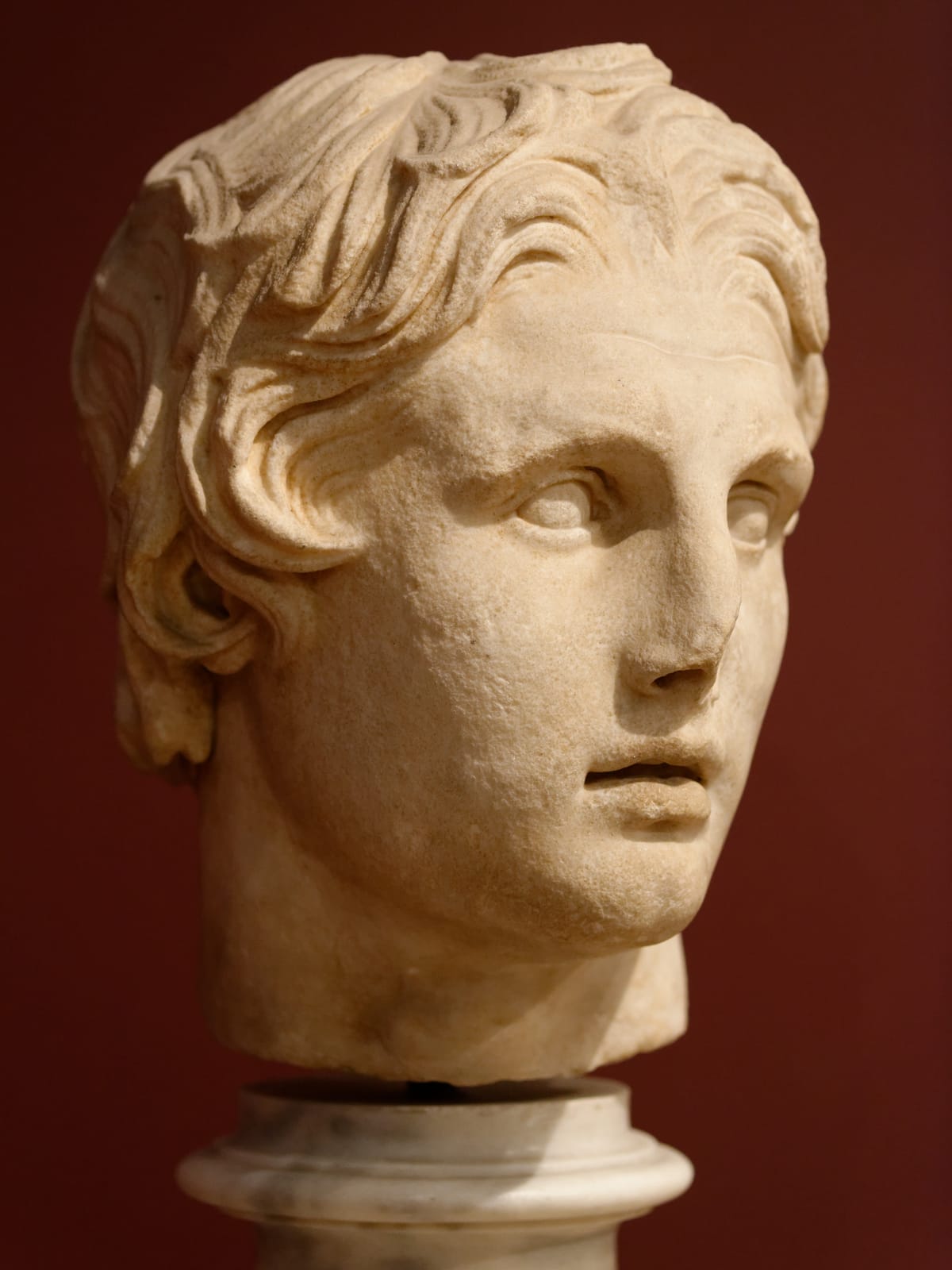
Alexander’s successors put his image to work. Lysimachus, once one of his bodyguards and later king in Thrace, struck silver coins around 297–281 BC showing Alexander with the ram’s horn of Ammon. Like the marble head on this card, it is a likeness made after his death. Lane Fox’s and Cartledge’s biographies are the best modern ways to see how historians weigh these scattered witnesses.
Tetradrachm of Lysimachus (Museum der Universität Tübingen)c. 297–281 BC; photographed 2020
Obverse of a silver tetradrachm struck for Lysimachus, c. 297–281 BC, probably at Lampsakos: Alexander with the ram’s horn of Ammon. A posthumous royal image, not a portrait from life.
Source & credits
ArchaiOptix / Wikimedia Commons; proportionally resized, full frame retained