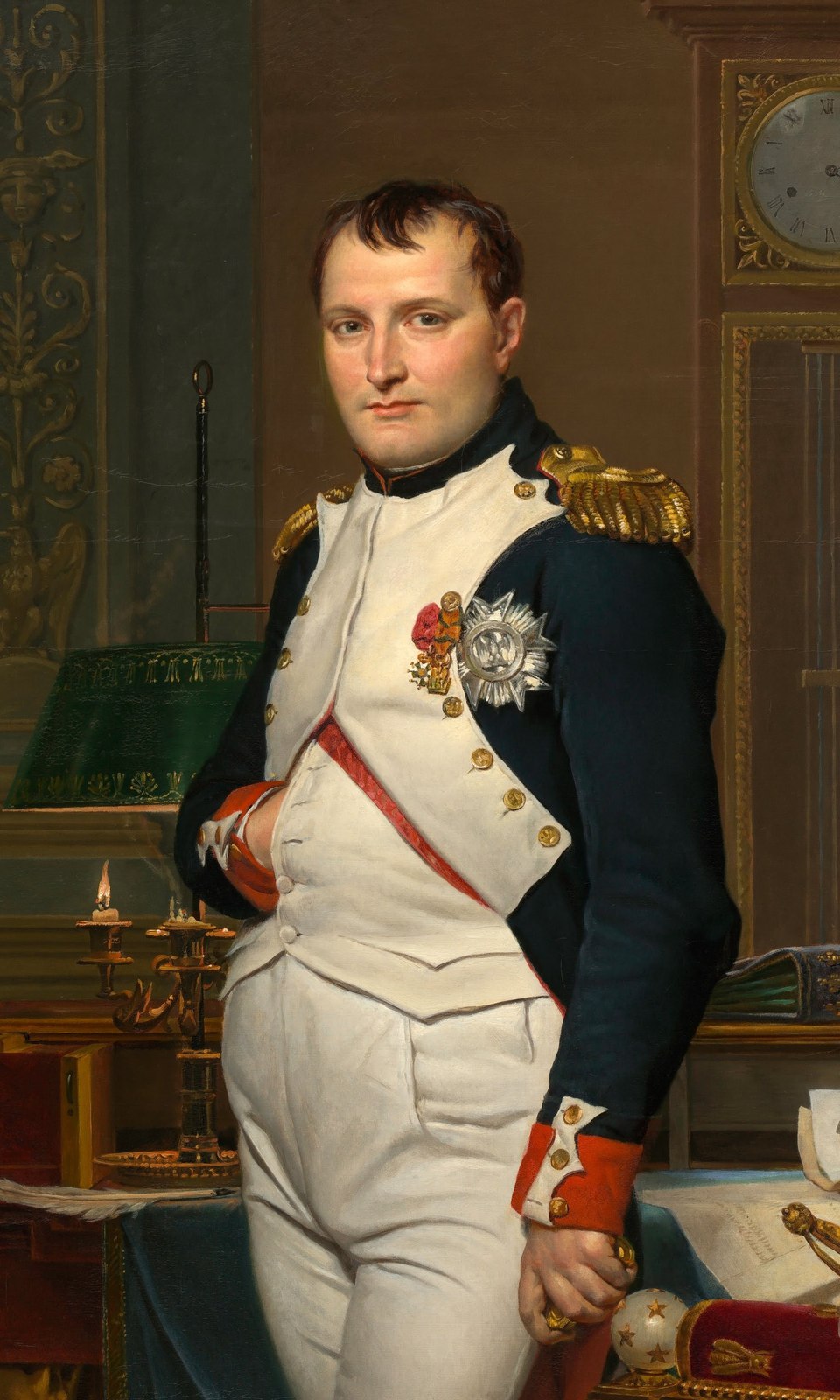
Napoleon could make a scattered army converge on a decisive point and make a fractured state answer to a new administrative order. Following the movements of his corps and the making of the Civil Code reveals an extraordinary organising mind. It also reveals the limits of that ambition: institutions endured, while conquest and colonial policy imposed devastating costs.
1769–1795
Corsica and the Revolution
Born in Ajaccio shortly after France acquired Corsica, Bonaparte trained in French military schools as an artillery officer. The Revolution opened careers that had been more tightly tied to birth, while its factional conflicts also made military authority politically valuable. At Toulon in 1793 he gained notice in the campaign against a royalist and British-held port.
His relation to Corsican politics shifted as the island’s struggles intersected with the French Revolution. By 1795 he had become a general connected to the Directory’s survival. The future ruler emerged from a revolutionary army and a fragile republic, not from a straightforward rise outside politics.
1796–1799
Campaigns make a political figure
Commanding the Army of Italy, Bonaparte used rapid movement and concentration of force to defeat Austrian and allied armies in 1796–1797. The campaign also involved requisition, negotiation and the creation of dependent republics. Its propaganda fashioned victories into a personal political identity while the costs were borne in occupied territories.
The 1798 expedition to Egypt joined military ambition to an organised scholarly mission, but it was an invasion met by resistance. The destruction of the French fleet at the Nile changed its prospects. Bonaparte returned to France in 1799, leaving an army behind. Read the campaign dossier with the Egyptian revolt and the British naval victory in the same frame as the scholars’ publications.
The coup of 18 Brumaire in November 1799, made with political allies including Emmanuel-Joseph Sieyès and backed by troops, ended the Directory. As First Consul Bonaparte concentrated executive power and built a more uniform administration through prefects, schools and fiscal institutions. Elections and assemblies continued in constrained form; censorship and police surveillance shaped public life.
The Civil Code of 1804 unified much private law across France and protected property and civil equality among men in significant ways. It was drafted by jurists including Jean-Étienne-Marie Portalis, François Denis Tronchet, Félix-Julien-Jean Bigot de Préameneu and Jacques de Maleville, then debated and promulgated under Bonaparte. The code also entrenched the husband’s authority within marriage and restricted married women’s legal independence. Its institutional achievement and hierarchy are legible in the same text.
The 1794 revolutionary abolition of slavery had not taken effect uniformly across French colonies. Bonaparte’s 20 May 1802 law maintained slavery where it remained, while further measures restored it where abolition had occurred. The expedition sent to Saint-Domingue sought to reassert French control against the autonomy built under Toussaint Louverture; Haitian resistance ultimately secured independence in 1804. Colonial violence is central to the story of the Consulate, not an afterthought to reform.
Napoleon crowned himself emperor in 1804. In the following campaign he organised seven army corps under commanders including Davout, Soult and Ney. Their converging movements surrounded the Austrian army at Ulm. At Austerlitz on 2 December 1805, he watched Allied troops descend from the Pratzen Heights and sent Soult to seize the weakened centre. The campaign is an unusually clear way to study timing, routes and the concentration of force through the work of named commanders.
Victory expanded a system of allied, client and annexed states carrying French legal and administrative forms. It also demanded conscription, requisitions and political control. The same organisation that could concentrate an army depended on resources extracted from the places through which it moved.
The war in Spain and Portugal became prolonged and brutal, with local resistance and British intervention draining French strength. In 1812 Napoleon invaded Russia with a multinational Grande Armée. Battle, disease, supply failure and retreat destroyed much of it; civilians as well as soldiers suffered across the campaign.
Coalition forces entered Paris in 1814 and Napoleon abdicated. He returned from Elba in 1815, ruled during the Hundred Days and lost at Waterloo. His final exile on Saint Helena became another arena of memoir and mythmaking. The Code’s afterlife is real, but it should not turn the years of war into a footnote to a state-building success.
On Saint Helena, Napoleon and those around him shaped accounts of his rule for future readers. Memoir claims from exile need comparison with laws, correspondence, administrative records and the experiences of people his armies and institutions governed. He died there in 1821.
The contradictory record is the point of the biography: equality before some laws and authority over wives; professional advancement and censorship; administrative durability and catastrophic war; revolutionary inheritance and the restoration of slavery. Reading the 1804 code alongside the 1802 colonial law gives a firmer start than the legend of a solitary genius.