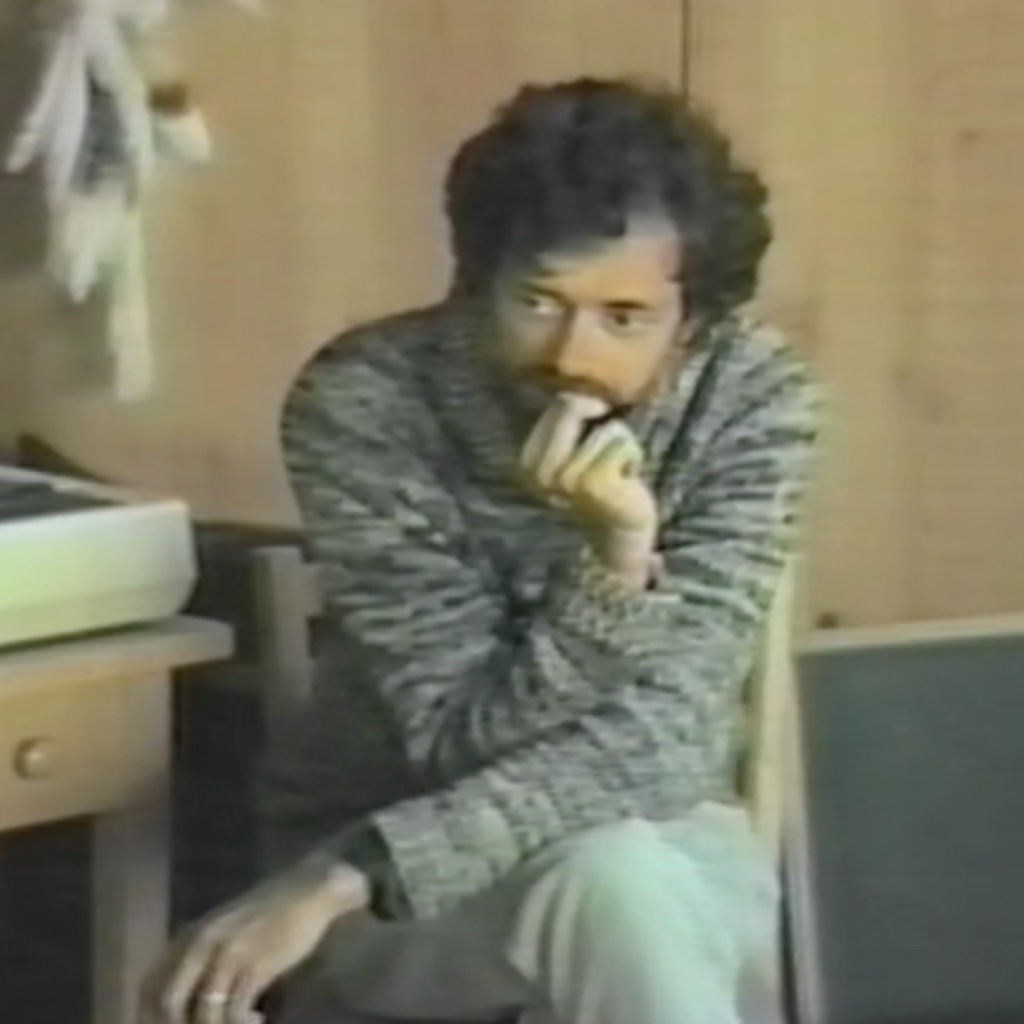
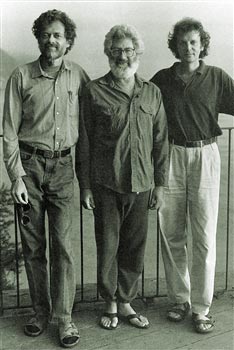
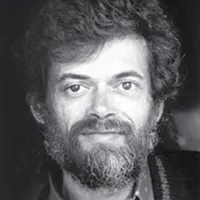
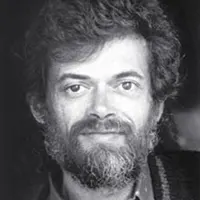
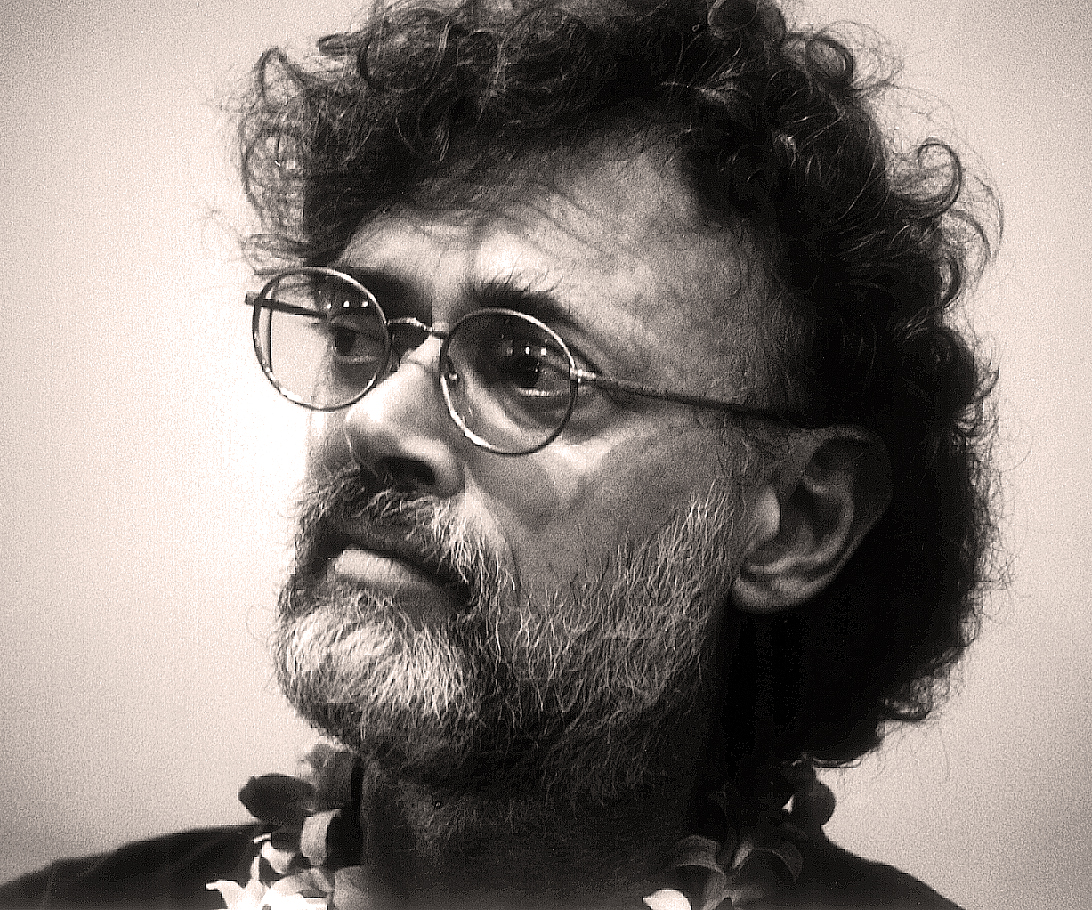
Terence McKenna with round glasses and a beard, photographed by Jon Hanna in 1999.

Terence McKenna

Mushroom Bard & Psychedelic Talker

Ex-hashish smuggler who co-wrote the guide to growing magic mushrooms at home, smoked cannabis daily for 35 years and lectured ravers toward a 2012 end of history that never came.

Heroic Dose
Five dried grams of psilocybin mushrooms, alone, in silent darkness.
Machine Elves
Smoked DMT and came back describing self-transforming machine elves.
Stoned Ape
Argued mushroom-eating primates out-bred their rivals into language.

Terence McKenna

Psychedelic Talker, Mushroom Grower & Ethnobotanist

Start hereThe Archaic RevivalRead chapter 3, “Tryptamine Hallucinogens and Consciousness”, then play the Esalen recording “Tryptamine Hallucinogen Consciousness” on the audio shelf: the machine-elves passage survives almost word for word, so you can hear how much of the spell is delivery. (Esalen’s archive dates the recording December 1982; the book’s note says December 1983.) Then pair chapter 10, “Mushrooms and Evolution” (1988), with the 1991 lecture “Mushrooms, Evolution, and the Millennium” for the stoned-ape argument in print and in his own voice.Explore book

Terence McKenna smuggled hashish, co-wrote the manual that put psilocybin mushrooms in American closets, smoked cannabis every day for thirty-five years, and became the most quoted psychedelic speaker of the late twentieth century. He told audiences to take five dried grams in silent darkness, described the “self-transforming machine elves” he met on DMT, and argued that mushrooms turned apes into talkers. Some of it was serious ethnobotany, much of it was superb performance, and two of his grandest ideas, the stoned ape and the 2012 Timewave, failed the tests they invited. This page keeps all three in view.

1946–1965

Beetles, butterflies and the west slope

Terence McKenna was born on 16 November 1946 in Paonia, a small town on what he called “the west slope of Colorado”, where the Fourth of July was Cherry Day and the visiting carnival was the nearest thing to the uncanny. He hunted fossils and collected beetles and butterflies. Looking back in 1989 he called it “this pursuit of iridescence” and said, “I was psychedelic long before I knew anything about psychedelics.”

The reading came early and strange: Jung’s Psychology and Alchemy at fourteen, Aldous Huxley’s The Doors of Perception and Heaven and Hell, and the 1957 Life magazine article in which R. Gordon Wasson described eating sacred mushrooms in Mexico. At sixteen he left Colorado to finish school in California. He was, he liked to say, born in Colorado and raised in California.

1965–1971

Berkeley, DMT and the hashish run

In 1965 he went to the University of California at Berkeley and joined Joseph Tussman’s Experimental Program, a two-year course where, as he remembered it, everyone was made to read Plato, Hobbes, Mill and Voltaire. Tussman’s claim that intelligence can be taught stayed with him for life. He first smoked cannabis that Easter vacation; it took “a couple or three exposures” before he understood what it did for him. At nineteen, by his own description, he was into Sartre, Camus, Marxism and Freud (“I was a jerk!”) until a friend offered him a new psychedelic that lasted three minutes. “We’re acid-heads. We can handle three minutes of anything!” he answered, and smoked his first DMT. “It’s never been the same since.”

He left Berkeley in 1968 and went east: Tibetan studies in Nepal, art dealing, the back streets of Bombay, and hashish smuggling. In his own later telling he was indicted while he was in India. The journalist Erik Davis, who interviewed him at length in 1999, wrote that “a stateside bust forced him into hiding in the wilds of Indonesia”, where McKenna worked as a professional butterfly collector supplying Japanese collectors. “When I hit the mushroom at La Chorrera in 1971, Interpol was looking for me,” he told a 1993 workshop. “I had a price on my head, I had no money, I had blown my college education.” The case, he said in 1998, was “all settled by the mid-1970s.”

1979–1992

A garden with a purpose

The most lasting thing he helped start is a forest garden. Kat Harrison owns five acres in upland South Kona on the Big Island of Hawaiʻi, where a small house and a shade-house for plant propagation went up in 1979. In the early 1980s a clearing there was enlarged for a repository of Amazonian plants, brought over to protect their genetic heritage together with notes on their traditional use and mythology. In 1985, in Botanical Dimensions’ own history, “the concept dawned on Kat” to make this a nonprofit, and in 1986 the new organisation bought the neighbouring eight acres of former native forest, at 2,200 feet on the flank of Mauna Loa.

The method was a trail. A wide, winding path was cut through the forest and rare medicinal plants were set along it “just as they often grow in their native habitat”. Until the mid-1990s collectors in Peru, Ecuador, Mexico, Costa Rica, Belize, Kenya and Thailand, some Indigenous or mestizo and some graduate students, sent or carried plants, with traditional lore gathered alongside where possible. Terence paid in lectures. At a 1990 benefit talk he explained the doubled ticket price and said that he and Kat had “conceived it together”, but Kat had “put it on its official feet”. In June 1991 he told a Los Angeles audience that a $51,000 balloon payment on the land was “paid off”: “It’s Kat who fashioned Botanical Dimensions into the functioning entity that it is… that credit all goes to Kat.”

Kat Harrison edited the newsletter PlantWise from 1990 to 1996, funded an Indigenous ethnobotanical garden near Iquitos, Peru, which became the Sachamama Garden directed by Francisco Montes Shuña, and has led Botanical Dimensions ever since. Terence retired from it in 1992, the year their marriage ended; they had two children, Finn and Klea. After he left, Botanical Dimensions was a major funder of the 1993 Hoasca Project, the first detailed biomedical study of long-term ayahuasca drinkers, led by Charles Grob and Dennis McKenna. The garden is now a private reserve fighting invasive species, drought and feral pigs, and its stewards are looking for a new owner.
A garden with tropical plants and a wooden building at Botanical Dimensions in Hawaiʻi.
1999–2000

A fruiting body in the brain

By the late 1990s he lived mostly in an off-grid house on Mauna Loa in South Kona, built from 1993, with more than 3,000 books, a satellite dish, drawers of Indonesian butterflies and four or five hours a day online. In May 1999, home from six weeks on the road, he was hit by violent headaches, and on 22 May he had a seizure. A CT scan in Kona found a walnut-sized glioblastoma multiforme deep in his right frontal cortex. His doctor described it as a “fruiting body” sending “mycelia” through the surrounding tissue; Davis noted that the language came straight out of the grower’s guide.

He had gamma-knife radiation. When his doctors told him his drug use had not caused the tumour, he pressed them: “So what about 35 years of daily dope smoking?” They pointed to studies suggesting cannabis might shrink tumours. “Listen,” he said, “if cannabis shrinks tumors, we would not be having this conversation.” In October 1999 surgeons at UC San Francisco removed most of the tumour and treated the cavity with an experimental p53 gene therapy. In February 2000 it came back, inoperable. He went to a friend’s house in Marin County and died on 3 April 2000, aged 53.

In his last months he told Davis he had grown “much more in tune with the Buddhist demand for compassion”, and that “taking shamanic drugs and spending your life studying esoteric philosophy is basically a meditation on death.” His family keeps the archive of papers and recordings. Botanical Dimensions continues under Kat Harrison, and Dennis went on to work on preserving the herbarium collections of Iquitos. The fairest way to read McKenna is to take the mushrooms, the elves and the garden as real parts of a real life, and the stoned ape and the Timewave as brilliant performances that failed their own tests.

Bookshelf

In his own voice

Writings & archives