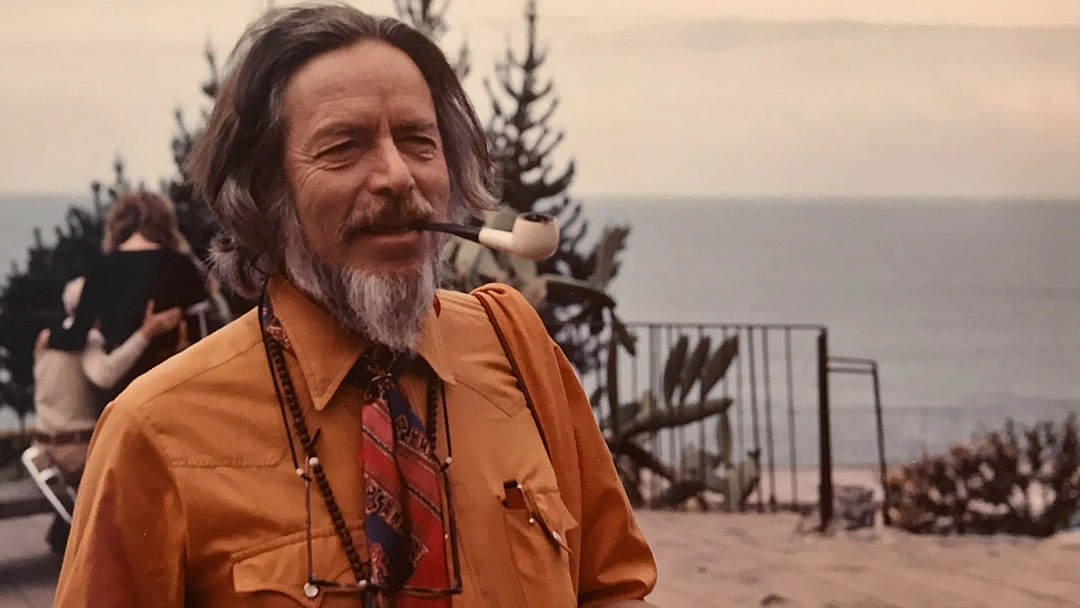
An English schoolboy Buddhist who became an Episcopal priest, lost the collar over his marriage, and remade himself in California as one of the most persuasive English voices Zen and Daoism have had: on unpaid Berkeley radio, in The Way of Zen, on LSD, on a Sausalito ferryboat. He never did a Zen monastery’s training, and said so in print. He drank heavily for most of his last two decades and died at 58.
1915–1932
Chinese embroidery in a Kentish cottage
Alan Wilson Watts was born on 6 January 1915 at Rowan Tree Cottage in Chislehurst, Kent, the only child of Laurence Wilson Watts, who represented the Michelin tyre company in London, and Emily Mary Buchan, a missionary’s daughter. Missionaries home from China had given his mother embroideries and paintings. In his autobiography, In My Own Way (1972), Watts remembered being “aesthetically fascinated with a certain clarity, transparency, and spaciousness in Chinese and Japanese art.”
A scholarship took him to the King’s School, Canterbury, where Patrick Leigh Fermor was a friend. Watts called the school’s religion “grim and maudlin.” He threw away his chance at a scholarship to Trinity College, Oxford, by writing the decisive exam essay in a style he said the examiners took as “presumptuous and capricious”. He did not go up to Oxford. Instead he worked in a printing house and then a bank, and read.
1931–1938
Secretary of the Buddhist Lodge at sixteen
Holidays in France with Francis Croshaw, a wealthy older Epicurean with a Buddhist library, settled the question for the teenager: Buddhism, not the Church of England. He joined the Buddhist Lodge in London, run by the barrister Christmas Humphreys, who later became a judge at the Old Bailey. Watts became its secretary at sixteen and worked on its journal, now called The Middle Way. By the estate’s account his first booklet, An Outline of Zen Buddhism, appeared in 1932. Out of hours he also sat at the feet of Dimitrije Mitrinović, a Serbian “rascal guru” who mixed Gurdjieff and Ouspensky with Freud, Jung and Adler.
In 1936, aged 21, he heard D. T. Suzuki speak at the World Congress of Faiths in London and published The Spirit of Zen. Twenty years later he called that book “a popularization of Suzuki’s earlier works” that was “very unscholarly” and “in many respects out of date and misleading”. Also in 1936, at the Lodge, he met Eleanor Everett, whose mother, Ruth Fuller Everett (later Ruth Fuller Sasaki), had brought her to London to study piano. They married in April 1938 and sailed for New York, where Watts began giving talks.
1938–1950
Chaplain at Northwestern, until the marriage broke
In New York his mother-in-law was part of the circle around the Rinzai teacher Sokei-an Sasaki, whom she later married. Watts tried formal training with Sokei-an and dropped it because the method did not suit him. He chose a career in the church instead. He became a US citizen in 1943, studied at Seabury-Western Theological Seminary in Evanston, and was ordained an Episcopal priest: in 1944 by the estate’s chronology, on Ascension Day 1945 by his own later account. From 1944 he was the Episcopal chaplain at Northwestern University. Mira Tweti’s account in Tricycle describes him writing “magical liturgies,” banning “corny” hymns, and holding students long after prayers with tea, cocktails and late-night talk. Behold the Spirit (1947), his attempt to find Christian warrant for a mystical religion, earned him a master’s degree in theology.
The marriage could not hold his beliefs about sex, and he was not monogamous. In 1949 Eleanor left with their two daughters and won an annulment on the ground that he had “contracted a monogamous marriage under false pretenses.” He told his parents she was getting a divorce in Reno. His bishop wrote him a letter of inquiry, and Watts answered in August 1950 by resigning the priesthood. He left Illinois with Dorothy DeWitt, one of his students and a former babysitter, who became his second wife. In a farmhouse near Millbrook, New York, he began The Wisdom of Insecurity.
The Academy, and Saturday nights on KPFA
Early in 1951 Watts moved to San Francisco to teach at the American Academy of Asian Studies. He stayed until 1957 and for several years ran the place, working alongside the Japanese painter Saburo Hasegawa, the religious scholar Frederic Spiegelberg and the Bengali philosopher Haridas Chaudhuri. Hasegawa mattered most. In The Way of Zen Watts records passages of Dōgen’s Shōbōgenzō and Bankei’s sermons as “read to the author” by Hasegawa. During these years he had a four-year affair with the poet Jean Burden, who inspired Nature, Man and Woman (1958). She later said: “He drank too much. Women were catnip to him.”
In 1953 he began an unpaid weekly programme on KPFA, the listener-sponsored Pacifica station in Berkeley, opening with The Great Books of Asia. The broadcasts ran until 1962. This is where the voice was trained. The Wisdom of Insecurity (1951), finished as he arrived, makes the argument of the whole career in small: a mind that tries to secure the future loses touch with the present, and the more it grasps at safety the more anxious it becomes.
“I claim no rights to speak of Zen”
In The Way of Zen Watts set out to do what, he complained, not even Suzuki had done: tell Zen’s story in one arc, from Indian Buddhism and Chinese Daoism through the Chan masters of the Tang dynasty to Japanese practice and arts. It became one of the first bestsellers about Buddhism in the West. His preface is unusually frank. The ideal author, he says, would be a Westerner who had trained for years under a Japanese master, and he was not that person. He wrote the book “since no one who understands the subject better than I seems willing or able to do so.” He admits his Tang-dynasty Chinese is “certainly not enough” for the finer points, and declares: “I cannot represent myself as a Zenist, or even as a Buddhist … I claim no rights to speak of Zen.” Studying Zen from outside, as an academic, he says, would be “like studying birdsong in a collection of stuffed nightingales.” He names the people who helped him: Hasegawa, his colleagues at the Academy, and Kazumitsu Kato, a priest of the Sōtō school.
Practitioners were less amused. In The Three Pillars of Zen, Philip Kapleau charged that Watts had dismissed zazen, seated meditation, on the strength of half a koan. Robert Aitken reports D. T. Suzuki saying: “I regret to say that Mr. Watts did not understand that story.” Watts defined zazen in one talk as a cat that “sits until it is tired of sitting, then gets up, stretches, and walks away,” and Tweti writes that he sat only when the mood took him. Shunryu Suzuki, founder of the San Francisco Zen Center, took the other side. When a student sneered at Watts, Suzuki snapped back, as David Chadwick tells it: “He is a great bodhisattva.”
1957 · 1975
God, Heaven or Spontaneity: one word in the Zhuangzi
One passage shows how his synthesis was made. In chapter 19 of the Zhuangzi, “Mastering Life” (達生), the master Liezi asks the gatekeeper Guan Yin how the perfected man can walk through fire without being burned. The answer is not skill or daring but “guarding the pure breath” (純氣之守). As an example, Guan Yin offers a drunk who falls out of a cart and is hurt but does not die, because “his spirit is whole” (其神全也): he did not know he was riding, and did not know he was falling. Then the punchline, in our literal gloss: if wine can keep a man whole like that, how much more can 天 (tian, Heaven or nature)? “The sage hides himself in Heaven, so nothing can harm him.”
Herbert Giles’s 1889 translation turns 天 into “God”: “And if such security is to be got from wine, how much more is it to be got from God. It is in God that the Sage seeks his refuge.” On pages 42–43 of The Way of Zen, Watts prints Giles’s paragraph almost word for word and footnotes it to Giles, page 232. Apart from one pronoun, only the last word changes. His version ends “how much more is it to be got from Spontaneity,” and stops before the sage’s refuge. The footnote does not mention the change, and his preface says that translations are his own “unless otherwise indicated.”
That one word is the method in miniature. Watts has already given Laozi’s 道法自然 (Daodejing 25) as “The Tao’s principle is spontaneity.” So he reads Heaven as ziran, the “self-so,” and then explains the drunk’s unawareness with the term Zen would make central, wu-xin, “no-mind” (he notes that it already occurs in the Zhuangzi): “not coma” but “un-self-consciousness.” A Victorian translator had made Zhuangzi a theist; Watts made him a Zen psychologist. In our reading, neither keeps the Chinese passage’s own frame. That frame is an argument about invulnerability and guarding the breath, and belongs to the literature of bodily self-cultivation more than to therapy. Watts’s version is lucid and alive, but it is his reading, not a transcript of the text.
Eighteen years later he quoted the same paragraph in Tao: The Watercourse Way, in the chapter on wu-wei, with the same “Spontaneity.” Now the footnote reads “tr. H. A. Giles (1), p. 232, mod. auct.,” his own stated mark for a translation he had altered, and he calls the passage “one of Chuang-tzu’s charming exaggerations.” By then he was working through the Chinese with the tai chi teacher Al Chung-liang Huang, who recalls the two of them reading “all the existing translations” and attempting “a new, on-the-spot translation.” Watts meant the drunk as an image of spontaneity, not as praise of drink. Knowing how he died, it is hard to read it now without thinking of the vodka.
From the mid-1950s Watts was drinking heavily. In 1958 he took mescaline as a volunteer for the psychiatrist Oscar Janiger and LSD as a subject in Keith Ditman’s studies at UCLA. The Joyous Cosmology: Adventures in the Chemistry of Consciousness (Pantheon, 1962), with a foreword by the Harvard psychologists Timothy Leary and Richard Alpert, treats the drugs as occasions for philosophical insight, not kicks. He dedicated it to his neighbours at Druid Heights. Tweti reports that he kept taking acid for the rest of his life and offered each of his children a guided trip when they turned eighteen.
From 1962 to 1964 he held a fellowship at Harvard. His second marriage ended in the early 1960s. While lecturing in New York he had met Mary Jane Yates King, called Jano, who became his third wife. Tweti calls her his drinking partner. He left Dorothy and their four children, with a fifth on the way. With seven children by two wives to support, the lecture circuit became a necessity as well as a stage.
Watts and Jano lived aboard the Vallejo, an old ferryboat moored at Sausalito that also housed his Society for Comparative Philosophy. In 1967 the San Francisco Oracle gathered Watts, Timothy Leary, Allen Ginsberg and Gary Snyder there for a recorded conversation, the “Houseboat Summit”. He called himself a philosophical entertainer, and the phrase catches both his gift and his limit. Analogy and performance opened doors, but he was a popular interpreter, not a spokesman for Zen, Daoism or Vedanta.
The Book: On the Taboo Against Knowing Who You Are (1966) gives his recurring claim its most playful form. The “ego in a bag of skin” is a social fiction, and the universe is a single self playing hide-and-seek with itself. Read it after The Way of Zen to watch history turn into an experiment in perspective, and notice how much Vedanta, rather than Zen, it leans on.
1969–1973
The voice remains
His last base was a cabin at Druid Heights on Mount Tamalpais, the bohemian settlement shaped by the poet Elsa Gidlow and the builder Roger Somers. There he wrote the mountain journal Cloud-Hidden, Whereabouts Unknown and his autobiography, which he dedicated to Gidlow. In 1972 Ed Stiles, Somers and Alfred Kylces built him a round library as a reading room and meeting place.
The drinking got worse. David Guy reports Gary Snyder’s recollection that by the end Watts was “putting away a bottle of vodka per day,” and Tweti that he was reportedly hospitalised with delirium tremens. Family and friends were worried about his alcoholism. He kept every deadline, and kept touring. He came home from a European lecture tour in October 1973 and died in his sleep at Druid Heights on 16 November 1973, aged 58. Tweti gives the cause as heart failure; The New York Times reported that he had been treated for a heart condition. Huang writes that on his last evening he played with balloons and said the floating felt “like my spirit leaving my body.” Within hours Buddhist monks cremated him on a wood pyre at Muir Beach, before the authorities could become involved. Tao: The Watercourse Way was left at five of its seven planned chapters.
His daughter Anne has said that some readers knocked him off the pedestal when they learned he was an alcoholic and a womaniser, and maintains that the work stands on its own. The recordings make the best case for that. The timing, the laugh and the pleasure in a good analogy come through more clearly in his voice than on the page.
The later life of a reading room1972 library · photographed 2015
The former library at Druid Heights, photographed by former resident Fabrice Florin in July 2015. Watts commissioned the round reading room in 1972; after his death it was converted into a residence. The loft and furnishings belong to that later life, rather than the original arrangement of his books and papers.
Source & credits
Fabrice Florin · CC BY-SA 2.0 · Full frame; resized and converted to WebP.