Huxley, not Orwell: Lincoln at Peoria against ‘Now … this’
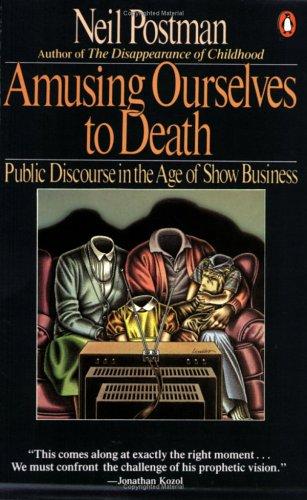
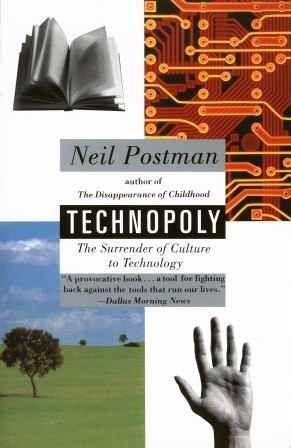
Amusing Ourselves to Death grew, by most accounts, from a talk on a 1984 Frankfurt Book Fair panel about Orwell’s Nineteen Eighty-Four. Its foreword is the most quoted thing Postman wrote: ‘Orwell feared those who would deprive us of information. Huxley feared those who would give us so much that we would be reduced to passivity and egoism … In short, Orwell feared that what we hate will ruin us. Huxley feared that what we love will ruin us.’ The book, he says, is about the possibility that Huxley was right.
The engine is a line about smoke signals. You cannot do philosophy in puffs of smoke: ‘Its form excludes the content.’ Every medium, Postman argues, has such a bias. He was careful to say he had no quarrel with junk (‘The best things on television are its junk’) and to separate a technology, the machine, from a medium, the social use it settles into. His target was serious things presented as entertainment: news, politics, religion (the televangelist chapter is called ‘Shuffle Off to Bethlehem’) and schooling (Sesame Street, he wrote, ‘encourages children to love school only if school is like Sesame Street’).
His case is a concrete comparison. At Peoria, Illinois, on 16 October 1854, Stephen Douglas spoke for three hours. Lincoln, due to reply at similar length, pointed out it was already 5 p.m. and proposed that the crowd go home for dinner and come back for four more hours. They did. At the first of the 1858 debates, in Ottawa on 21 August, the format was an hour for Douglas, an hour and a half for Lincoln and half an hour of rebuttal. When the crowd applauded, Douglas asked for silence, saying he wanted to address their ‘judgment’ and ‘understanding’, not their ‘passions’. Postman’s reading is that this was ‘expository prose lifted whole from the printed page’, and that its audience could follow long, legalistic sentences by ear. Beside it he sets the 1984 Reagan–Mondale debates: five minutes per answer on questions such as Central America, a minute of rebuttal, and next-day verdicts that Reagan’s joke about his age had knocked Mondale out.
Chapter 7 names the grammar of television news after its stock segue, ‘Now … this’. No murder, earthquake or political blunder is so grave that the phrase cannot wipe it away, and he puts the time a viewer is allowed to dwell on it at ‘approximately forty-five seconds’. He then takes television at its most solemn: ABC’s eighty-minute panel after The Day After on 20 November 1983, with no music, no commercials, and Kissinger, McNamara, Elie Wiesel, Carl Sagan, William Buckley and Brent Scowcroft. Each man got about five minutes, called on ‘seriatim, as if they were finalists in a beauty contest’, and almost nobody answered anybody else.
Test the argument against later evidence and it splits. Kiku Adatto’s study for Harvard’s Shorenstein Center (June 1990) measured network evening-news coverage of presidential campaigns and found that the average uninterrupted sound bite from a candidate fell from 42.3 seconds in 1968 to 9.8 seconds in 1988. That is hard data in Postman’s direction, though it measures news clips, not debates, and appeared five years after his book. The nineteenth-century half is shakier. Postman says Lincoln and Douglas wrote their speeches in advance. But the ‘pure print’ he hears reaches us through shorthand reporters for the partisan Chicago papers, whose texts, in the Lincoln scholar Harold Holzer’s words, editors and transcribers ‘improved’ for their own man. Lincoln then edited the clippings into a book for his 1860 campaign, and a modern critical edition (Rodney Davis and Douglas Wilson, 2008) still had to correct garbled transcriptions. Some of the printed quality Postman admired was put there by print. The crowds, as Postman himself notes, also shouted ‘You tell ’em, Abe!’.
The book sold widely; The Villager’s obituary put it at eight languages and some 200,000 copies by 2003. Roger Waters named his 1992 album Amused to Death after it. Introducing the 2005 edition, Postman’s son Andrew quotes a student whose class tried to find a cable channel that disproved the thesis and could only come up with C-SPAN, ‘which no one watches’.