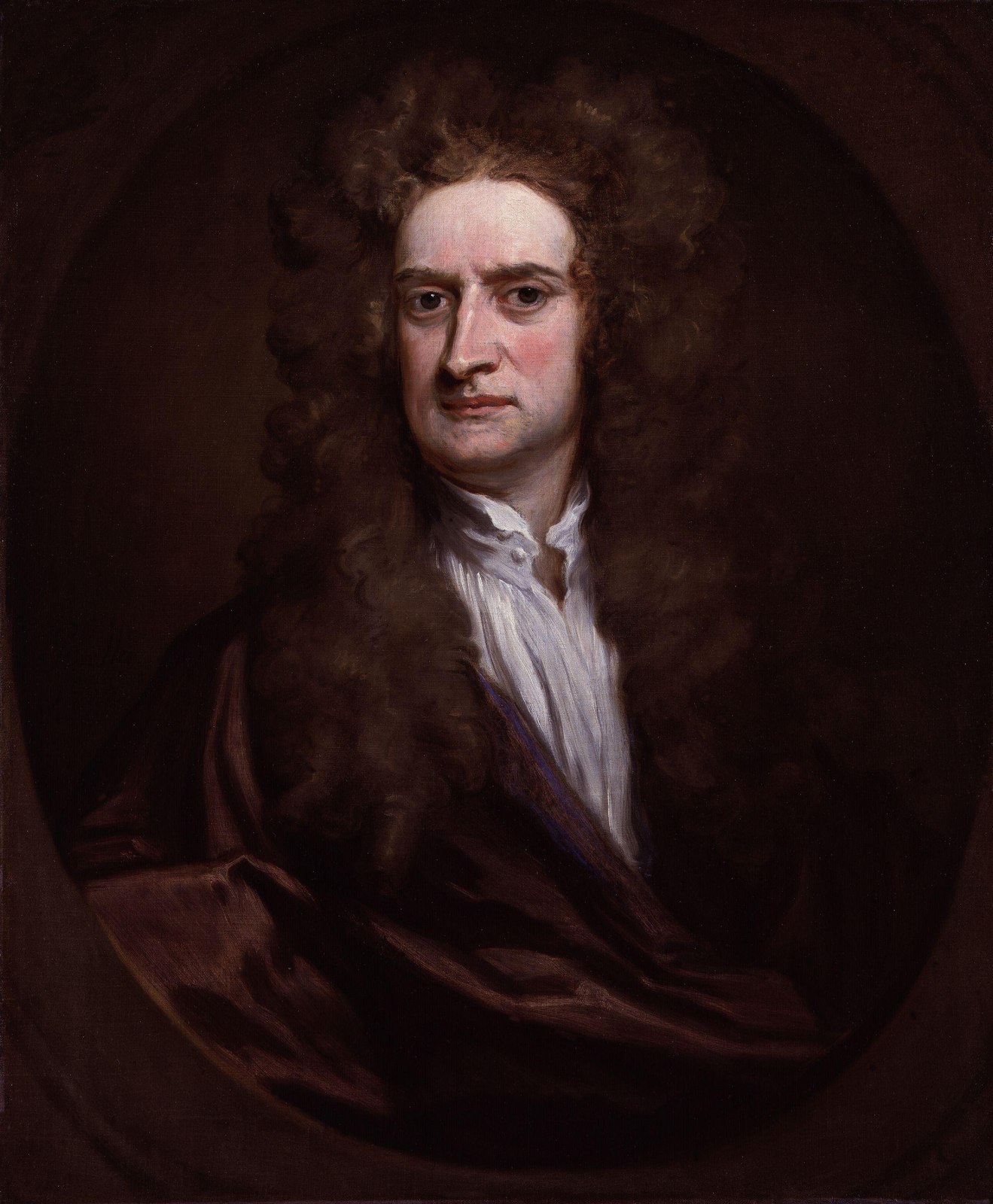
Newton made a large wager on mathematical explanation: the motion of the Moon and planets could be studied by the same rules as bodies near Earth. Yet his working life also included theology, alchemy and public administration. The celebrated equations belong to that wider, sometimes contentious life.
1642/43–1669
Woolsthorpe and Cambridge
Newton was born at Woolsthorpe on Christmas Day 1642 in England’s old calendar, 4 January 1643 in the Gregorian calendar used for the card. Educated at Grantham, he entered Trinity College, Cambridge. During plague closures in 1665–1666 he worked privately on mathematics, motion and light. The familiar apple story has roots in later recollection, but it is not a complete account of a theory proved in a single afternoon.
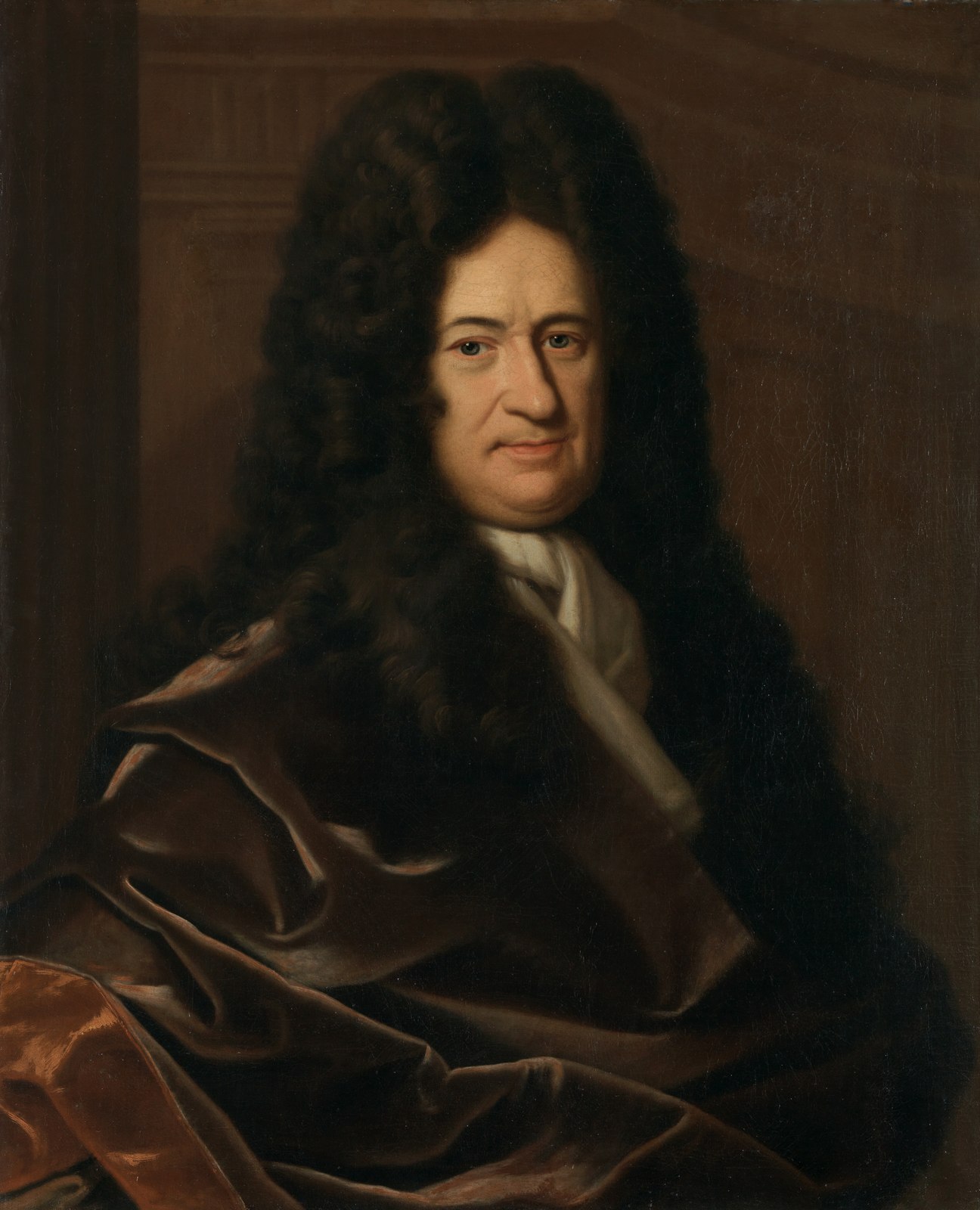
He developed methods of fluxions for changing quantities and became Lucasian professor of mathematics in 1669. These early calculations preceded his full published account and later became the subject of a bitter priority dispute with Leibniz, who independently developed a distinct calculus and published his method first.
1670–1676
A prism makes colour an experiment
Newton used prisms to produce a band of colours and then isolated a narrow part of that band for a second refraction. A red ray did not become blue just because it passed through another prism; different coloured light bent by different amounts. This helped him argue that white light is a mixture and that a prism sorts its components rather than manufacturing them.
He reported his optical theory to the Royal Society in 1672. Robert Hooke and others disputed parts of his account, and the ensuing exchanges were sharp. A small reflecting telescope, presented to the Society, also addressed a practical difficulty of refracting lenses: colour fringing. The instrument and the paper belong together as tests of his optical reasoning.
Edmond Halley visited Newton in 1684 with a problem discussed with Robert Hooke and Christopher Wren: what path would follow from an attraction that weakened with the square of distance? Newton sent De motu, then expanded the argument into the Principia. Halley shepherded and financed its publication; Hooke’s earlier inverse-square suggestions and John Flamsteed’s observations belong to the history too.
The Principia starts with definitions and laws of motion, then uses geometrical propositions to connect forces with paths. In Book III Newton applies the same framework to moons, planets and tides. The inverse-square law permits Kepler’s elliptical motion under ideal conditions, while real celestial bodies disturb one another. The strength of the book is its chain of mathematical consequences, not the claim that one apple observation disclosed every step.
Newton moved to London as Warden of the Royal Mint in 1696 and Master in 1699. He took the Great Recoinage and counterfeit investigations seriously, working within a state apparatus whose prosecutions could carry grave penalties. In 1703 he became president of the Royal Society, an office that increased both his influence and the stakes of his disputes.
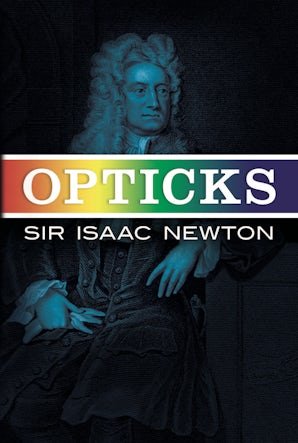
Opticks appeared in 1704, with experiments, diagrams and later Queries that reached beyond the strictly demonstrated results. Unlike the Latin Principia, it was written in English and offers a more direct entrance to his experimental method. Begin with the prism trials; their sequence is easier to test in thought than the Principia’s geometric proofs.
Newton spent extraordinary effort on biblical chronology, prophecy and theology, and wrote extensively on alchemical materials. These studies did not simply hide behind an otherwise modern scientist; they formed part of his attempt to understand nature and divine order. His private religious views diverged from orthodox Trinitarian doctrine, while his public office required careful navigation.
The Newton–Leibniz calculus controversy grew acrimonious. The Royal Society’s 1712–1713 report favoured Newton, but Newton himself shaped it while serving as president. Modern historical judgment credits independent invention and distinguishes Newton’s earlier private method from Leibniz’s earlier publication and widely adopted notation. The dispute should not eclipse the mathematical work each produced.