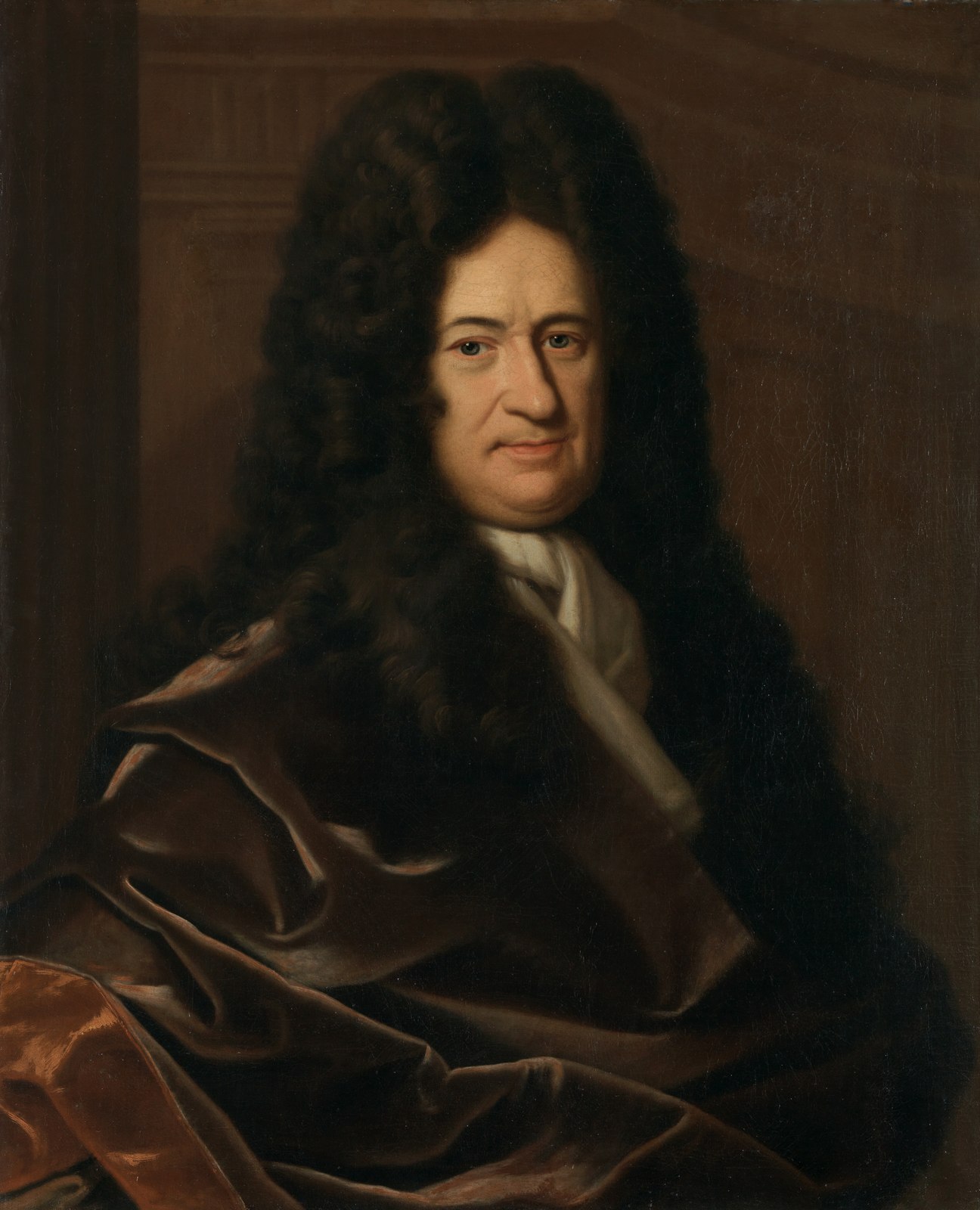
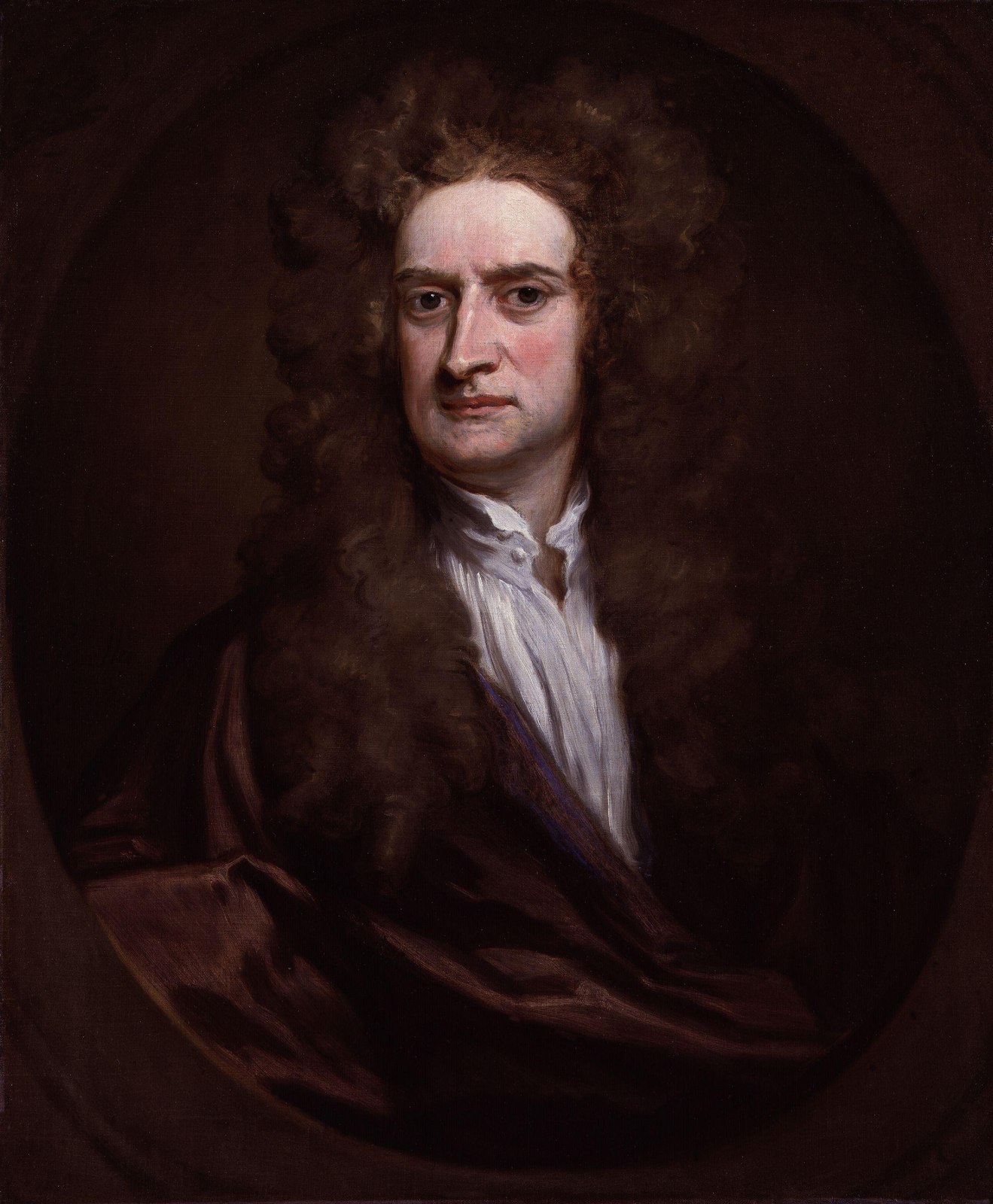
Leibniz looked for forms of writing that made thinking more exact: symbols for a curve’s local change, a machine for arithmetic, principles for asking why a fact is so. His career in courts and libraries placed that work among diplomacy, archival history and a vast correspondence.
1646–1672
Law, logic and a portable education
Born in Leipzig, Leibniz grew up with access to his father’s library and studied philosophy and law. He completed legal studies young, then worked for political patrons in Mainz. Questions about the systematic organisation of law and knowledge were already central to his ambition; the calculating machine he later designed belongs to the same appetite for orderly operations.
A diplomatic mission took him to Paris in 1672. There, Christiaan Huygens encouraged more rigorous mathematical study and introduced problems and readings that stretched him beyond his earlier training. Leibniz’s intellectual formation was a sequence of encounters and revisions, not the spontaneous arrival of a ready-made universal method.
1672–1676
Paris: change becomes a notation
In Paris Leibniz worked through problems of tangents and areas. He introduced the elongated ∫ for a sum and used d to mark a small difference. If y grows as x squared, his rules make its change readable as dy = 2x dx. The notation makes operations visible and repeatable, even though seventeenth-century infinitesimals did not yet have the later formal foundations of limits.
He met Newton’s circle through correspondence mediated by Henry Oldenburg. The letters and their delays later became evidence in a priority fight, but they do not erase the distinct course of Leibniz’s notebooks. Newton had developed fluxions earlier in private; Leibniz’s independent differential method reached print earlier and gave later mathematicians durable symbols.
Leibniz entered service of the Hanoverian court as librarian and counsellor. He sought documents for a history of the House of Brunswick and travelled through European archives. The commissioned narrative was never completed, but the work produced substantial collections of evidence and connected him to scholars, diplomats and rulers.
His 1684 paper in Acta Eruditorum gave rules for differential calculus in compressed form, and a 1686 paper treated integration. Jakob and Johann Bernoulli pushed the method further through problems and teaching. Credit for the calculus’s spread belongs to that mathematical community as well as to the inventor of its notation.
The Discourse on Metaphysics, Theodicy and later Monadology ask how individual things and a lawful whole fit together. A monad in the latter is a simple, partless substance; its changing perceptions belong to an inner history. The principle of sufficient reason asks why a fact holds rather than another possibility, though the answer may exceed human knowledge.
His claim that God chooses the “best possible world” is a philosophical attempt to reconcile order and evil, not a comforting claim that suffering is desirable. A reader can begin with Monadology’s short numbered propositions, then use the Theodicy to see the larger and more contested argument.
The calculus priority dispute hardened into public accusation. A Royal Society committee’s report favoured Newton; as president, Newton shaped the report, and the process was not an impartial adjudication. Historians now recognise independent invention, alongside important differences of method and publication. Leibniz’s last years were also marked by strained court relations and unfinished institutional plans.
In letters to Samuel Clarke, a Newtonian ally, Leibniz argued that space and time are orders of relations among things, not containers existing on their own. This dispute reaches beyond calculus. It asks whether two otherwise identical universes shifted together in space would differ at all, a precise test of what “absolute position” could mean.