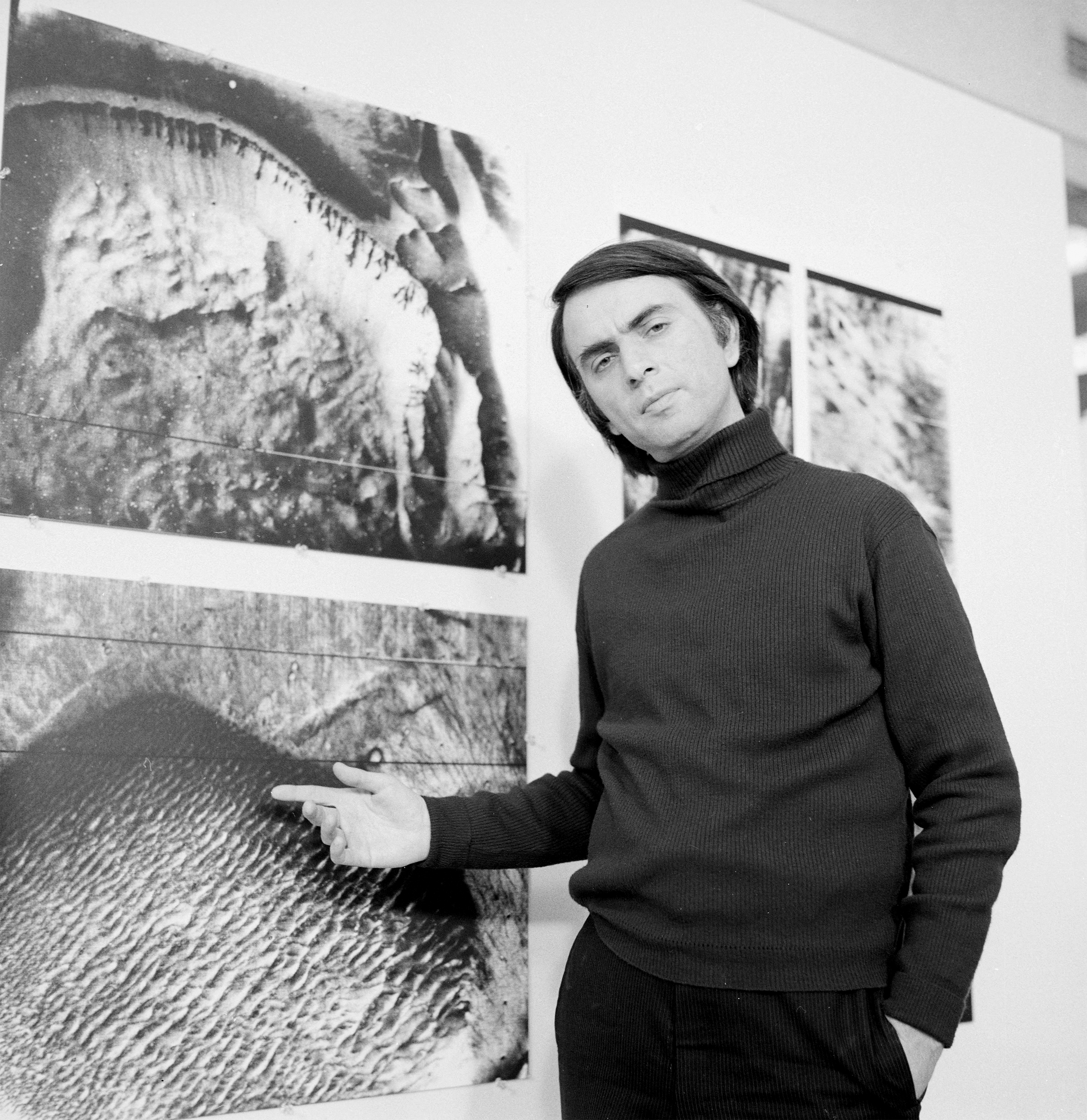
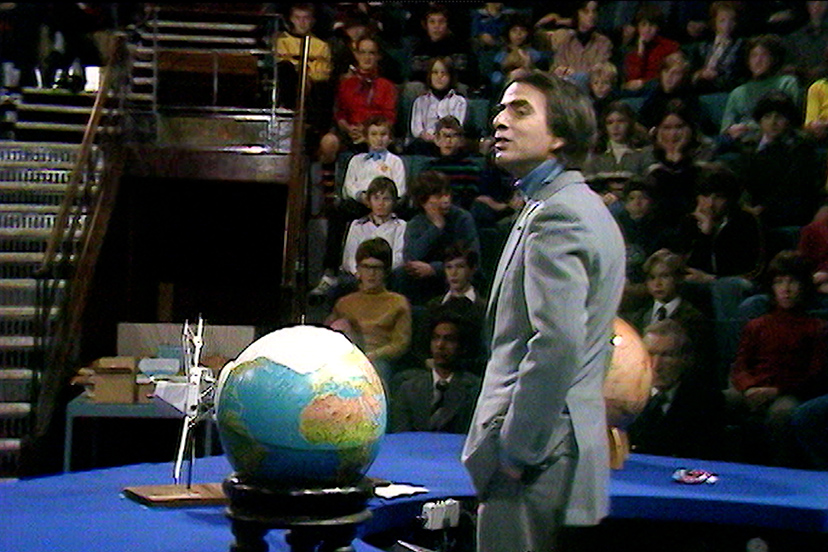
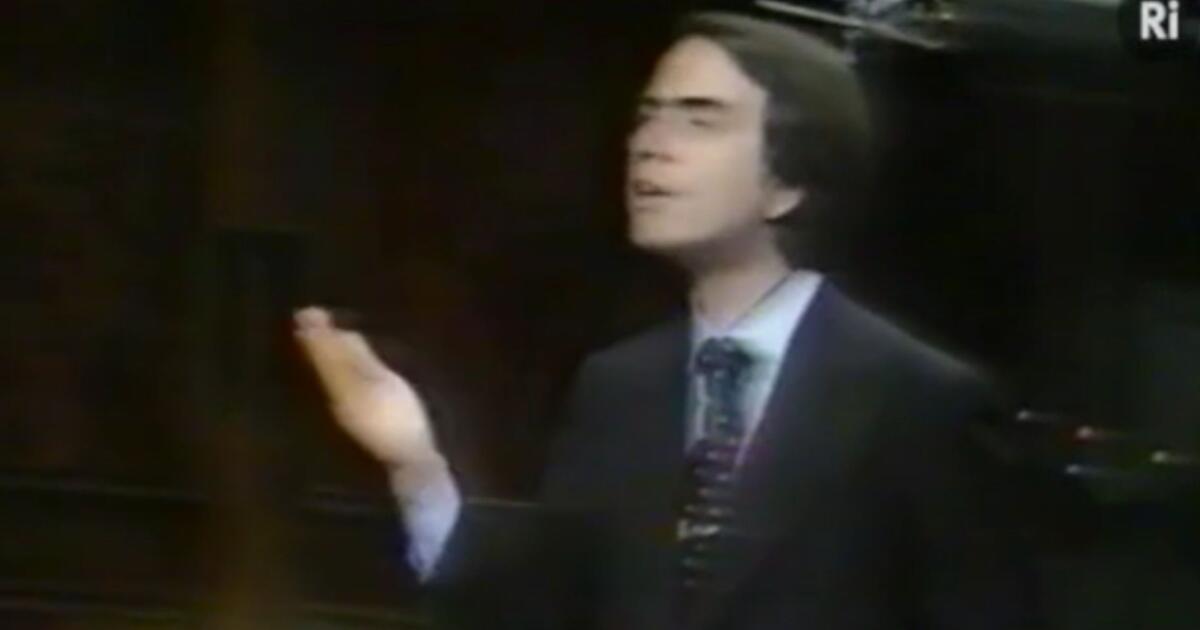
Carl Sagan standing beside planetary maps in a NASA/JPL archival photograph.

Carl Sagan

Planetary Scientist, Cosmos Presenter

Denied tenure at Harvard, he read Venus’s heat in radio waves and Mars’s seasons in moving dust, then took Cosmos to half a billion viewers. Wrote on cannabis as “Mr. X”.

Radio Thermometer
Read Venus’s 600 K surface from microwaves that clouds could not stop.
Baloney Kit
Wants independent confirmation, numbers and a claim that could be proved wrong.
Mr. X
Wrote on smoking cannabis in 1971 under a pseudonym; named after his death.

Carl Sagan

Planetary Scientist & Science Communicator

Start hereCosmosBegin with the television episodes on Venus and Mars, where his own research becomes narrative; then read the 1960 Venus report on the documents shelf to see the reasoning underneath.Explore book

Begin with Cosmos, but look at what stood behind it: a 1960 inference that Venus has a surface near 600 K, a 1967 reading of Mars’s seasonal darkening as grains changing size, and a decade on NASA imaging teams. This page follows that science first, then the fame, then the arguments about both—a Harvard tenure refusal, a pseudonymous essay on smoking cannabis, a nuclear-winter claim its critics thought oversold, and a baloney detection kit from a man who conceded when a prediction failed. James Pollack, Frank Drake, Linda Salzman Sagan, Ann Druyan and Steven Soter share the credit where they enter.

1934

Stars in a Brooklyn library

Carl Edward Sagan was born on 9 November 1934 in Brooklyn, the son of Samuel Sagan, a garment worker from the Russian empire, and Rachel Sagan. His own version of the origin story is a library one: given his first card, he asked for something on stars, was handed a picture book of film stars, complained, and was brought the right book, which said ‘that the stars were suns, but very far away’. The 1939 New York World’s Fair, to which his parents took him, supplied the other half: a photoelectric cell crackling under a flashlight, a tuning fork drawn as a wave on an oscilloscope, a first sight of television.

The family moved to Rahway, New Jersey, in 1948, and at sixteen he went to the University of Chicago, one of the few colleges he had applied to that would take someone so young. It was Robert Hutchins’s Great Books college, where, as he later recalled, an aspiring physicist was expected to know Plato, Aristotle, Bach and Shakespeare. He sat in a physics department orbiting Enrico Fermi, learned what mathematical elegance meant from Subrahmanyan Chandrasekhar, talked chemistry with Harold Urey, spent summers in genetics with H. J. Muller, and studied planets under Gerard Kuiper, then America’s only full-time academic planetary scientist. He took a physics BS in 1955, a physics MS in 1956 and a doctorate in astronomy and astrophysics in 1960; his thesis, under Kuiper, was ‘Physical Studies of the Planets’.

One footnote sits uneasily beside the wonder. In 1958 he and Kuiper worked on Project A119, a classified US Air Force study of detonating a nuclear warhead on the Moon. A 1999 report in Nature revealed that Sagan had listed the classified titles of two A119 papers in his 1959 application for a Berkeley scholarship, and the project’s leader, Leonard Reiffel, confirmed it as a security leak.

1956–1962

A hot, dry Venus

In the late 1950s nobody knew what lay under Venus’s clouds. Infrared thermocouples looking through Earth’s 8–13 micrometre window gave about 234–240 K, well below freezing, but Sagan pointed out in 1960 that such readings were composites from several levels of the atmosphere and said nothing certain about the ground. Radio waves go through cloud. In 1956 Mayer, McCullough and Sloanaker, using the Naval Research Laboratory’s 50-foot dish, detected centimetre-wavelength emission from Venus. If it was thermal, its brightness temperature—the temperature of a perfect emitter that would give off the same radio power—was about 600 K (roughly 330 °C), give or take 100. Later observations at wavelengths from 8.6 millimetres to 21 centimetres broadly agreed.

Sagan’s JPL Technical Report 32-34, ‘The Radiation Balance of Venus’ (15 September 1960, written at Yerkes Observatory when he was twenty-five), reasons backwards from that number in three steps. First, is it heat at all? The rival idea was synchrotron radiation from charged particles trapped in a Venusian radiation belt, as had been proposed for Jupiter. Such emission should brighten steeply with wavelength—by his calculation at least as the 3/2 power, so that 20 cm would be more than ninety times brighter than 1 cm. The measured brightness temperatures were nearly flat, about 560–620 K between 3 and 10 cm, so the emission had to be thermal. Second, how hot should a bare Venus be at that distance and with that reflectivity? Between about 250 K and 350 K, depending on how fast it turns. Third, the gap must be the atmosphere: to hold the ground at 600 K, the air has to block almost all outgoing heat, which he calculated as an effective absorptivity of 0.995, opaque from 1.5 to 40 micrometres. ‘It is evident,’ he wrote, ‘that a surface temperature of 600°K demands a very efficient greenhouse effect.’

Part of the model was wrong. Needing something that absorbs beyond 20 micrometres, he settled on water vapour and derived a surface pressure of about 4 atmospheres under an ice-crystal cloud; Venera 7, the first probe to land on another planet, measured about 475 °C in December 1970 and an estimated pressure near 90 atmospheres. The core inference—a dry, very hot surface kept hot by its own air—held. Mariner 2 flew past on 14 December 1962 with Sagan attached to its science team (Cornell’s memorial puts him on the infrared radiometer team); its microwave scans showed limb darkening that the team read as support for a hot surface under an opaque atmosphere. By then he was a Miller Fellow at Berkeley (1960–62), had published a 1961 Science article on Venus’s atmosphere, and was writing a series of papers with his first graduate student, James Pollack, on the planet’s radiation balance. He later used Venus as a warning about Earth, telling Congress in 1985 that the greenhouse effect would change our climate.

1968

Refused by Harvard, hired by Cornell

After Berkeley, Sagan joined Harvard’s astronomers; Cornell’s memorial also has him working with the geneticist Joshua Lederberg at Stanford. Harvard first offered a lectureship; Sagan asked for an assistant professorship, and Fred Whipple and Donald Menzel persuaded the university to agree. He taught at Harvard and worked at the Smithsonian Astrophysical Observatory, which published the 1967 Mars reports, until 1968, when Harvard refused him tenure. He later said the decision was very unexpected.

The reasons were never made public. Cornell’s alumni magazine reports murmurs that his passion, exobiology, was ‘a discipline without a subject matter’; the explanations offered since add interests too broad for a narrow specialty and a public profile some colleagues read as self-promotion. The hardest detail is Harold Urey, the Nobel chemist who had been his Chicago mentor: Urey had given him damaging references—the magazine summarises them as calling his work wordy, often useless and untrustworthy—and wrote on 17 September 1973, ‘I have been completely wrong.’ MIT turned him down as well.

Thomas Gold, director of Cornell’s Center for Radiophysics and Space Research, had been courting him. Provost Dale Corson had reservations; Gold answered, ‘Dale, you will not ever regret this.’ In a four-page letter in June 1967 Sagan set conditions about staffing, space and support; about six months later Gold offered an associate professorship with tenure at $15,000 a year, and Cornell’s trustees appointed him on 22 January 1968. The dates leave it unclear whether Harvard’s refusal came before or after Cornell’s offer, so the tidy story of rejection and rescue deserves some caution.

Cornell suited him. He became a full professor in 1970, directed the Laboratory for Planetary Studies, served as associate director of the Center for Radiophysics and Space Research from 1972 to 1981, and from 1976 held the David Duncan chair. In 1973 he first appeared on Johnny Carson’s show and went on to about two dozen more visits; Carson’s ‘billions and billions’ impression was of a phrase Sagan said he never used. With Bruce Murray, a former JPL director, he co-founded the Planetary Society in 1980.

1969–1999

Mr. X

Sagan smoked cannabis, and in 1969 he wrote about it. The essay, for his friend and former Harvard colleague Lester Grinspoon’s book Marihuana Reconsidered (1971), appeared under the name ‘Mr. X’. In it he says he started about ten years earlier among friends, sceptical: five or six attempts did nothing and he suspected a placebo. Then, lying on a friend’s living-room floor, he saw an intricately detailed miniature Volkswagen in the shadows a houseplant cast on the ceiling, and with his eyes closed found ‘a movie going on the inside of my eyelids’, a country scene whose colours changed about once a heartbeat.

What he claims is specific. Music opened up: for the first time he could hear the separate parts of a three-part harmony. Art made more sense and food tasted stronger. He insists the insights he had while high were real, if hard to carry back to the sober self, and that the work was in recording them: after one session he wrote eleven short essays in an hour, which he says he later used in commencement addresses, lectures and books. Of his own science he says he tried a few hard problems high, that recall worked, and that it produced a ‘bizarre possibility’ he would not have thought of sober, mentioned in passing in a paper; he thought it very unlikely to be true but experimentally testable. He also says he had never taken LSD and had driven in heavy traffic high without difficulty. All of this is his own account; nothing in the essay can be checked.

He kept his name off it. After his death in 1996 Grinspoon told Sagan’s biographer Keay Davidson, and Davidson’s Carl Sagan: A Life (1999) brought the secret to wide attention. A headnote on a web reprint of the essay says Sagan continued to use cannabis for the rest of his life; his widow, Ann Druyan, later joined the board of NORML. The essay does not give a reason for the pseudonym. It is reasonable to connect it with a career spent advising NASA and arguing for public trust in evidence, but that is our interpretation, not Sagan’s stated motive.

1983–1991

Nuclear winter

Mars supplied the physics. Cornell’s memorial notes that by the 1980s it was clear dust in Mars’s dry atmosphere changes air and surface temperatures, and that year-to-year dust storms drive its climate; that, with Sagan’s long interest in radiative heat balance, led him and Brian Toon, Richard Turco, Thomas Ackerman and James Pollack to ask what soot and dust from a nuclear exchange would do to Earth. Their paper in Science in December 1983 is known by the authors’ initials, TTAPS. Turco coined the name ‘nuclear winter’; the model was one-dimensional, its smoke and dust amounts assumptions, and the team’s stated aim, according to the American Institute of Physics, was to promote international arms control. Sagan, who had also written to the Soviet scientist Georgy Golitsyn asking him to look into the phenomenon, became its public voice.

The critics were quick. Edward Teller wrote in 1983 correspondence that ‘a propagandist is one who uses incomplete information to produce maximum persuasion.’ Starley Thompson and Stephen Schneider, with a three-dimensional model, argued in Foreign Affairs in 1986 for a milder ‘nuclear autumn’, although Brian Martin wrote in 1988 that they resisted reading this as a rejection of the basic points; Russell Seitz called the stacked worst-case assumptions ‘worst-case analysis run amok’. Cornell’s memorial admits that ‘the size of the effect, even its sign, remains controversial’, while crediting the work with showing that national-security agencies had failed to imagine the outcome. Biographers have called nuclear winter a scientific low point for Sagan that nonetheless raised his public profile.

In 1991, as the Gulf War began, he went on Nightline to say that smoke from Kuwait’s burning oil wells could reach the stratosphere with effects like the Tambora eruption: ‘It should affect the war plans.’ It did not. Peter Hobbs measured the smoke absorbing 75 to 80 per cent of sunlight at its peak and lasting a few days, and in The Demon-Haunted World Sagan conceded that ‘not much smoke reached stratospheric altitudes and Asia was spared.’ Later work by Alan Robock, Toon and colleagues with modern climate models projected severe, multi-year cooling from a large exchange (7–8 °C for 150 teragrams of smoke, in a 2007 study), though William Cotton and a 2018 Los Alamos study argue the effect is weaker. Our reading: a real mechanism, an uncertain size, and an advocate who pressed further than the evidence in public and said so afterwards.

Bookshelf

In his own voice

On film

Manuscripts & papers

Television

  • 1980 · Presented and co-written by Carl Sagan

    Cosmos: A Personal Voyage

    Viewing options

    The original 1980 series. Check the edition and disc region when purchasing.

    Amazon affiliate links support Dæmon at no extra cost to you. As an Amazon Associate I earn from qualifying purchases.