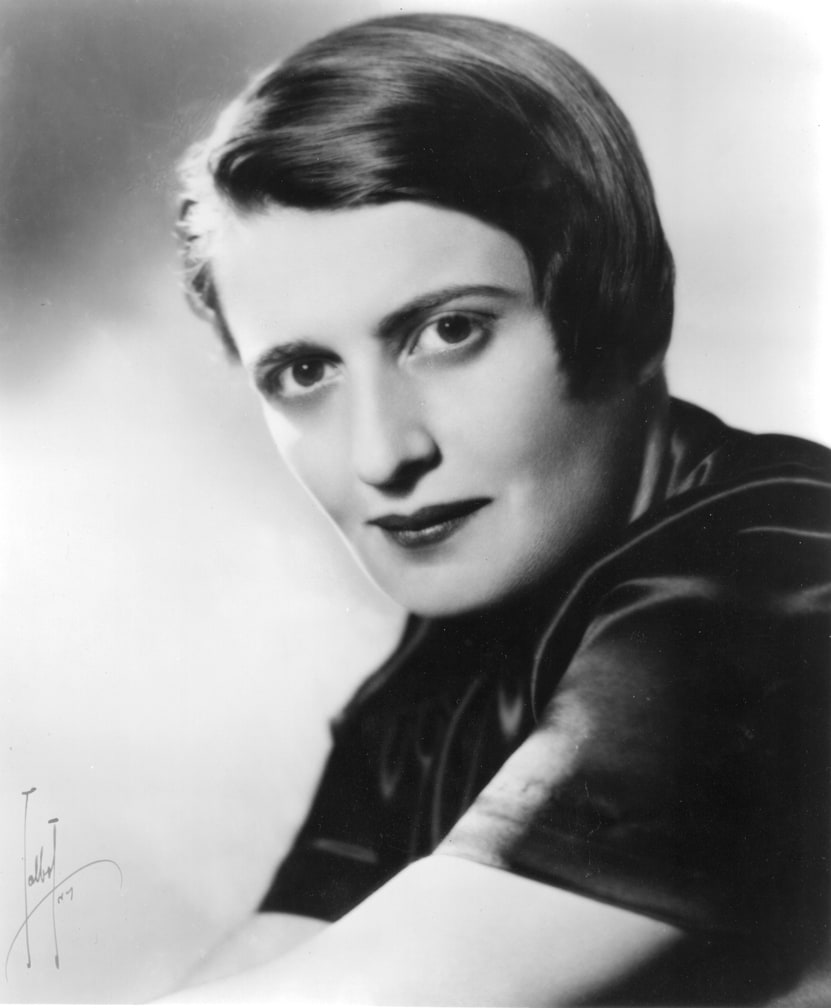
Born Alisa Rosenbaum, she left Soviet Russia on a visitor’s permit and stayed, wrote on Benzedrine, preached The Virtue of Selfishness and took Nathaniel Branden as her lover, then her enemy.
Audience Jury
Lets the theatre crowd vote the verdict in her murder-trial play.
Mind on Strike
Imagines the productive walking out and the world grinding to a halt.
A Is A
Builds an ethics on reason, self-interest and never striking first.
Ayn Rand gave the argument for an independent life a novelist’s scale: buildings, railways, love affairs and whole societies become tests of what a person will live for. Her fiction can be exhilarating; its moral certainty also asks to be examined. Follow the storyteller into the philosophy, with room to disagree.
1905–1926
Revolution and departure
Born Alisa Rosenbaum into a Jewish family in St Petersburg, Rand grew up with books and cinema before the Revolution overturned the household’s security. Her father’s pharmacy was confiscated after the Bolsheviks took power. The family spent a period in Crimea, then returned to Petrograd, where she studied history at university and subsequently trained in film. Political upheaval and a fascination with constructed worlds would both enter her writing.
She left for the United States in 1926 on permission to visit relatives and stayed. Victor Hugo’s expansive fiction offered one model for the writer she wanted to become: events charged with moral consequence, and characters whose choices could carry an entire novel. Her later account of Russia should be read as the work of an emigrant with an explicit political commitment, rather than as an impartial history of the country.
1926–1936
Hollywood, theatre and a first novel
Hollywood put Rand close to the practical machinery of storytelling. She worked for Cecil B. DeMille, took other studio jobs, and married actor Frank O’Connor in 1929. Success came through theatre before a bestselling novel: Night of January 16th turned a murder trial into a production in which members of the audience served as the jury. Their verdict decided the ending. The audience had to exercise the judgment that the play made its subject.
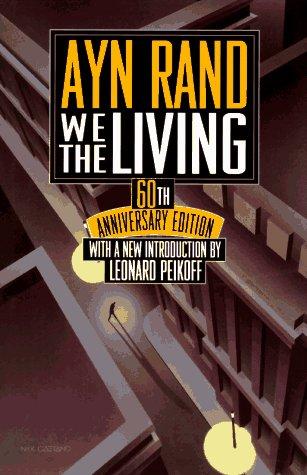
We the Living, published in 1936, moved that concern with personal choice into Soviet Russia. Its young protagonist Kira wants to become an engineer; political power enters even her most intimate decisions. Rand drew on the world she had left, but made a novel rather than a memoir. The book established a recurring problem in her fiction: how much of a person’s life can remain their own when institutions demand obedience?
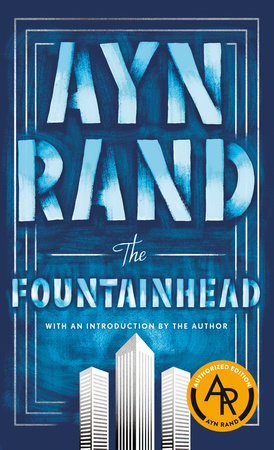
The Fountainhead gives independence a visible form. Howard Roark designs from his understanding of a building’s purpose, while Peter Keating advances by learning what clients, teachers and critics wish to see. Their contrasting careers turn an abstract dispute into rooms, façades, commissions and compromised friendships. Roark’s stubbornness can cost him work; Keating’s accommodation can win him success without giving him a secure sense of authorship.
The novel makes a strong claim about creative integrity, and its melodrama deliberately raises the stakes. It also concentrates moral authority in exceptional figures. Reading closely means allowing the buildings and choices to interest you while asking whether the opposing characters receive the same imaginative generosity. Its 1943 success gave Rand the resources and audience for a much larger fictional experiment. While finishing it she was prescribed Benzedrine, an amphetamine, against fatigue; her biographer Jennifer Burns finds she kept taking it for about three decades.
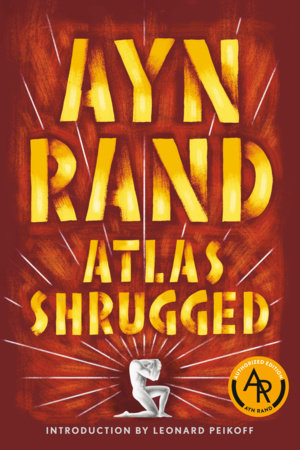
Atlas Shrugged begins with a mystery: capable people are disappearing while the institutions that need them deteriorate. Railroad executive Dagny Taggart tries to keep trains running as the explanation slowly emerges. Rand joins an industrial story to romance, a hidden community and long philosophical speeches. The strike of the productive makes a thought experiment into the plot: what happens if the people on whom a system depends withdraw their cooperation?
Published in 1957, it is her fullest fictional defence of reason, productive achievement and laissez-faire capitalism. The moral contrast is intentionally extreme. Notice which kinds of labour and dependence the story makes visible, and which it leaves outside its frame. Its enormous ambition lies in making a worldview inhabit a novel; whether that constructed world supports the worldview is a further question.
In lectures, periodicals and essay collections, Rand made the argument explicit. The Objectivist Ethics begins with living things having to act to sustain themselves, then argues that human beings need reason, chosen values and productive work to live well. Her defence of self-interest includes a prohibition on initiating physical force; it does not give someone permission to prey on others. The Virtue of Selfishness collects this essay alongside contributions by Nathaniel Branden.
The difficult step is the passage from what life requires to what a person ought to value. Philosophers dispute whether it establishes her conclusions, and whether her treatment of rational self-interest adequately accounts for obligations to people unable to support themselves. The Stanford Encyclopedia’s analysis makes those objections specific enough to test against her own text.
Objectivism also became a movement, with Branden helping to teach and distribute its ideas. In 1954 their friendship became a sexual affair, which both spouses were told of and, after objecting, accepted. Branden later began a hidden affair with the young actress Patrecia Scott; when Rand learned of it in 1968 she broke with both Brandens, repudiated Nathaniel in The Objectivist, and his institute closed. Rand continued writing and speaking until her death in 1982. Return from the arguments to the novels: their appeal includes the invitation to take one’s work seriously, even for readers who find the philosophy incomplete.