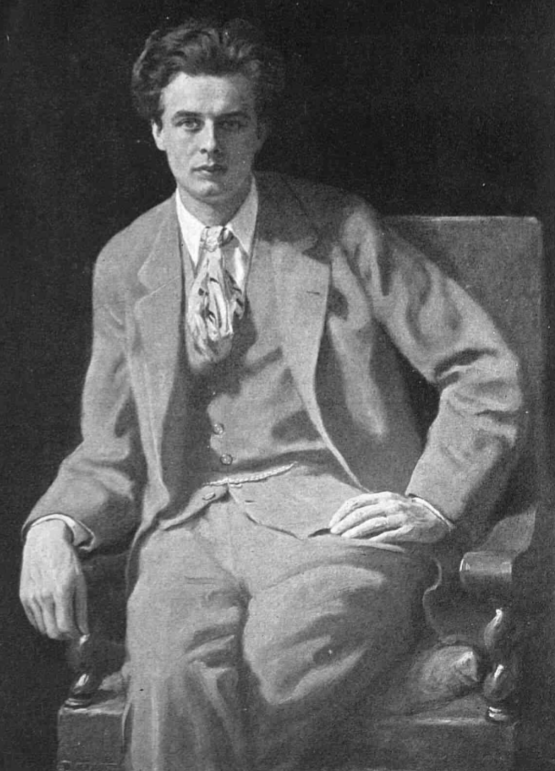
Aldous Huxley distrusted easy consolations, including his own. Across satire, dystopia, pacifist argument, comparative mysticism and late utopia, he kept asking how an educated person might distinguish greater freedom from a more agreeable form of conditioning.
1894–1921
Science in the family, literature after lost sight
Huxley grew up in a family of scientists, teachers and writers near Godalming. He expected to study medicine until keratitis severely impaired his sight at sixteen. After partial recovery he read English at Balliol College, Oxford, graduated in 1916 and was rejected for military service. The change of vocation did not remove science from his work; it made questions of observation, instrument and human purpose unusually personal.
He married Maria Nys in 1919, worked for the Athenaeum and as a drama critic, and began with poetry and stories. Crome Yellow turns a country-house gathering into an instrument for hearing rival theories, vanities and failed intimacies. The young satirist’s gift is quick classification; the danger, which his later work confronts, is that lucidity can become a shield against participation.
Antic Hay, Those Barren Leaves and Point Counter Point enlarged the social field. In the last, plot lines alternate like musical voices and recognisable intellectual types argue through compromised lives. Huxley does not simply stage a debate: a proposition sounds different when spoken by a jealous spouse, a laboratory researcher or a novelist turning friends into material.
Brave New World converts that counterpoint into a system. Hatcheries, conditioning, caste, compulsory consumption and soma remove many causes of suffering while also removing privacy, durable attachment and unplanned choice. Its satirical force comes from making the World State efficient and pleasant enough that the reader must say what freedom is for, rather than merely recoil from a uniformed tyrant.
During the uneasy years after Brave New World, Huxley wrote journalism, travel and the formally ambitious Eyeless in Gaza. The novel breaks Anthony Beavis’s life out of chronological order: callousness and grief are placed beside later efforts at responsibility, so moral change is something the reader reconstructs rather than accepts as a declaration.
Huxley joined the Peace Pledge Union and argued in Ends and Means that methods shape the society they claim to build. His commitment was serious and historically consequential, yet the general pacifist programme did not answer every case posed by fascist expansion. The distinction between a searching novel and a prescriptive essay is useful here: the fiction leaves more resistance inside the form.
Aldous and Maria moved to the United States in 1937. Hollywood screen work paid well and exposed him to collaborative authorship: Jane Murfin shared screenplay credit on Pride and Prejudice; John Houseman and director Robert Stevenson shared Jane Eyre. Huxley also worked on projects that were rewritten or never produced. Film credits are a useful corrective to the image of an isolated sage.
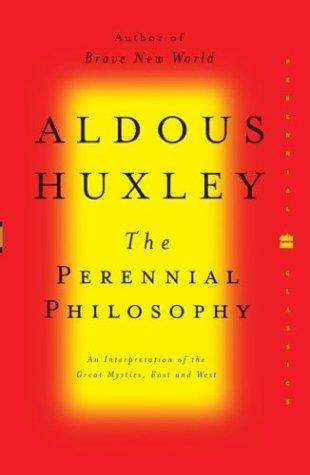
Through Gerald Heard and the Vedanta circle around Swami Prabhavananda, with Christopher Isherwood among its writers, Huxley pursued contemplative practice and comparative religion. The Perennial Philosophy arranges voices from distinct traditions around a shared “divine reality.” Its juxtapositions can be illuminating, but they are an editorial thesis: doctrinal differences and historical power do not disappear because excerpts rhyme.
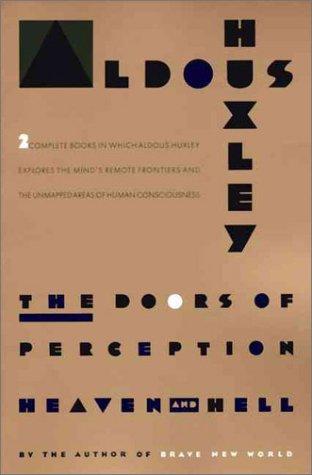
In 1953 Huxley took mescaline under the supervision of psychiatrist Humphry Osmond, with Maria present and recording notes. The Doors of Perception turns the session into exact sensory description and a much larger metaphysical interpretation. That movement is the book’s fascination and its limit: one person’s experience under particular conditions cannot by itself validate a universal account of mind.
After Maria’s death in 1955, Huxley married the violinist and psychotherapist Laura Archera. He continued to write and lecture, including the 1959 Human Situation series at the University of California, Santa Barbara. Brave New World Revisited speaks more directly about propaganda, population, drugs and education, sometimes clarifying the novel’s concerns and sometimes trading its dramatic openness for broad prediction.
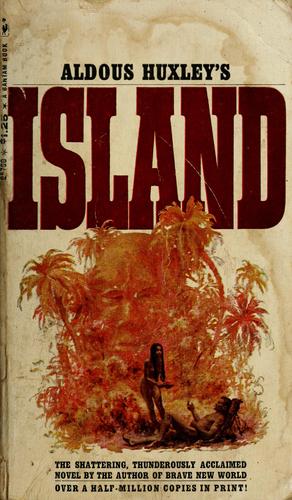
A 1961 fire destroyed the Huxleys’ Los Angeles house and much of the personal archive. Island, published the next year, answers Brave New World with Pala: attention training, mutual adoption, frank education, local medicine and limits on consumption become social practices rather than a philosopher’s speech. The outsider Will Farnaby learns through institutions and relationships, while oil interests and military ambition close in.
The answer is deliberately vulnerable, not innocent. Pala’s programme blends traditions through Huxley’s Western synthesis, and its reproductive planning and idealised island deserve critical scrutiny. Begin with Brave New World, read Island against it, then use Point Counter Point and Eyeless in Gaza to recover the novelist from the prophet. The essays and recorded lectures are best treated as arguments to test, not forecasts to score.