Power comes with conditions
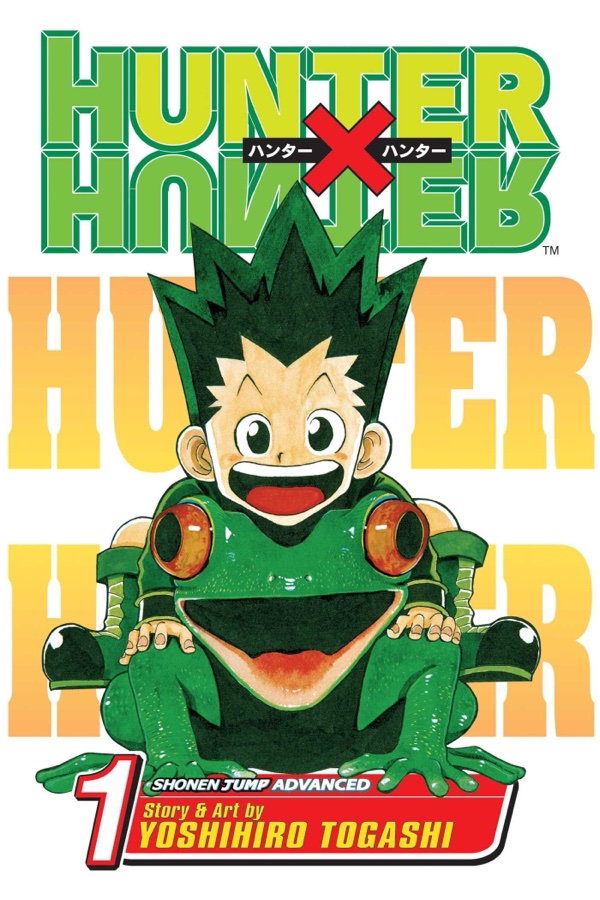
Hunter × Hunter began in Weekly Shōnen Jump on 3 March 1998. Gon Freecss, raised on Whale Island, sets out to become a licensed Hunter because his absent father Ging is one. The exam is a sequence of small rulebooks: a run of roughly 100 kilometres into a swamp of monsters, a cooking test set by two gourmet Hunters, a Trick Tower where candidates must get past a squad of convicted killers. Takeuchi applied screentone to pages of the first volume. Thompson’s description of Togashi’s method is that he “invents some little closed system or rules just so the heroes can break them” — the Greed Island game, which is a collectible card game inside a role-playing world, is the extreme case. Another of his observations is visual: Ging’s first appearance, in volume 8, shows him riding a giant beast, then the view pulls out into a two-page spread to reveal that beast riding on something vastly bigger. The page teaches the scale of the world in one turn.
Passing the exam turns out to be the easy part; a real Hunter must master Nen. Its grammar is concrete. Every user practises four basics — Ten to shroud the body, Zetsu to hide it, Ren to pour out more aura, Hatsu to express a personal ability — and each person’s Hatsu falls into one of six types: Enhancer, Transmuter, Emitter, Conjurer, Manipulator or Specialist. Then comes the clause that makes the system a contract: a user can make an ability stronger by binding it to restrictions and vows, and the stricter the pledge, the greater the power. Kurapika, last survivor of a clan murdered for their eyes by the Phantom Troupe, binds his chains so that they may be used only against the Troupe, on pain of his own death. In the Yorknew City arc that vow lets him kill two of its members and seal the powers of its leader, Chrollo. The critic Ryūji Kayama has argued in Bunshun that the early rule games protect the boy heroes — Netero, the chairman, plays Gon and Killua for a ball using only his left hand and right foot; the Heavens Arena stops fights on a ten-point knockout; killing in Greed Island makes winning impossible — and that the Chimera Ant arc is where every such shackle comes off. Netero loses that left hand and right foot fighting the Ant King, Meruem.
The Chimera Ant arc is the series at its most extreme. An ant queen washes up, acquires a taste for people, and her soldiers grind captured villagers into meatballs; her son Meruem takes over a dictatorship that Thompson calls a thinly veiled North Korea and prepares to consume its five million citizens, and plays an invented board game, Gungi. Kayama matches the attack on the palace — Zeno’s aerial “Dragon Dive” and the hunters splitting three ways to get inside — to moves on the Gungi board. Netero ends his fight with a suicide bomb; Gon wrecks his own body in his revenge on Neferpitou. Thompson calls the manga “incredibly dense,” sometimes too fond of characters explaining rules, and notes gory panels in later volumes apparently censored with screentone. He is also plain about Hisoka, the magician who kills with playing cards, whose interest in the boys he calls “blatantly pedophilic.” Togashi does not make his villains safe.