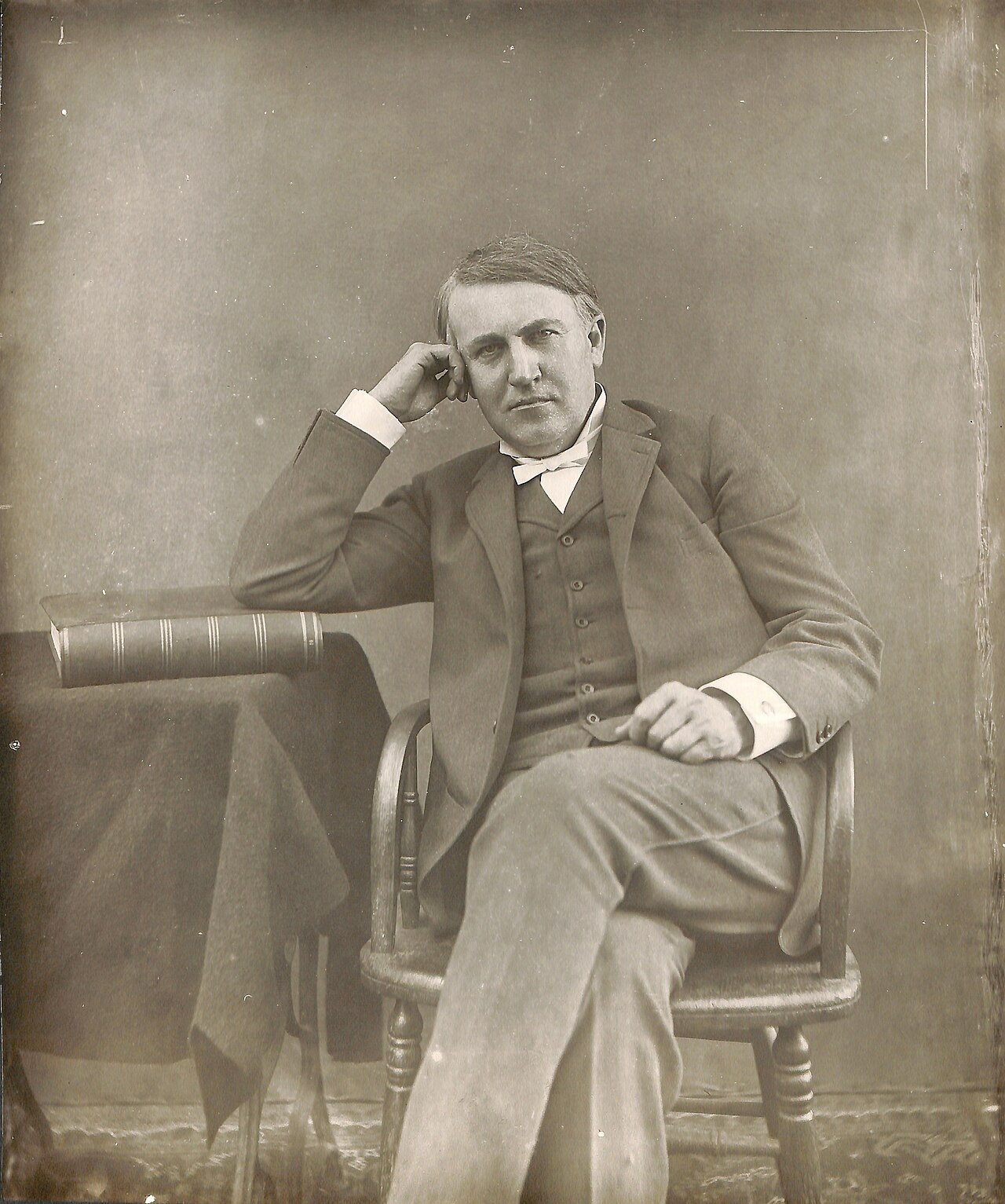
Edison’s inventions are easier to understand when the laboratory stays in the frame. A phonograph needed a recording surface; a useful lamp needed generators, wires, meters and customers. He built organisations to turn a promising effect into a service.
1847–1870s
The telegraph as a workshop
Edison grew up in Ohio and Michigan, left formal school early and learned telegraphy while working on the railroad. A telegraph operator encountered practical problems in signals, timing and recording; travelling work also exposed Edison to markets for better equipment. A successful stock ticker helped finance his Newark workshop.
His first businesses were built around improvements to existing networks, not inventions arriving from nowhere. Skilled shop workers joined him in Newark and later followed to Menlo Park. The Rutgers Edison Papers trace how those early commercial relationships formed the core of the later laboratory.
At Menlo Park, Edison assembled machinists and experimenters around tools, records and a steady flow of problems. The 1877 phonograph recorded vibrations on tinfoil and played them back: an astonishing demonstration, but not yet the later durable sound business. Its mechanism is simple enough to imagine and demanding enough to improve.
Charles Batchelor, John Kruesi and other workers deserve their own place in the account. Rutgers’ Working at Menlo Park identifies their technical roles and shows why a patent bearing one name can conceal a collective process.
The electric-light project required a long-lived incandescent lamp, but also generators, distribution wires, switches, meters and a tariff customers could accept. Edison and his team experimented with filaments and the practical balance of the entire circuit. Francis Upton contributed mathematical and scientific training; Batchelor and many machinists made the trials workable.
The Edison Lamp Company record shows the next decision: make lamps reliably enough to sell, and place the manufacturing organisation beside the research. Pearl Street in New York began serving customers in 1882. That achievement was a system made by many people and investors, amid competing approaches to electrical power.
Edison opened a larger laboratory at West Orange in 1887. It supported work on improved phonographs, batteries and moving pictures. W. K. L. Dickson and other staff were central to the film apparatus; attribution to Edison alone obscures their work. The site let research, prototypes and factories interact, but not every costly experiment became a viable product.
The National Park Service audio tour describes West Orange as an early purpose-built, team-based research operation. Walk through its rooms virtually with that question in mind: what kinds of work are visible in the finished device, and which are hidden?
A costly failure preceded Edison’s last large product campaign: he sold his General Electric shares to finance iron-ore milling, yet could not make the process pay. Beginning in 1899, he turned to an alkaline storage battery meant for electric cars. It took roughly a decade of laboratory trials and manufacturing changes to make the battery practical. By then gasoline cars had improved enough that the expected market was shrinking.
The battery found different customers: rail-car lighting and signals, maritime buoys and miners’ lamps. According to the National Park Service, it became his most profitable product. In 1911 Edison combined his West Orange companies into Thomas A. Edison Incorporated and passed more daily operation to staff. The pivot from vehicle power to dependable industrial uses, and the move from personal oversight to a larger company, show an entrepreneur revising the business around what the product could actually do.
He continued smaller investigations, including a late search for domestic rubber sources with Henry Ford and Harvey Firestone, until his death in 1931. The battery story sits beside the lamp: a useful system may emerge from a first commercial aim that fails.