The sky becomes available
By its own legend, the company was born at four in the morning on 19 December 1974, at the edge of Livry-Gargan, when Philippe Druillet, Mœbius, Jean-Pierre Dionnet and Bernard Farkas resolved to answer henceforth only to the collective name Les Humanoïdes Associés. That is Dionnet’s account in the first issue’s editorial, which also gives the plan: reissue Le Bandard fou and bring out a science-fiction comics magazine every three months. Druillet and Giraud were Pilote stars; Dionnet was a young critic and writer; Farkas, from outside comics, ran the money. Nikita Mandryka supplied the name Métal Hurlant, “screaming metal”, and Étienne Robial drew the title lettering and laid out the pages. Issue 1, dated January 1975, had 68 pages, eighteen of them in colour, cost 8 francs and carried the words “Réservé aux adultes”. “We just wanted freedom,” Dionnet said half a century later. He also said they started with no money at all, always paid the artists, and never told Mœbius or Druillet how close the magazine came to dying; by the early 1980s artists including Druillet were leaving, tired of being badly paid.
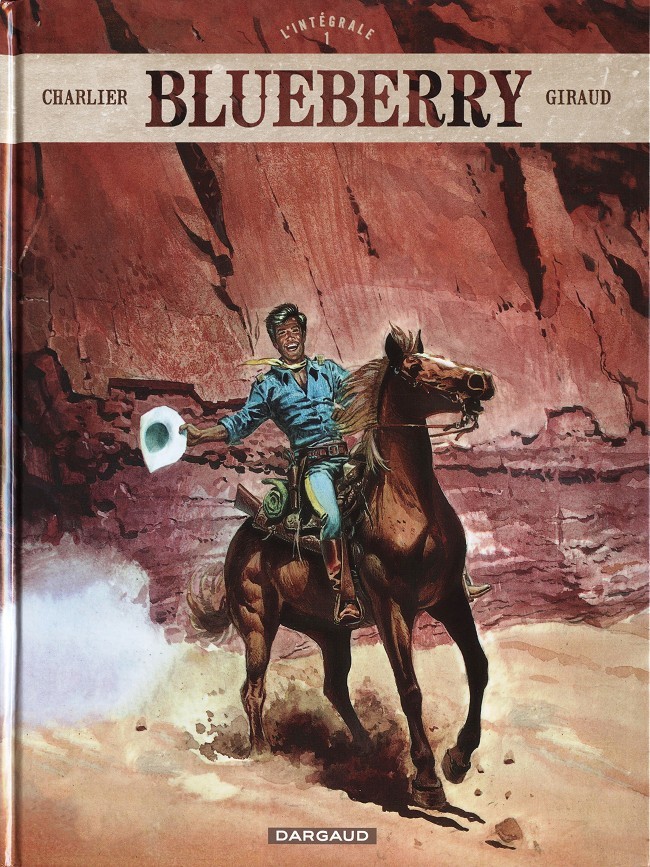
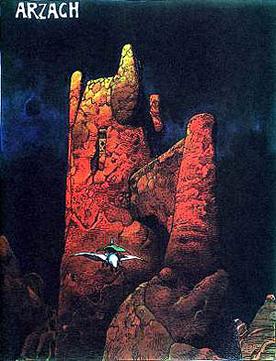
Mœbius drew the first cover and eight pages of Arzach. Coloured directly on the drawing, it has no balloons, no captions and no sound effects. A hooded rider on a white pterodactyl sees a woman undressing in a castle tower, lassoes the guard who shouts at him and ties him to a dinosaur skeleton in the sand, climbs to her window, finds her face is monstrous, and flies off, leaving the guard where he is. The joke lands only because nothing is explained: the eye has to follow the glide, the tower, the bones and one face. The title was spelled differently in each instalment (Arzach, Harzak, Harzack, Arzak, Harzakc) over five issues to January 1976, four eight-page stories and one of two pages. Freed from Blueberry’s “choking captions and balloons”, in Gravett’s phrase, the founders gave a large share of a magazine’s scarce colour pages to pictures that had to carry the story alone.
The Airtight Garage began as an accident of editing. In a foreword written in 2006 Mœbius describes coming home in “slightly exalted states” to draw a page or two late at night until he collapsed. Two such pages he regarded as a graphic joke that “could not, should not lead anywhere”, and he put them in a drawer. Dionnet, who had a habit of going through his drawers, found them, took them away, asked for a short continuation that could serve as sequel and ending, and printed them. Just before the next issue he phoned about the delivery. Mœbius had done nothing, and he had kept no photocopies, so in two days of panic he drew two more pages “whose coherence was not guaranteed”; the whole story, he wrote, was made “in that kind of disjointed panic.” The magazine’s index shows Le Garage hermétique de Jerry Cornelius starting in issue 6, March 1976, the issue with which Métal Hurlant went bimonthly; from issue 9, in September, it was monthly, and the Garage ran in every issue to no. 41 in June 1979. “Every month the series would descend into pure improvisation,” he said, as Gravett quotes him: two, three or four pages, no script, Major Grubert building a three-level universe inside an asteroid while everyone hunts Jerry Cornelius, a character Michael Moorcock had offered to any writer who wanted him. It ends with Grubert stepping through a door into a Paris Métro station, and became the album Major Fatal in 1979.
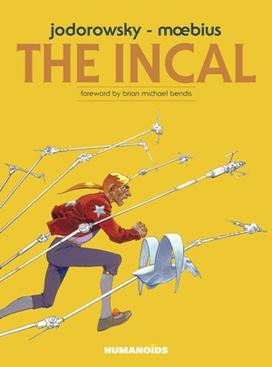
Cinema arrived through the same door. Alejandro Jodorowsky, who admired Blueberry, recruited Giraud in 1974–75 for his adaptation of Frank Herbert’s Dune; Giraud rushed Angel Face to get to it. Jodorowsky, Giraud said, “gave me direct proof that it was possible to open the door inside.” Beside H. R. Giger, Chris Foss and the effects designer Dan O’Bannon he drew the storyboard, about 3,000 drawings by the count of Frank Pavich’s 2013 documentary Jodorowsky’s Dune, before the money ran out in 1976. Jodorowsky also handed him Carlos Castaneda’s books about the Yaqui sorcerer don Juan, and Castaneda’s vocabulary drifted into the comics: the Garage’s villain is called the Nagual. O’Bannon wrote The Long Tomorrow, a future noir of stacked vertical cities that Mœbius drew for Métal Hurlant 7 and 8 in 1976 and that later fed Blade Runner, a film Scott asked him to work on when he was already committed elsewhere. O’Bannon, writing Alien, brought the Dune team to Ridley Scott; Giraud designed the Nostromo crew’s costumes, including the bulky, samurai-like spacesuits that the costume designer John Mollo realised, while Ron Cobb designed the ship and Giger the creature. “Fifteen days of work and years of media and publicity fallout,” Giraud called it. Jodorowsky’s first comic with him, Les Yeux du chat (1978), was told in single images, a blind boy on one page and his eagle hunting eyes on the facing one. In 1979 the two signatures shared one magazine: Métal Hurlant serialised Charlier and Gir’s Blueberry album Nez cassé in issues 38 to 40, beside the last instalments of the Garage.