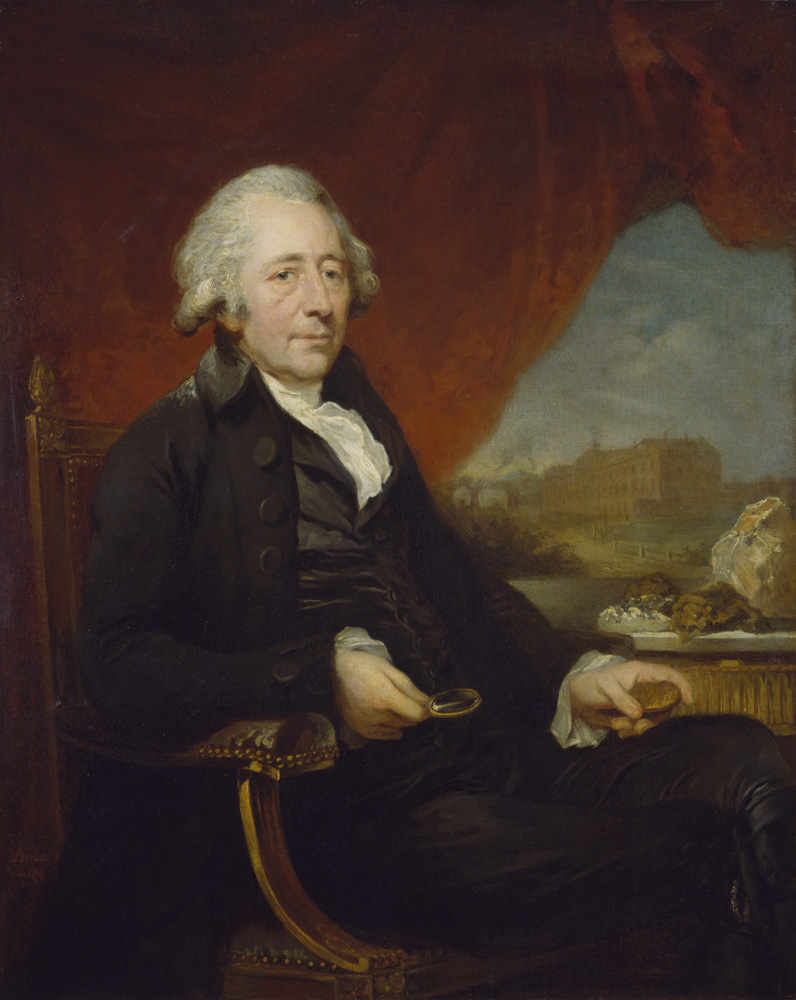
Boulton’s talent was to make invention reproducible and saleable. Buttons, silver, steam engines and coins seem different businesses, yet each asked how designs, trained hands, capital and reliable machinery could meet a growing market.
1728–1762
A Birmingham maker
Boulton grew up in Birmingham’s metal trades and joined his father’s business making buckles and other small metal goods then called “toys.” He learned that an object’s design could command a market only if suppliers, finishers and sellers could deliver it consistently. After his father’s death he expanded production and began building a larger works at Soho.
The move was entrepreneurial as much as architectural. Soho brought different crafts under a coordinated system while leaving room for outside designers and suppliers. The archive’s pattern books and correspondence reveal how much thought went into choosing, costing and repeating a form.
1762–1775
Soho’s many hands
The Soho Manufactory made plated ware, silver goods, buttons and decorative objects for domestic and export buyers. Boulton sought an assay office in Birmingham, achieved in 1773, so local makers could certify silver without sending it to London. This was an institutional change that improved the credibility of a manufacturing district, not simply a private convenience.
The Archives of Soho preserve workers and household servants alongside the partners’ letters. Their existence should change how one reads the famous name above the door: skilled labour, workshop managers, designers and sales agents all made Boulton’s promise of quality possible.
James Watt had developed the separate condenser, reducing the fuel wasted when a cylinder was repeatedly cooled and reheated. The 1775 partnership joined his engineering to Boulton’s capital, manufacturing network and sales ability. Early customers were mines that needed to pump water, with the business often paid according to the fuel the improved engine saved.
The partnership’s records make a useful antidote to a lone-inventor story. Engines required drawings, precision parts, installation and service. William Murdoch and other engineers contributed practical solutions in the field; the firm’s success depended on translating a principle into machines that could run for customers.
Rotary motion opened steam power to mills and workshops beyond mines. Demand changed the company’s space and methods, leading to the Soho Foundry at Smethwick in the 1790s. The Birmingham premises catalogue cautions that Soho Manufactory itself remained a site for Boulton’s other businesses rather than becoming a wholly owned steam-engine factory.
The distinction matters because Boulton was managing several systems at once. A working engine was not a drawing brought to life by one craftsman: it was an investment in foundry capacity, fitting, trained erectors, records, customer relationships and repairs.
Boulton applied machinery to coinage at the Soho Mint, supplying copper coins for Britain and other governments. More regular weight, striking and edge treatment were answers to a practical problem: circulating money needed public confidence. The enterprise involved engravers, die makers, machine operators and officials as well as Boulton’s commercial judgment.
He died in 1809. Read the Soho archive guide after seeing a medal or engine: it restores the correspondence, experiments and workers behind polished artifacts. His most enduring method was organising many kinds of expertise so a technical improvement could survive the journey to production.