He gave a virus scanner away on bulletin boards and sold the fear that made firms pay, then spent the fortune on yoga, guns, Belize, flight, crypto touting and a Spanish cell.
Shareware Hook
Let anyone copy the scanner free, then charged the companies that came to need it.
Five Million
Let a guess of five million Michelangelo infections stand, and sold the panic.
Bath-Salt Boasts
Claimed on a drug forum to have made 50 pounds of MDPV, then called it a prank.
John McAfee put a virus scanner on bulletin boards for anyone to copy, charged the companies that came to rely on it, and sold the fear that made both happen. The scanner was real and useful; the fear was at times inflated, and he later boasted of what that did for sales. After he cashed out he became a yoga teacher, an ultralight evangelist, a heavily armed expatriate in Belize, a fugitive from a murder inquiry in which he was never charged, a presidential candidate and a paid crypto tout. He died in a Spanish prison cell in 2021. Much of his early life survives only in his own telling; this page follows the documents where they exist and marks his stories as his.
1945–1986
Acid, cocaine and a security clearance
John David McAfee was born on 18 September 1945 on a US Army base at Cinderford in Gloucestershire, to Don McAfee, an American soldier, and Joan Williams, an Englishwoman. The family went back to Don’s Virginia, where he worked as a road surveyor and Joan as a bank teller. McAfee’s account of the house is brutal: his father drank, beat him and his mother, and shot himself when John was fifteen. “Every relationship I have, he’s by my side; every mistrust, he is the negotiator of that mistrust. So my life is fucked,” he told Wired’s Joshua Davis in 2012.
He took a mathematics degree at Roanoke College in 1967, paying his way, he said, by selling “free” magazine subscriptions door to door that came with a shipping and handling fee. “I made a fortune.” He began a mathematics doctorate at Northeast Louisiana State College and was thrown out for sleeping with an undergraduate, whom he later married. The Los Angeles Times obituary places him at NASA in 1968. Wired’s account, built from his interviews, has him writing punch-card programs for Univac in Bristol, Tennessee, until an arrest for buying marijuana got him fired, then landing a job at the Missouri Pacific Railroad in St Louis in 1969 with a résumé the magazine calls totally fake.
There he made an IBM computer schedule trains while, by his account, dropping acid in the mornings. One day he snorted a whole bag of DMT; within an hour, he said, his mind was shattered, and he ended up behind a garbage can downtown hearing voices. He never went back. Jobs at large firms followed, Xerox and Siemens among them, until Omex in Santa Clara, where in 1983 he was director of engineering, snorting cocaine off his desk, selling it to his subordinates, taking quaaludes to come down and finishing a bottle of Scotch a day. His wife left him. A therapist sent him to Alcoholics Anonymous, and he said he stayed sober from then on.
By 1986 he had a security clearance and a job on a classified voice-recognition programme at Lockheed in Sunnyvale. He also launched his first scheme of the viral age: the American Institute for Safe Sex Practices, a computerised dating service open only to people who tested HIV-negative, who were issued a card certifying it. Nearly everything in this chapter before Lockheed comes from McAfee himself, a man who later said his aim with reporters was to “fuck with the media as much as I can”, so it reads best as a self-portrait.
1986–1989
Eighteen viruses at the DOS prompt
In 1986 two brothers in Lahore released Brain, the first known virus aimed at IBM PCs: it lived in the boot sector of floppy disks and hid by showing any program that inspected the sector a saved clean copy. McAfee read about it in the San Jose Mercury News and, he said, found it as terrifying as his father’s beatings, an attack with no reason he could see. In 1987 he started McAfee Associates from his 700-square-foot house in Santa Clara; by 1989 its documents gave the address as 4423 Cheeney Street. The Computer Virus Industry Association, the trade body he founded and chaired, gave the same street address and bulletin-board number, and his own essays cited it as an authority.
Who wrote the first scanner? McAfee told Steve Morgan of Cybersecurity Ventures in 2015 that he paid a programmer he had met on a bulletin board, Dennis Yell, $200 to write it, and in February 2019 he tweeted, “I designed it and hired a coder.” The name rests on his word alone. The earliest surviving releases show him doing the technical work that mattered next. The version notes are signed by him in the first person: when IBM released its own scanner, VIRSCAN, he traded virus samples with IBM’s David Chess and explained that he had chosen to encrypt VIRUSCAN’s identification strings so that hackers could not easily alter viruses to slip past them. Aryeh Goretsky, his first full-time employee, recalls McAfee flashing a “SECURITY OFFICER” badge and the association’s name to collect Disk Killer–infected floppies from the US office of a Taiwanese notebook maker in Milpitas, then releasing a new version within hours.
The oldest archived release, VIRUSCAN 0.2V18, is a 33 KB program with a short manual, its files dated June to September 1989. You typed SCAN C: and it worked through the hard disk’s partition table, the DOS boot sector and every file that could be loaded and run, looking for a code string characteristic of each of 18 viruses, among them Pakistani Brain, Jerusalem, Stoned, Cascade and Datacrime. A thousand files took about three minutes. A hit named the file and the virus. Removal was mostly instruction: boot from a clean write-protected floppy, run SYS over an infected boot sector, delete infected programs and reinstall them from the original disks, or low-level format the drive. A licence cost $15 and bought free help with removal; anyone unregistered had to buy the disinfecting utilities.
What made it a business was the loop around the program. Users uploaded suspect files to a protected area of the company’s bulletin board, which Goretsky says staff checked as often as hourly; each new virus was taken apart, a string chosen, and a new SCAN posted. Early version numbers tracked the count: 0.6V39 knew 39 strains in October 1989, and 2.3V56 knew 61 by January 1990, many first reported by researchers the notes name, among them Fridrik Skulason in Iceland, Jan Terpstra in the Netherlands, Joe Hirst in Brighton and Yisrael Radai in Jerusalem. By then a /D switch overwrote an infected file with the byte C3, the x86 return instruction, before deleting it; home users paid $25 a year for upgrades downloaded from the five-line board at 408 988 4004; and companies, agencies and organisations had to buy site licences. Free to spread, paid to keep at work: within five years, Wired reported, half the Fortune 100 were paying.
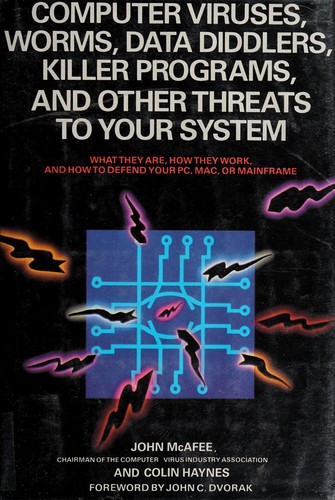
He sold the danger as hard as the cure. He fitted out a 27-foot Winnebago as an “antivirus paramedic unit”, told The MacNeil/Lehrer NewsHour in 1988 that some companies were near collapse, and in 1989 published, with Colin Haynes, a book whose jacket billed him as the association’s chairman and which warned that the reality was “so alarming that it would be very difficult to exaggerate.” Critics noticed. Rob Rosenberger and Ross M. Greenberg’s Computer Virus Myths cited a Cornell report saying that McAfee, source of a $98 million estimate for cleaning up the 1988 Morris worm, “was probably serving [him]self”.
In September 1989 Aryeh Goretsky, a college student and friend, asked McAfee for a part-time job and became the company’s first full-time employee. On his first day McAfee explained file-infecting viruses by drawing boxes on scrap paper, and the first support call was about Brain. Programmers followed; Goretsky remembers one senior programmer advising a customer to drive a wooden stake through his hard disk and bury it upside down at a crossroads, after which programmers were kept off the phones. By 1993 the bulletin board had 25 lines, the company had a CompuServe forum and an internet address, and an agent list ran from Argentina to Australia.
Michelangelo, a descendant of the Stoned boot-sector virus first detected in New Zealand in April 1991, sat quietly in boot sectors until the computer’s clock read 6 March, then wrote garbage over the start of the hard disk, destroying the master boot record and often the file allocation table. As the 1992 date approached, a reporter asked McAfee how many machines were infected. Goretsky, who was in the office, says McAfee answered that it could be 5,000 or five million and there was no way to know, and that in print it hardened into five million. Wired’s 2012 account has McAfee telling almost every major news outlet that the virus could destroy as many as five million computers; the March 1992 edition of Computer Virus Myths lists “over 5,000,000 computers (1992)” among the McAfee figures it mocks.
The phones rang without pause. The bulletin-board lines jammed, McAfee added modems and sent callers to CompuServe, staff worked twenty-hour days, and buyers were told to download now and send a cheque later. On 7 March the Mirror reported that experts reckoned 10,000 systems had been hit worldwide. Goretsky counts about 60,000 infections reported to McAfee Associates, half before the date and half on it, and believes the true number was higher. McAfee’s own version of the payoff, in a 2000 email quoted by Wired: “My business increased tenfold in the two months following the stories and six months later our revenues were 50 times greater.” Goretsky puts the growth at fourfold. The industry, and McAfee above all, was accused of scaremongering; the accusation did not hurt sales.
McAfee Associates listed on Nasdaq in October 1992, and his shares were suddenly worth about $80 million. Inside, according to a 2001 San Jose Mercury News account relayed by the Los Angeles Times, early staff held Wiccan rituals at lunch, fought with swords, recited Shakespeare and kept a contest to have sex in as many parts of the office as possible. McAfee said he did not like running companies of more than a few dozen people; in 1993 he hired William Larson as chief executive, and in 1994 he sold his remaining stake. The company that later sold to Intel for $7.68 billion was built by others.
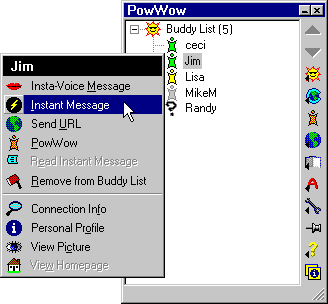
In December 1994 he founded Tribal Voice in Woodland Park, Colorado, and carried the shareware trick into conversation. EDN introduced him in 1999 as a chairman “whose dream is to free every soul from its physical body via the Internet.” PowWow, a free Windows client, let people send instant messages, talk by voice, browse the web together and build their own chat communities. Word of mouth did the marketing: by April 1999 the company claimed nearly three million users, and its own site soon claimed five million in 18,000 communities. Staff remembered McAfee as the most disruptive tester; whenever he signed on under one of his personalities, hundreds of users followed him in and the system crashed. Engineering was led by others, latterly chief technology officer Nigel Thompson, formerly of Microsoft. The early company dressed itself in tribal imagery; once it went corporate, EDN was told, “all that stuff about Indian tribes and outlaws had to come down.” He sold Tribal Voice in 1999, for $17 million according to the Los Angeles Times.
Around 2000 he bought an estate in the Rockies at Woodland Park and ran intensive retreats in relational yoga, a system of his own; in 2001 he published four books on yoga and spirit, among them Into the Heart of Truth. He said he had learned Transcendental Meditation from the Maharishi in his early twenties and followed him around the United States. By 2012, in Belize, he was telling Westword about “observational yoga”, in which paying customers sat in easy chairs with juice and coffee and watched other people hold the poses. He claimed 800 clients, cited a “scientific basis”, and added that in Belize he could “make any kind of outrageous claim that I choose”. The paper’s headline asked whether it was a prank.
Flying was the other obsession. He promoted aerotrekking, flying small light aircraft low between remote airstrips, and built a private airport on his New Mexico land. In 2006 his 22-year-old nephew Joel Bitow, an instructor in the venture who held only a sport-pilot certificate, crashed and died with a passenger, Robert Gilson. The lawsuits followed; a 2014 judgment for Gilson’s family of $2.5 million was never paid. The 2008 crash took much of his fortune, and by 2009 he had auctioned the Hawaii acreage, the New Mexico airport and his ten-passenger plane. He told Wired he also wanted to be a harder target: living abroad would make any judgment against him harder to collect.
He moved into a beach villa on Ambergris Caye in Belize in April 2008, having chosen it on Google Earth, and from 2010 spent more than a million dollars on a compound of thatched bungalows by the New River, near the mainland village of Carmelita. He started a cigar maker, a coffee distributor and a water taxi, injected testosterone every other week, and set up QuorumEx with Allison Adonizio, a microbiologist doing postgraduate research at Harvard, to hunt plant compounds that disrupt bacterial quorum sensing. He spent his mornings in Lover’s Bar, a brothel-saloon in Orange Walk, began sleeping with a 16-year-old, Amy Emshwiller, who later told Wired she once fired his revolver at him in bed and missed, bought guns and gear for the local police and paid them to patrol, and hired guards with long criminal records. Adonizio left, saying he had become “a very scary person”.
On 30 April 2012 Belize’s Gang Suppression Unit raided the Carmelita compound on a tip about a methamphetamine lab. McAfee came out naked with a revolver, laid it down and was handcuffed; police shot one of his dogs. They found no meth and no illegal drugs, seized ten weapons and 320 rounds, held him one night in the Queen Street jail and dropped the charge. The suspicion had a source. From 2010 he had posted on the drug forum Bluelight about MDPV, the stimulant sold as bath salts, describing getting a few drops on his fingers and not sleeping for four days, and claiming to have made 50 pounds of it and handed out more than 3,000 doses in Belize. Afterwards he called it “the most tongue-in-cheek thing in the fucking world” and denied taking it.
Back on the island he lived with guards, several young women, a pistol strapped across his bare chest and eleven dogs that barked at everyone on the beach. Gregory Faull, a 52-year-old Florida bar owner two houses down, filed a formal complaint about the dogs that week. On the night of 9 November, McAfee wrote to Davis, men came off the dock and his dogs were poisoned; four died, and he shot them as they convulsed. On 11 November Faull was found in his house with a single gunshot wound to the back of the head. When police came to McAfee’s property that afternoon, he dug a trench in the sand and lay in it with a cardboard box over his head. Police spokesman Raphael Martinez called him a person of interest and said they hoped he had information. McAfee said he had nothing to do with it and thought the killers had come for him and got the wrong house.
He ran. For weeks he moved around Belize, disguised, he said, with dyed hair and chewed gum stuck to his upper gums, phoning Wired and blogging. In early December a Vice crew travelling with him posted a photograph with its location data intact, placing him in Guatemala. Arrested there on 5 December for entering illegally, he was refused asylum by President Otto Pérez Molina, who said the flight looked like fear of an investigation rather than persecution, and went to hospital with chest pains he later said he faked to buy his lawyer time. Guatemala sent him to Miami instead of Belize. He was never charged over Faull’s death. Faull’s estate sued him in federal court in Orlando; he never answered, and in November 2018 Judge Gregory Presnell entered a default judgment holding him liable for the wrongful death, with about $25 million in damages awarded in 2019. The complaint’s allegation that he paid a local man $5,000 to torture and kill Faull was accepted as pleaded because he never contested it; it was never tried. Nanette Burstein’s 2016 documentary Gringo added worse allegations, including Adonizio’s that he drugged and raped her; McAfee said the film’s witnesses were paid to lie.
2013–2020
Publicity and legal flight
The night he landed in Miami he picked up Janice Dyson, a sex worker in South Beach; they married in 2013. He spent the next years turning notoriety into a brand: a 2013 video, How to Uninstall McAfee Antivirus, mocked the software and the press while he sat among young women, guns and white powder; he held forth at the hacker conference DEF CON in 2014; for a time he ran a small listed company, MGT Capital. He sought the Libertarian presidential nomination twice. In 2016, at a New York party debate, he opened with “I am unprepared for everything, always” and sat down after 30 seconds; Gary Johnson took the nomination. In 2020, campaigning from exile, he quit the race on 4 March, endorsed the satirist Vermin Supreme and announced a run for vice-president instead.
Cryptocurrency became the new shareware. In July 2017 he promised that bitcoin would hit $500,000 within three years or he would eat his dick on national television, and later raised the call to $1 million by the end of 2020. Prosecutors said the enthusiasm was paid. A 2021 indictment in Manhattan alleged that from December 2017 to October 2018 he and his bodyguard turned adviser, Jimmy Gale Watson Jr., bought cheap altcoins, recommended them to the roughly 784,000 followers of his Twitter account, and sold into the rise, clearing more than $2 million, and that start-ups running initial coin offerings secretly paid them more than $11 million to tout their tokens. The SEC’s civil complaint of October 2020 put McAfee’s undisclosed take from promoting seven offerings at more than $23 million.
He also announced that he had not filed a tax return in eight years because taxation was illegal. “Every year I tell the IRS, ‘I am not filing a return, I have no intention of doing so, come and find me,’” he said in a video. In 2019 he went to sea, living on a yacht off Cuba and campaigning from it; in July he was briefly detained in the Dominican Republic after arriving with high-calibre weapons aboard. In October 2020 Spanish police arrested him at Barcelona airport as he was about to board a flight to Istanbul. A Tennessee indictment made public that week alleged that from 2014 to 2018 he had earned millions from consulting, speeches, cryptocurrency promotion and the rights to his life story, filed no returns, and hid income and assets, including a yacht and real estate, in other people’s names.
Speaking at DEF CON8 August 2014
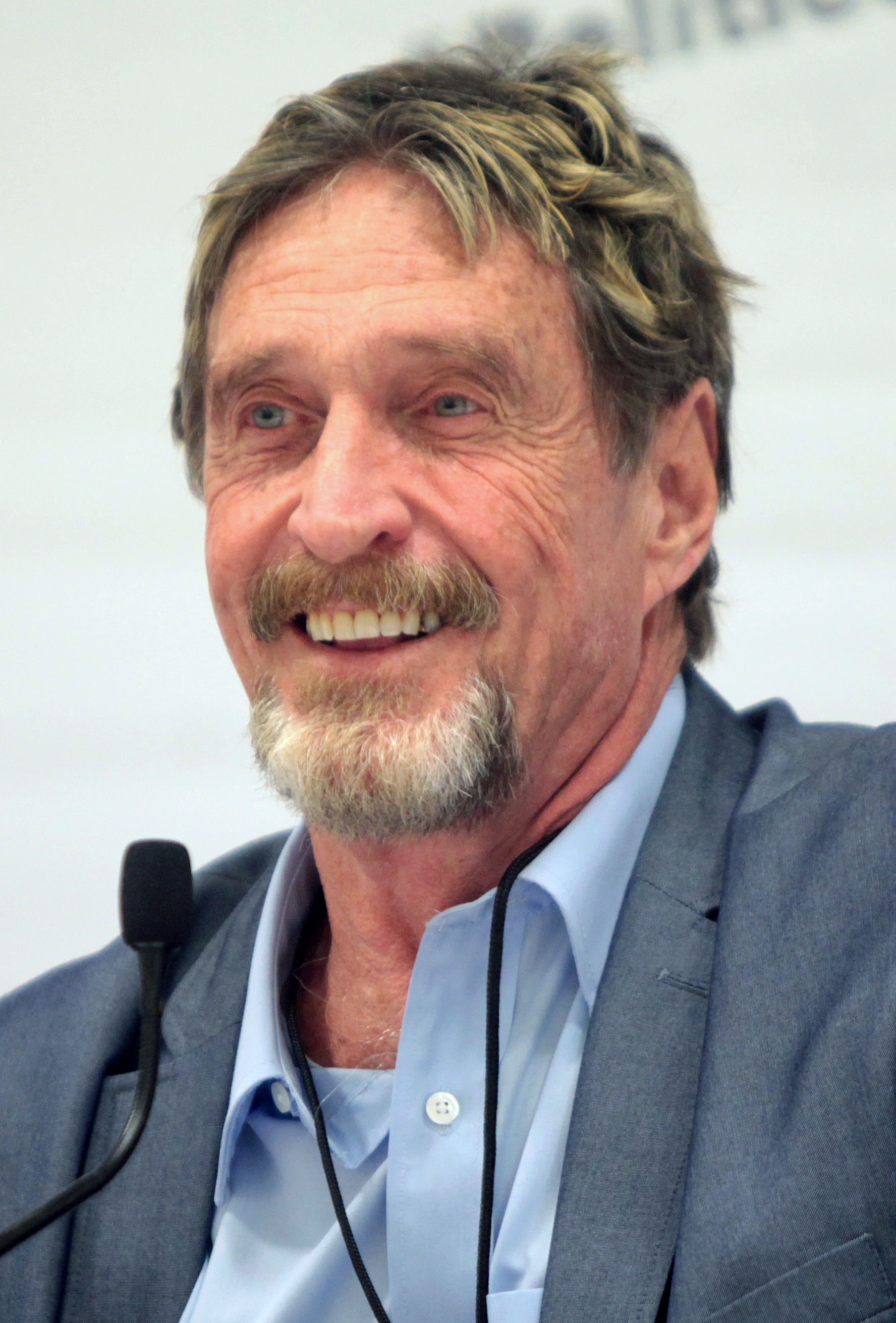
McAfee speaks at DEF CON on 8 August 2014. The conference setting documents one part of his later public persona; the photograph is not evidence for the legal claims discussed in this chapter.
Source & credits
NullSession from Bettendorf, Iowa, United States · CC BY-SA 2.0 · https://creativecommons.org/licenses/by-sa/2.0 · Full frame; WebP conversion; resized.
Xeni Jardin and McAfee speak at Politicon, Pasadena Convention Center, 25 June 2016. The full frame preserves the other participant and the public event, rather than isolating McAfee into another portrait.
Source & credits
Gage Skidmore from Surprise, AZ, United States of America · CC BY-SA 2.0 · https://creativecommons.org/licenses/by-sa/2.0 · Full frame; WebP conversion; resized.
He spent eight months in Brians 2 prison outside Barcelona, telling the Independent it was a “fascinating adventure”. On 23 June 2021 the Spanish National Court’s decision to extradite him on the Tennessee tax charges for 2016 to 2018 was made public; it could still be appealed and needed cabinet approval. That evening guards found him hanged in his cell. The Catalan justice department said everything pointed to suicide; his lawyer told Reuters he had apparently hanged himself; a source told the Associated Press he had a note on him; and within days El País reported that the autopsy found suicide.
He had prepared the conspiracy theory himself. In 2019 he claimed the US government would kill him and dress it up as suicide, and he had a tattoo reading “$WHACKD” to make the point. His lawyer said he had seen no sign of suicidal intent; his widow said his last words to her were “I love you and I will call you in the evening”; a Q appeared on his Instagram within hours. The family pressed for a new investigation. The Martorell court that examined the death refused to reopen it, and in September 2023 the Audiencia de Barcelona rejected their appeal, finding, in elDiario.es’s report, no indication of anything other than suicide, nothing at all. In December 2023 his body, kept for two and a half years in a refrigerator at Barcelona’s justice complex, was released to his family. The tax and fraud charges died with him, untried.