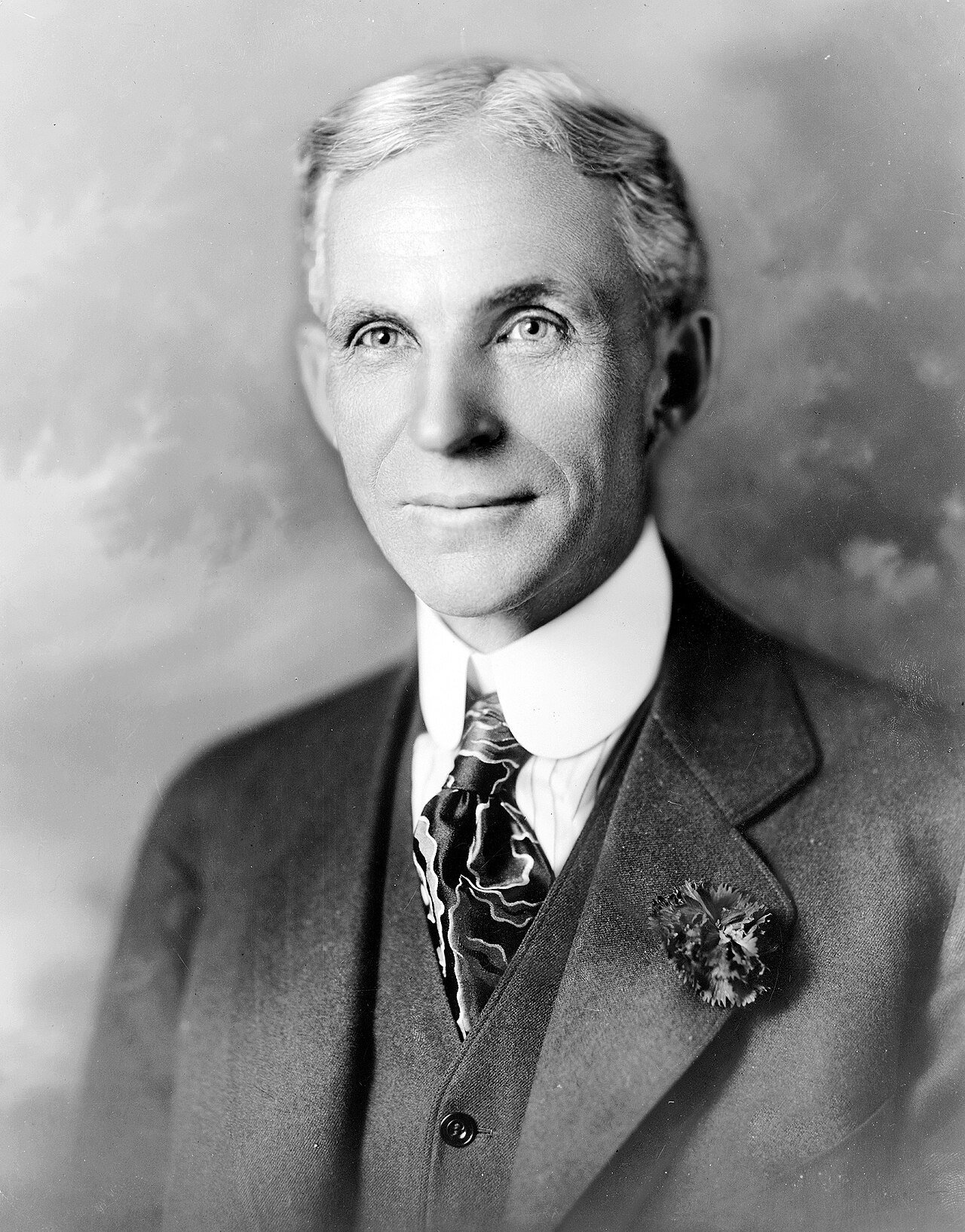
The Model T became a machine for ordinary households because Ford and his colleagues kept changing how it was designed and built. At Highland Park, they changed the motion of work itself: parts, tools and people were arranged so a car could move steadily toward completion. That achievement gave Ford unusual power over workers and public debate, with consequences this history follows closely.
1863–1908
A car for more people
Raised on a Michigan farm, Ford preferred machinery to farming and learned through Detroit machine and electrical work. His early motor ventures failed before the Ford Motor Company took hold in 1903. Investors, managers and engineers supplied capital and skills; Ford’s decisive aim was a dependable car that could reach a much larger public.
The Model T arrived in 1908. Its design and repairability mattered as much as its price, and the price could fall only if production changed. The Henry Ford museum follows the car through those linked choices rather than treating one launch as the entire achievement.
At Highland Park, Ford managers experimented with moving parts through subdivided tasks, beginning with components such as magnetos in 1913 and extending to the chassis. Interchangeable parts, machine tools and material flow came together in a faster system. Workers performed narrower, repetitive jobs while output rose and prices fell.
The museum’s assembly-line guide shows the sequence and names production managers among those who refined it. It is more accurate to credit Ford with leading and funding a sustained organisational experiment than to call him the sole inventor of the moving line.
High turnover threatened the line’s stability. Ford and vice president James Couzens announced the five-dollar day in 1914, increasing workers’ earning potential and drawing crowds of applicants. The offer answered a real labour problem and made jobs more attractive, but it was not an unconditional daily wage for everyone.
Eligibility rules and the Sociological Department subjected workers’ private lives to company inspection. The bargain exposes both sides of Ford’s system: high pay was partly made possible by productivity, while the pace and social control were costs borne by people on the line.
Ford bought The Dearborn Independent and used its reach, including dealer distribution, to spread antisemitic conspiracy lies. William J. Cameron wrote much of the notorious series, but Ford owned the paper and directed its distribution. The false claims harmed Jewish Americans and travelled internationally. They cannot be separated from the power his automobile fortune gave him.
After a libel suit, Ford issued an apology in 1927 and closed the paper. The United States Holocaust Memorial Museum documents why that action did not undo the circulation of the material. Read the museum account as a study of how an industrialist’s media ownership can magnify prejudice.
Competition forced a successor to the ageing Model T. Edsel Ford and company teams helped bring the Model A into a changed market, while the vast Rouge complex put more production stages under one company’s control. Labour conflict continued; the company signed its first UAW contract in 1941. Edsel died in 1943, and the elderly Ford resumed the presidency until his grandson Henry Ford II took over in 1945.
Ford died in 1947. The factory, the car and the wage are part of a history of access to mobility; the newspaper and worker discipline are part of the same career. Follow the museum’s company chronology and the Holocaust Museum’s account together to see how reach can be used in sharply different ways.