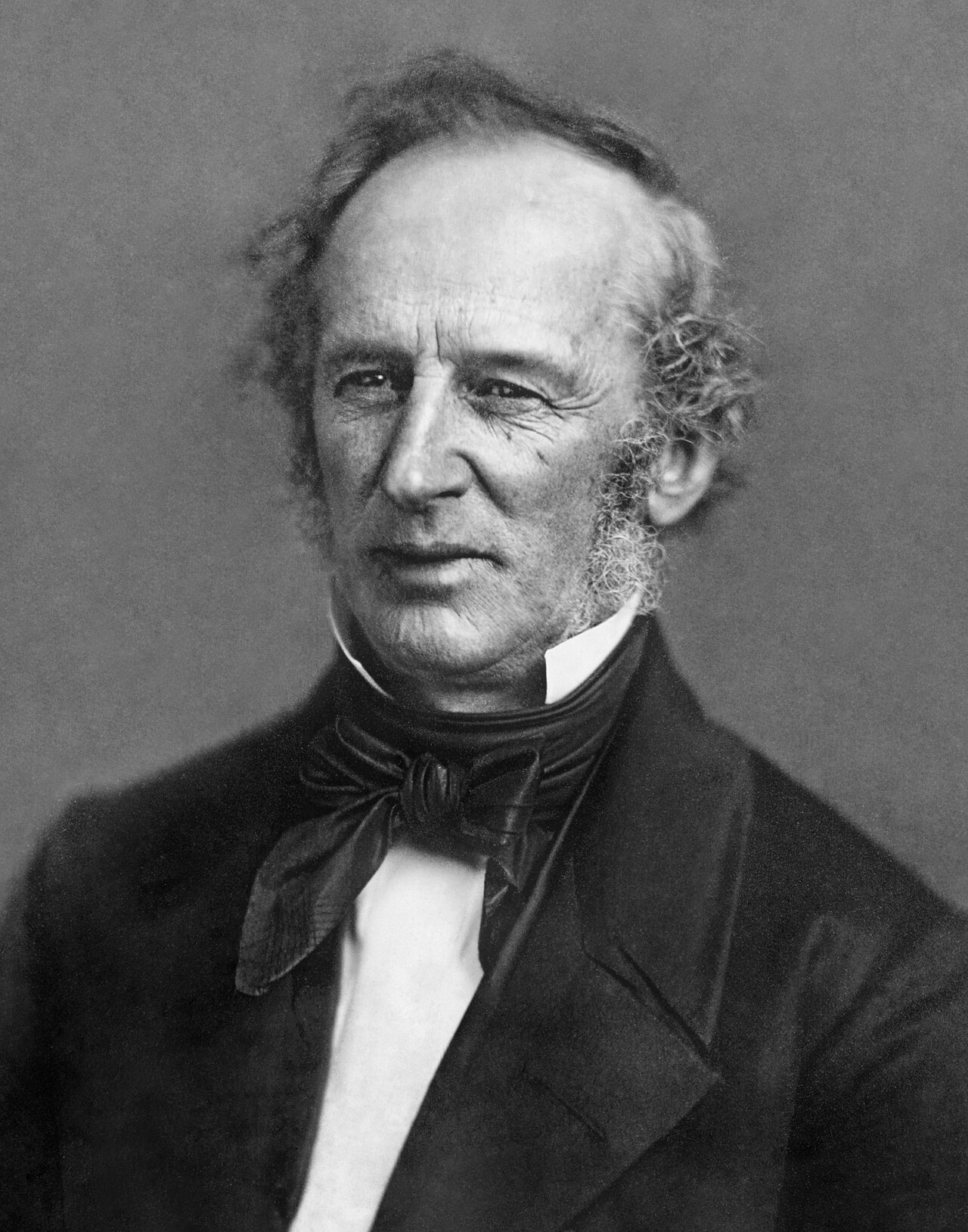
Vanderbilt sold movement: a cheaper or more dependable passage could win a route, and control of a route could make rivals bargain. His career asks readers to hold the useful network and the power used to assemble it in the same view.
1794–1820s
Crossings close to home
Vanderbilt grew up on Staten Island amid the work of boats and coastal trade. He began carrying passengers and freight between the island and Manhattan, learning how the price of a crossing, the reliability of a boat and the timing of a connection could change demand. He later worked with steamboat operator Thomas Gibbons.
Gibbons v. Ogden in 1824 ended New York’s steamboat monopoly in interstate traffic. Vanderbilt did not win the case alone; Gibbons was the litigant and the Supreme Court made the ruling. The original opinion shows how a change in law opened room for an ambitious operator to compete on the water.
On the Hudson and routes to New England, Vanderbilt expanded by adjusting departure times and fares against rival boats, while watching operating costs closely. Historian T. J. Stiles traces how a technical grasp of vessels and passenger flows gave those price cuts force. Competition could benefit passengers immediately; forcing a rival off a route could leave Vanderbilt with much greater bargaining power.
His reputation for ruthless dealing grew from that mix. He managed vessels, schedules and capital rather than designing a new steam engine. Crews, shipbuilders, pilots and managers turned his commercial choices into the actual service.
California traffic offered Vanderbilt a business problem: how to connect Atlantic and Pacific steamers without sailing around South America. In 1849 his syndicate secured a Nicaraguan concession for a canal and, meanwhile, exclusive passenger transit. The operating route put shallow-draft boats on the San Juan River, steamers across Lake Nicaragua, carriages on a short road to the Pacific, and ocean vessels at either end. Its advantage depended on the whole chain meeting on time, not simply on a cheap fare.
The concession also made the route a political prize. During the American filibuster William Walker’s armed rule in Nicaragua, which restored slavery, former associates Charles Morgan and Cornelius Garrison obtained the transit rights and vessels. Vanderbilt aided Costa Rica’s campaign against Walker and sent an agent whose party seized the river steamers, cutting a supply line; Central Americans fought the war and bore its losses. When that conflict ended, Vanderbilt did not rebuild a lasting service. As historian Brian Loveman records, he took payments from Panama competitors to keep the Nicaragua route closed in 1857–58—a stark reminder that owning an alternative could be more profitable than carrying passengers on it.
In the Civil War he donated a steamship to the Union. The Navy’s USS Vanderbilt record traces how a commercial vessel and crew became wartime infrastructure, another use of the fleet his route businesses had assembled.
Vanderbilt turned from sea crossings to the broken rail connections around New York. He gained the Harlem and Hudson River lines, then control of the New York Central in 1867; the Hudson and Central were formally consolidated in 1869. The Central already ran from Albany to Buffalo. Control of the Lake Shore & Michigan Southern extended his reach along Lake Erie to Chicago during the following decade. The Central–Hudson and Lake Shore remained legally separate in his lifetime, but shared management could sell a through New York–Chicago journey and coordinate trains across their boundaries.
Terminals, timetables, rolling stock and onward connections now mattered as much as individual track. The period New York Central map makes the corridor and its junctions visible. William H. Vanderbilt and many railway managers and workers operated it; Cornelius made the ownership and competitive choices. Stiles finds that in these later years Vanderbilt also negotiated with neighbouring lines, rather than buying every connection. Coordinated service reduced transfers for passengers and freight, while control of the connected route strengthened his hand in those negotiations.
The New York rail network needed a city terminal as well as distant lines. Vanderbilt’s companies opened Grand Central Depot in 1871, making a common Manhattan arrival point for their trains. It was an operating decision and a visible claim to permanence; the later Grand Central Terminal belongs to another generation.
Vanderbilt also made a major gift to found Vanderbilt University in Nashville. It was consequential, though his wealth was not organised around a broad giving programme. When he died in 1877, his fortune rested heavily on the rail system. The map and the Nicaragua study show two versions of his method: assemble a passage from separately controlled pieces, then defend the commercial power that the connection creates.