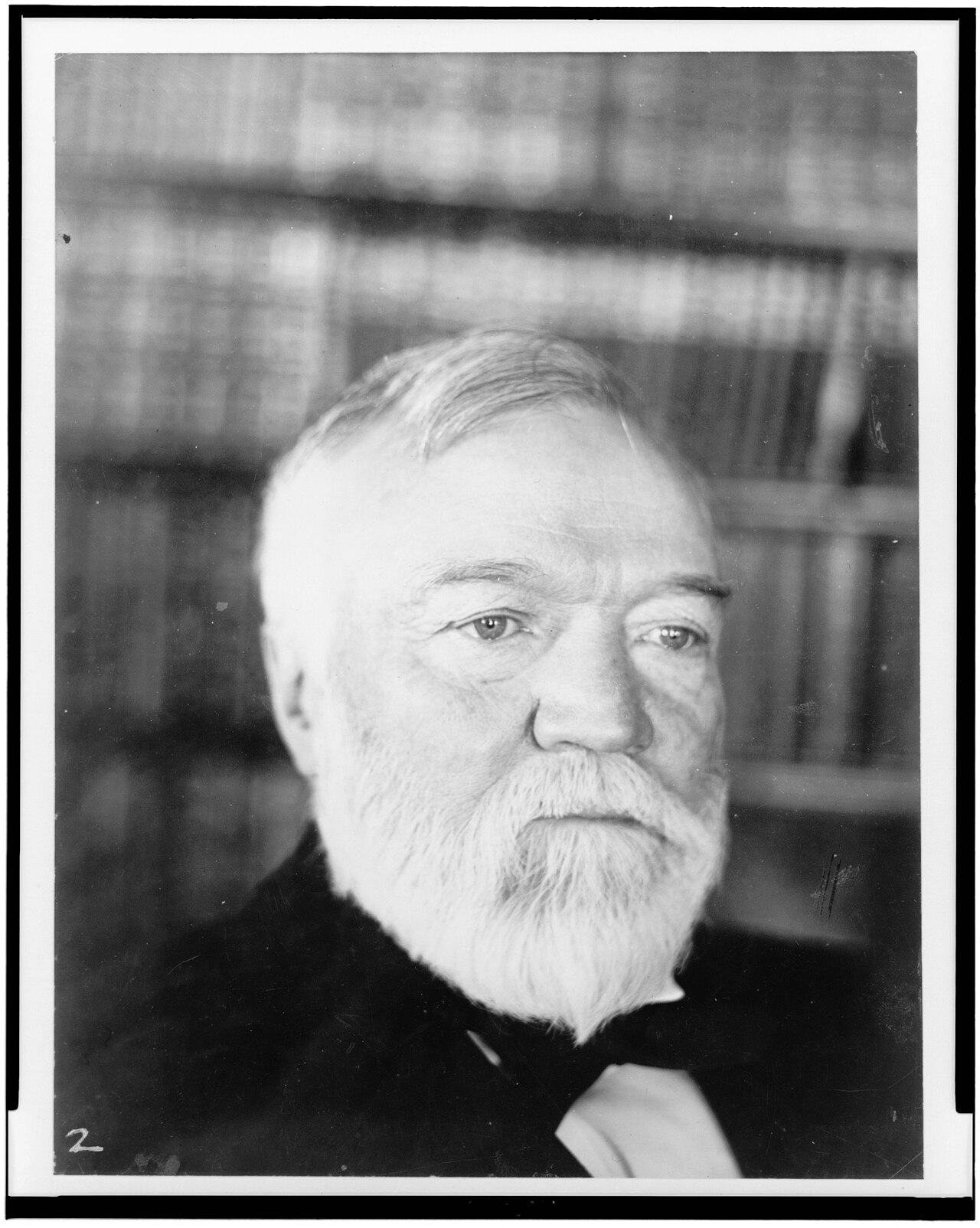
Carnegie’s life moves from a borrowed book to an immense steel fortune and back to public libraries. The passage is neither a simple ascent nor a gift story: the Homestead workers’ fight shows what his business method meant on the factory floor.
1835–1860s
From Dunfermline to the railroad
Carnegie’s family left Scotland for Pennsylvania after handloom weaving could no longer support them. As a young worker he moved from a cotton mill into telegraph work and the Pennsylvania Railroad. Thomas A. Scott became a mentor; the railroad taught Carnegie about scheduling, capital and the advantage of owning a useful connection.
A local patron’s small lending library had shown him what free books could offer an ambitious child. Carnegie later made that memory central to his giving. It is a real thread through the life, though it does not by itself explain how his fortune was made.
Carnegie invested in steel as new processes cut production costs and demand for rails and structures rose. He and managers such as Henry Clay Frick sought control of coke, ore, transportation and mills, so one bottleneck would not set the price for everything downstream. The enterprise rested on engineers and thousands of workers as much as on the owner’s strategic eye.
He wrote publicly about wealth and work while the company grew. In The Gospel of Wealth, published in 1889, he argued that the rich should administer surplus wealth for public benefit during their lifetimes. That prescription was also a claim that owners, rather than workers or voters, should decide the terms of distribution.
At the Homestead steelworks, Frick locked out workers as the company sought to break their union. Armed Pinkerton guards and workers fought; people on both sides died before state militia enabled the plant to reopen with nonunion labour. Carnegie was abroad, but surviving telegrams show his support for Frick’s course.
The correspondence belongs beside his published defence of dignity and opportunity. The contradiction is not a footnote to philanthropy. It reveals how his low-cost steel system relied on control of labour, and how distance from a manager did not remove an owner’s responsibility.
Carnegie sold his steel interests to J. P. Morgan in 1901 and turned more fully to giving. His libraries were a distinctive method: he supplied building funds, while towns undertook to provide sites and continuing support. The condition aimed to make the library a lasting public institution rather than a temporary monument.
The library map shows how widely that model spread. It also invites local inquiry: a building grant could expand access, but communities still had to fund staff, books and equitable service. Carnegie’s wealth set the opportunity; public decisions kept the doors open.
Carnegie created institutions for education, science and peace before his death in 1919. Their reach outlasted his direct control. His essay remains an unusually clear statement of a wealthy person’s theory of obligation; it is worth reading critically rather than only quoting its most generous sentence.
A good route is to read The Gospel of Wealth, then the Homestead correspondence, then visit the history of a nearby Carnegie library. Each changes the scale of the question, from a claim about society to the decisions of a company and a town.