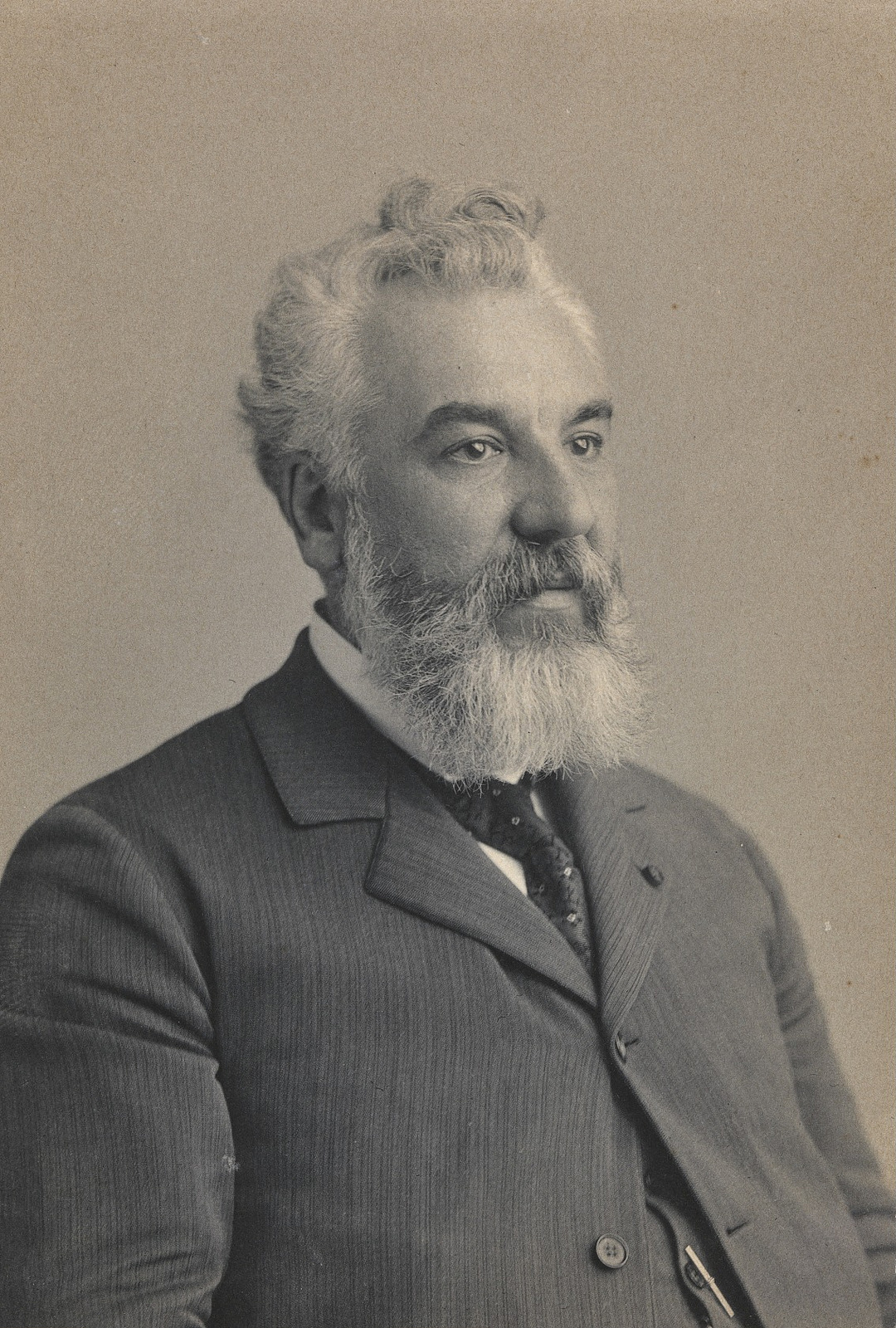
Bell first tried to send several telegraph messages along one wire. Following the vibration of sound instead led him and Thomas Watson toward a speaking wire. His later laboratories took that curiosity into recording, light and flight, while the schools where he began remained a consequential part of his life.
1847–1875
A life organised around speech
Bell grew up in Edinburgh in a family that studied how speech is made. His father Alexander Melville Bell devised Visible Speech, a notation for positions of the vocal organs; his mother Eliza was hard of hearing. After two brothers died of tuberculosis, the family moved to Canada in 1870. Bell soon taught deaf pupils and teachers in Boston, adapting his father’s method into paid lessons.
The 1875 School of Vocal Physiology brochure makes that work tangible: Bell advertised instruction in articulation and Visible Speech before a telephone company existed. His teaching gave him unusual attention to the human voice, but it also fixed his preference for spoken language as the aim of deaf education. The later cost of that preference was borne by students whose sign language was denied.
Bell first sought to send several telegraph messages over one wire using different tones. Gardiner Greene Hubbard and Thomas Sanders backed the work; the young electrician Thomas Watson built and adjusted apparatus with him. Their trials showed that a continuously varying electrical current, rather than a train of simple on-off pulses, could follow a sound wave. A diaphragm and electromagnet could turn vibration into current and back into audible motion.
Bell’s patent was filed on 14 February 1876 and granted on 7 March. Elisha Gray filed a related caveat on the same day, and other experimenters had explored electrical speech. Priority was contested in court; the legal victory does not erase parallel invention or Watson’s hands-on contribution. In the notebook entry for 10 March, Bell recorded calling to Watson; Watson then came and reported that he had understood the sentence. Read the notebook with the patent: one records an experiment, the other stakes a claim.
Bell’s demonstrations at the Philadelphia Centennial Exhibition and public lectures helped people grasp why a speaking wire mattered. But a saleable telephone needed instruments, lines, exchanges, operators and a company able to defend patents. Bell, Hubbard, Sanders and Watson formed the Bell Telephone Company in 1877. Hubbard’s organising and capital were as consequential to its expansion as Bell’s ability to demonstrate the device.
Bell married Mabel Hubbard in 1877. Mabel had become deaf after childhood illness; their correspondence is part of the family archive, not proof that she shared his educational position. Patent litigation with Western Union and Gray followed, and a settlement came in 1879. Bell’s name came to stand for a communications network built and operated by thousands of other people.
With Charles Sumner Tainter, Bell made the photophone: speech vibrated a reflecting surface, modulating a beam of light; a light-sensitive receiver varied an electrical signal that could reproduce sound. Their 1880 drawing and sealed Smithsonian records show collaboration and experimental caution. The demonstration worked over a limited distance, although ordinary telephone wires were far more practical then.
Bell used his Volta Prize funds to establish a Washington laboratory. There he, Tainter and his cousin Chichester Bell worked on wax-cylinder recording, improving on Edison’s tinfoil phonograph. The enterprise choice was to keep a funded workshop of specialists alive beyond the original telephone patent. These were different inventions and shared accomplishments, not one unbroken solo triumph.
Bell continued campaigning for oral instruction of deaf children. In his 1883 address, printed in 1884 as Memoir upon the formation of a deaf variety of the human race, he treated deaf people’s marriages and language communities as a hereditary danger. Other researchers challenged his evidence: only a small share of deaf parents have deaf children. His argument helped a eugenic way of thinking about Deaf lives gain authority.
Gallaudet’s Deaf-history exhibition explains the human consequence: Bell could use sign with adults, yet urged schools to teach children without it. When oralism took authority, many deaf students lost access to sign language and to Deaf teachers and peers. His care for individual pupils and his public influence cannot be assessed honestly without the community’s account of what those policies displaced.
At Beinn Bhreagh in Nova Scotia, Mabel Hubbard Bell inspired, founded and financed the Aerial Experiment Association. Bell chaired it with Glenn Curtiss, Frederick “Casey” Baldwin, Thomas Selfridge and J. A. D. McCurdy. Their shared trials produced several aircraft; the Silver Dart flew at Baddeck in 1909. Mabel’s 1907 notes and the association’s records make her material role visible instead of treating her as a spouse in the background.
After the association ended, Bell and Baldwin continued work on hydrofoils; their HD-4 reached a speed record in 1919. The 1909 close-out letter itemises the association’s members and Mabel’s repayment share, an unusually clear record of money and credit. Bell died in 1922. The arc from a speech school to a funded aviation group shows his habit of assembling experiments and collaborators, alongside the authority he used less well in deaf education.